

Chromebook assembly begins in Pakistan with export plans, Apple store coming next month — minister

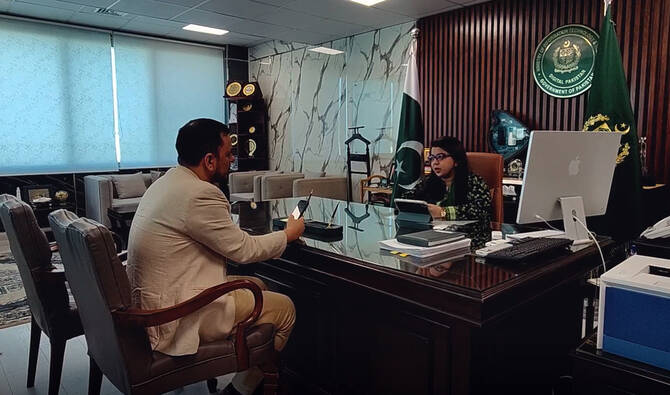
Pakistan’s IT Minister Shaza Fatima Khawaja (right) speaks during an interview with Arab News in Islamabad, on November 6, 2025. (AN Photo)
Short Url
Updated 07 November 2025
Follow

Chromebook assembly begins in Pakistan with export plans, Apple store coming next month — minister

  • Pakistan launched first Chromebook assembly line this week, hoping to produce 500,000 devices till next year
  • IT minister says Apple to launch its first official store in Pakistan next month in partnership with Air Link

ISLAMABAD: Information Technology Minister Shaza Fatima Khawaja said this week that the country’s new Chromebook assembly facility has already created 600 jobs in Pakistan, disclosing that US multinational Apple will open its first store in Pakistan next month. 

Pakistan launched its first Google Chromebook assembly line on Nov. 4, located at the National Radio & Tele­com­munications Corpora­tion’s (NRTC) facility in the northwestern city of Haripur. The facility was launched as a result of a public-private partnership involving the Pakistani government, Google and Tech Valley, along with the NRTC and Allied Corporation.

Pakistan has said it hopes to scale production to half a million Chromebooks by 2026, adding that Google’s presence in the country will enable technology transfer and result in more jobs for people. 

In an exclusive interview to Arab News on Thursday, Khawaja said Islamabad aimed to export “Made-in-Pakistan” Chromebooks to the region from its manufacturing facility in Haripur.

“Technology transfer has already created 600 jobs in that single assembly line,” the minister said. “I think that’s one of the biggest news for Pakistan this year, that Google has announced their physical presence in the country.”

Khawaja guaranteed users will be able to rely on the quality of the Chromebooks produced in Pakistan, both in terms of the product and the after-sales services.

She noted that increasing high-tech manufacturing in Pakistan will usher in more expertise.

“Google coming into the country poses a lot of confidence in our economy and its overall stability and growth,” the minister noted. “They’ve opened a Chromebook assembly line and are signing a long-term MoU with us for youth training programs.”

The IT minister said the Chromebooks will be affordable devices that will help students in their academic activities. She said the move to begin its production in Pakistan was aimed at enhancing digital inclusion, particularly in schools across the country.

“When we distributed laptops in previous government programs, we saw that it was not just about a device--it was life-changing for students, their families and even their communities,” she said. 

APPLE TO ENTER PAKISTAN NEXT MONTH

Khawaja said US-based multinational Apple will also enter Pakistan’s market for the first time next month. 

“As far as Apple is concerned, they’re coming in with a partner,” she said. 

Khawaja said Air Link, one of Pakistan’s largest manufacturers, distributors and retailers of smartphones, smart TVs, and smart wearables, will help launch an Apple Store in Pakistan in December via a partnership. 

“That’s what is happening right now and next month, inshallah, we will be opening the first Apple Store, official Apple Store in Pakistan,” the minister said.


Pakistan improves water management but remains highly vulnerable to floods, shortages — report

Updated 9 sec ago
Follow

Pakistan improves water management but remains highly vulnerable to floods, shortages — report

  • Asian Water Development Outlook says national water security score up 6.4 points since 2013 but service delivery still weak
  • ADB-linked report warns that groundwater dependence, urban demand and ecosystem decline remain critical risks

ISLAMABAD: Pakistan has strengthened its water governance and planning capacity over the past decade but continues to face serious risk from climate shocks, declining freshwater availability and weak service provision, according to the Asian Water Development Outlook 2025.

The regional water security assessment linked to the Asian Development Bank evaluates countries across Asia on water supply, governance, climate resilience, urban systems and environmental health. 

The study found that Pakistan has made policy progress since 2013, yet implementation remains inconsistent and the country is still exposed to extreme weather events, rapid population growth and stressed aquifers. The assessment warns that improvement has not kept pace with risk.

“Pakistan’s national water security score improved moderately from 2013 to 2025 by 6.4 points. At the same time, water governance performance, measured through SDG 6.5.1, rose from 50 percent in 2017 to 63 percent in 2023,” the report said. 

Despite these gains, rural supply and service reliability remain uneven. 

“Pakistan’s rural household water security remains under pressure due to ineffective service models, limited surveillance, and persistent contamination,” while economic performance is hampered by “falling per capita water availability, insufficient storage, and heavy reliance on poorly monitored groundwater resources for industrial activity,” according to the report.

Pakistan’s cities remain under pressure, with infrastructure struggling to match population growth and demand: 

“Urban water security has shown only modest gains, with rising demand, untreated wastewater and urban flooding straining infrastructure and service delivery.”

Environmental conditions have also deteriorated, driven by unchecked industrial discharge and limited regulatory enforcement. 

“Environmental water security has declined slightly, as rapid population growth, industrial activity, and untreated wastewater continue to degrade aquatic ecosystems,” the report added. 

Pakistan remains highly exposed to disasters including major floods, droughts and glacial lake outburst floods (GLOFs). The report cites the 2022 monsoon crisis, noting that it “affected over 24 million people.” 

While early-warning systems are improving, infrastructure investment and coordinated management remain inadequate.

The document concludes that Pakistan must convert policy gains into ground-level delivery by expanding financing, strengthening provincial coordination and scaling ecosystem protection to stabilize long-term water security.