- The party says it supports only one clause so far that relates to the structure of armed forces leadership
- PPP Chairman Bilawal Bhutto-Zardari says they won’t compromise on provincial share in federal resources
KARACHI: The Pakistan People’s Party (PPP), a key coalition partner in Prime Minister Shahbaz Sharif’s government, on Thursday rejected key parts of the government’s proposed 27th constitutional amendment, including changes to the National Finance Commission (NFC) and devolution of powers, saying it would only support the clause relating to the armed forces.
According to political leaders privy to the issue, the amendment proposes creating a new constitutional court, restoring executive magistrates, revising the distribution of federal revenue among provinces and making changes to how senior judges and military leadership appointments are structured within the constitution.
The government has sped up consultations with parties in the governing alliance, including the PPP, the Muttahida Qaumi Movement (MQM) and the Pakistan Muslim League-Quaid (PML-Q), in a bid to secure the two-thirds parliamentary majority required for constitutional changes.
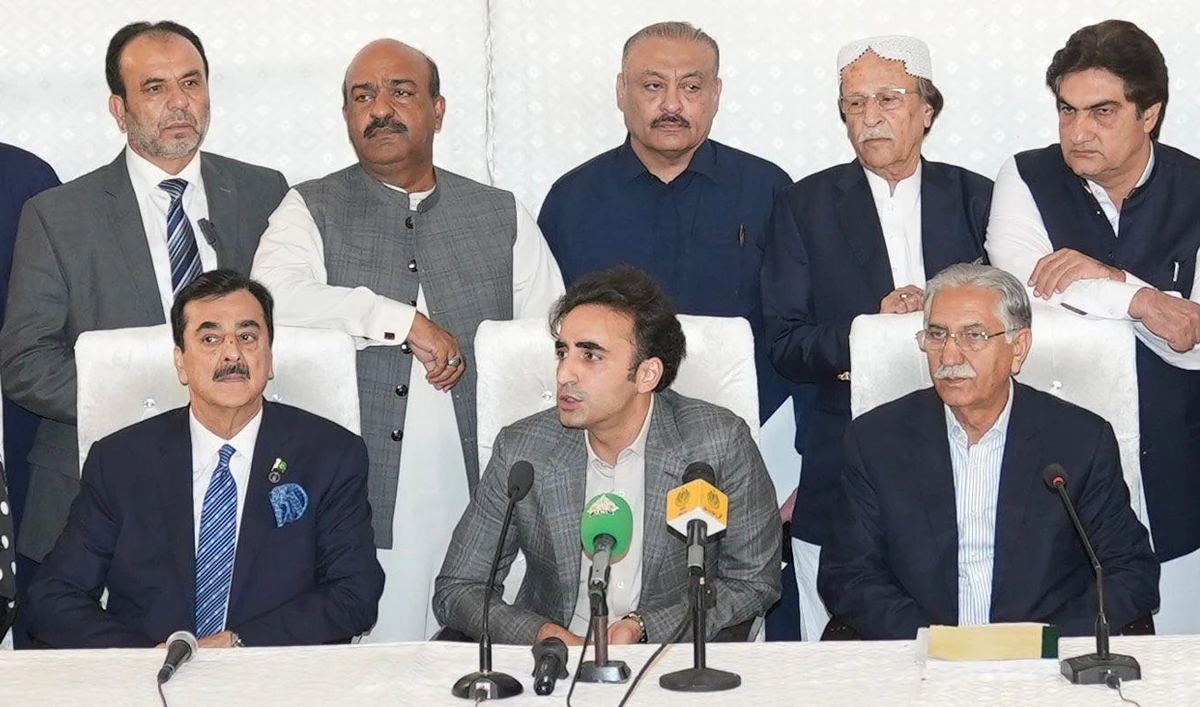
Speaking at a news conference after a meeting of the PPP’s central executive committee (CEC), party chairman Bilawal Bhutto-Zardari said the committee had turned down any proposal that altered provincial share in federal resources or reversed devolution of powers achieved through the landmark 18th amendment.
“As far as the constitutional protection is concerned in the province’s share in constitution, that proposal is rejected by the Pakistan People’s Party,” he told reporters in Karachi after the CEC meeting that lasted for around five hours and will resume today to deliberate upon some more clauses. “In any case, we are not ready to support this proposal.”
He said the CEC had rejected proposals regarding “the reversal of devolution” of powers and called for equal representation of all provinces in the proposed constitutional court.
“We are not ready to compromise on equal representation of all four provinces,” he said.
Bhutto-Zardari shared the committee had so far approved only one amendment, a revision to Article 243, concerning the structure of the armed forces’ command.
“In Article 243, the government has thought of bringing about changes, that the position of the Joint Chiefs of Staff has to be given a new title. Then they have to give a new position of the National Strategic Command,” he said, adding one change was regarding the position of field marshal.
“The only constitutional amendment we have agreed to support is this one.”
Deliberations on other proposed amendments, including the creation of a constitutional court, would continue when the CEC reconvenes after Friday prayers, according to the PPP chairman.
The government’s proposed 27th amendment reportedly seeks to overhaul several constitutional provisions, including judicial structure, the election commission’s appointment mechanism, and revenue distribution between the federation and provinces.
The most contentious elements involve potential revisions to the NFC award, which determines how federal tax revenue is shared among provinces. The PPP, which spearheaded the 18th amendment in 2010 to expand provincial autonomy, has consistently opposed any measures that would dilute financial or administrative powers of the federating units.
Bhutto-Zardari told reporters in Karachi said his party refrained from commenting publicly on the proposals until the country’s leadership formally discussed them, but the CEC’s stance was now clear on all major points.
“The rest of the points have either been completely rejected or our discussion on them will continue tomorrow [Friday],” he said.
Constitutional amendments in Pakistan have frequently redefined the balance of power between the federation, judiciary, and provinces. The 18th amendment, enacted during the first presidency of Asif Ali Zardari, remains one of the country’s most significant political reforms, transferring control of education, health and other key subjects to provinces.
Bhutto-Zardari reiterated that his party would “resist any attempt” to roll back that devolution.
“The conversations are still ongoing,” he said. “God willing, we will continue our CEC [meeting on Friday].”
While the government’s discussions with coalition partners continue, the Pakistan Tehreek-e-Insaf (PTI), the main opposition party led by former prime minister Imran Khan, has vowed to oppose the 27th amendment and demanded full disclosure of the draft before it reaches parliament.
Speaking to a private news channel, Geo News, Information Minister Attaullah Tarar said the amendments would be tabled before the federal cabinet after the PPP CEC makes any decision on it.
In Pakistan, constitutional amendments have historically been used to reshape the balance of power between the legislature, judiciary and provinces. The proposed 27th amendment follows the 26th amendment passed in October 2024, which gave parliament a role in appointing the chief justice and created a new panel of senior judges to hear constitutional cases, measures critics said weakened judicial independence.
Pakistan’s constitution, adopted in 1973, has been amended more than two dozen times, often reflecting shifts in authority among civilian governments and the military. Provisions governing the NFC award are among the most politically sensitive because they underpin the country’s federal structure and provincial autonomy.