

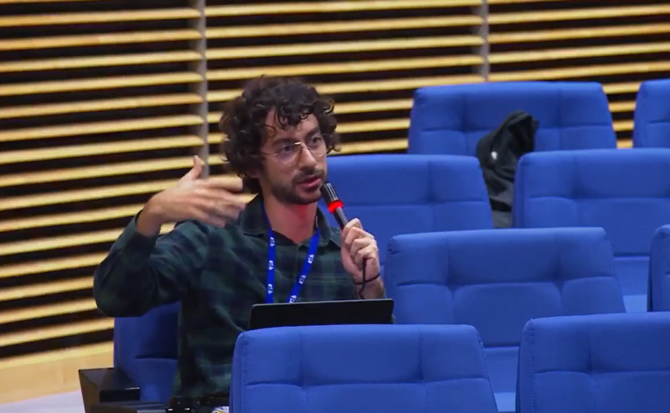

LONDON: Journalists at Italy’s news agency Nova have condemned death threats they received days after one of their colleagues was dismissed following a question about whether Israel should pay for Gaza’s reconstruction.
Gabriele Nunziati, a Brussels-based correspondent covering the EU for Rome’s Nova, was let go late last month after he questioned European Commission chief spokesperson Paula Pinho about Israel’s responsibility for rebuilding Gaza.
The story, first reported by Italian news website Fanpage on Tuesday, quickly spread through national and international media, prompting accusations that the agency was suppressing freedom of speech.
In a statement to Arab News on Thursday, Nunziati’s former colleagues revealed they had been the target of intimidation and death threats since the incident became public.
“We journalists of Agenzia Nova are saddened by the situation of our colleague Gabriele Nunziati. However, we want to express our views. To defend ourselves from the gratuitous and unfounded attacks in recent days, from threats, insults. We do not accept them,” said the journalists in a letter.
They emphasized that no staff member “has ever received political pressure (..or) felt censored.
“We have always been free to ask the questions we deem appropriate, as a tool to understand and help understand current developments and the complexities of the national and international scenario.”
Piena solidarietà al giornalista Gabriele Nunziati, corrispondente a Bruxelles per @agenzia_nova, licenziato dopo aver posto una domanda durante una conferenza stampa della Commissione Europea:
“Se la Russia dovrà pagare per l’Ucraina, perché non dovrebbe farlo anche Israele per… pic.twitter.com/6wVGQLncqe— Ilaria Salis (@SalisIlaria) November 5, 2025
The journalists acknowledged that “many inaccuracies” have surrounded Nunziati’s case, but insisted that “only the facts have the right to emerge in the report of a news agency.”
On Oct. 13, Nunziati asked Pinho at a press briefing whether Israel should be held responsible for reconstruction costs in Gaza — a territory more than 70 percent destroyed — drawing on the EU’s repeated stance that Russia should pay for rebuilding Ukraine.
“You’ve been repeating several times that Russia should pay for the reconstruction of Ukraine,” Nunziati, who was a contractor with Nova, said at the daily press conference. “Do you believe that Israel should pay for the reconstruction of Gaza since they have destroyed almost all its civilian infrastructure?”
Pinho described it as “an interesting question,” but declined to comment further.
The clip of the exchange went viral — an uncommon occurrence for European Commission press conferences — bringing Nunziati considerable attention.
In an interview, Nunziati said that he received two “tense” calls from Nova superiors within the two weeks following his question, but the agency did not clarify the reason for ending his contract.
Nova later confirmed it had ended its relationship with Nunziati because his question was “technically incorrect” — explaining that Russia had unprovokedly invaded a sovereign country, whereas Israel was responding to an attack.
The agency said that it explained this distinction to Nunziati “several times,” but he “did not understand the fundamental legal differences” and insisted on framing his question as accurate — actions that they said revealed a “lack of understanding of international law.”
The video of the exchange was subsequently amplified by Russian nationalist and anti-European Islamist channels, which Nova said had caused embarrassment for the agency.
Nunziati stood by his question, arguing on Instagram that it was fact-based.
“My question can only be considered biased if one needs to deny reality. It is a fact that Israel has almost completely razed Gaza to the ground … It is a fact that the International Criminal Court has issued an arrest warrant for war crimes and crimes against humanity against Benjamin Netanyahu and some of his ministers … It would be biased to deny them.”
Anna Laura Orrico, a member of the Italian Parliament representing the Five Star Movement, condemned Nunziati’s dismissal as “simply shameful for a media outlet,” should the reports prove true.
The National Federation of the Italian Press, alongside the International and European Federations of Journalists, also condemned the firing and criticized Nova for censorship.
The National Council of the Order of Journalists expressed shock and called for Nunziati’s immediate reinstatement, emphasizing that the role of journalists is “to ask questions that may be uncomfortable or unwelcome.”
Nunziati’s dismissal comes amid concerns over eroding press freedom in Italy since Oct. 7, 2023. Italy dropped three places to 49th in this year’s press freedom index by Reporters Without Borders, amid scandals including surveillance of journalists reporting on far-right extremism.
An investigation by The Guardian revealed that director of Fanpage, Francesco Cancellato, was spied on using spyware supplied by Israel to government agencies after exposing fascist and antisemitic behavior within Italy’s far-right youth wing.
Italy’s current government, led by Giorgia Meloni, denies any involvement in the case.


