

KSrelief steps in to help Afghanistan earthquake survivors

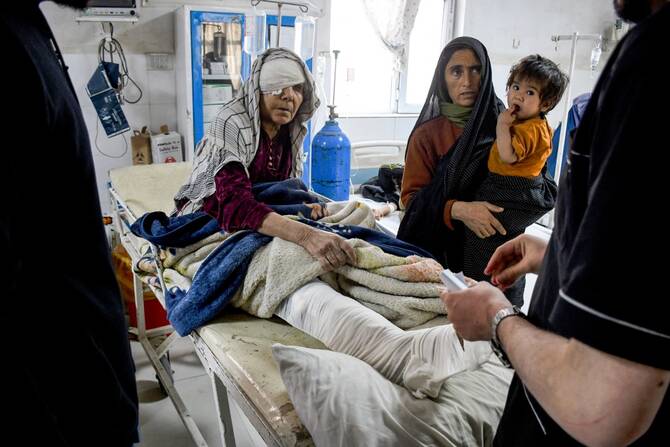
An injured Afghan woman receives treatment at a hospital in the aftermath of an earthquake, that struck overnight in Mazar-i-Sharif on Nov. 3, 2025. (AFP/File)
Short Url
Updated 06 November 2025
Follow

KSrelief steps in to help Afghanistan earthquake survivors

  • At least 27 people were killed and 1,000 injured when the quake hit north Afghanistan
  • Tremors also damaged the iconic 15th-century Blue Mosque in Mazar-i-Sharif

KABUL: King Salman Humanitarian Aid and Relief Center is providing essential aid and supplies to residents of northern Afghanistan after a powerful earthquake struck the area earlier this week.

At least 27 people were killed and nearly 1,000 more injured when the 6.3 magnitude quake struck the northern provinces of Samangan, Sar-e-Pul and Balkh on Monday, according to the Ministry of Public Health.

Dozens of homes were destroyed and civilian infrastructure was severely affected, especially in rural areas where emergency support was limited. Tremors also damaged one of the country’s most iconic mosques, the 15th-century Blue Mosque in Mazar-i-Sharif.

As aid agencies and UN teams have called for urgent international assistance, warning that many survivors are without shelter and medical support, KSrelief has delivered hundreds of tents, blankets and over 140 tonnes of food supplies.

“This time, the earthquake affected many families in Balkh, Samangan and Sar-e-Pul provinces and we are receiving this round of support from Saudi Arabia. Our thanks and gratitude to the people and the government of Saudi Arabia and special thanks to the KSrelief,” Shahabuddin Delawar, general director of the Afghan Red Crescent Society, said upon receiving the aid from Saudi Ambassador Faisal bin Talaq Al-Baqmi in Kabul.

“This is not the first time Saudi Arabia has helped Afghanistan. Our cooperation has a long history. Saudi Arabia has always extended a helping hand to Afghanistan. Recently, during the Kunar earthquake response, we received very generous support from Saudi Arabia, providing vital relief for thousands of Afghan families.”

The quake in northern Afghanistan comes just three months after a powerful earthquake hit the densely populated rural areas of Kunar and Nangarhar provinces in the country’s east in early September. More than 2,200 people were killed and many more injured as entire villages were wiped out.

Response to the September earthquake has already strained Afghan emergency and medical services, which are now struggling to cope with the aftermath of the new disaster.

Abdul Fatah Jawad, director of Ehsas Welfare and Social Services Organization, which is helping with relief efforts, said the situation was “heartbreaking,” especially in Samangan and Balkh, where hundreds of families had lost everything.

“People are deeply traumatized, especially women and children. Most families have been sleeping out in the open for days, in the cold, with barely any shelter. The nights are freezing, and many children are already falling ill,” Jawad told Arab News.

“The scale of the devastation is overwhelming, and the needs are far greater than the help that has reached so far. I urgently call on the people, the government, and international organizations to step forward and help. Every bit of support can save lives right now.” 


Ukrainian women embrace combat roles as technology reshapes the battlefield

Updated 5 sec ago
Follow

Ukrainian women embrace combat roles as technology reshapes the battlefield

KHARKIV: When Russia’s full-scale invasion began nearly four years ago, a 26-year-old soldier known as Monka didn’t see a combat role she could do. But that changed as technology reshaped the battlefield and opened new paths.
Last year, she joined the military as a pilot of short-range, first-person view, or FPV, drones after giving up a job managing a restaurant abroad and returning home to Ukraine to serve.
Her shift is part of a larger trend of more women joining Ukraine’s military in combat roles, a change made possible by the technological transformation of modern warfare, military officials say.
“The fact that technology lets us deliver ammunition without carrying it in our hands or running it to the front line — that’s incredible,” said Monka, who serves in the Unmanned Systems Battalion of the Third Army Corps. She and other women followed Ukraine’s military protocol by identifying themselves using only their call signs.
More than 70,000 women served in Ukraine’s military in 2025, a 20 percent increase compared to 2022, including over 5,500 deployed directly on the front line, according to Ukraine’s Defense Ministry.
Some units have tailored recruitment efforts toward women, expanding rosters in a sign that Ukraine is looking to strengthen and expand its army even as peace negotiations weigh a possible cap on the future size of the military.
Leaders in the capital Kyiv, as well as many soldiers like Monka, see the army as one of the few security guarantees that Ukraine has against Russia.
“We need everyone — engineers, pilots, IT specialists, programmers, we simply need brains. It’s not about men or women. We need people who are ready to work hard,” she said.
More women seek combat jobs as technology changes
A drone pilot is one of the Ukrainian military’s most popular combat professions chosen by women, military officials said.
When Imla from the Kraken 1654 unit left her career as a professional hockey player to join the military, the 27-year-old initially planned to become a combat paramedic.
She spent her first six months as a platoon medic, but the job required learning to fly drones. She started with small ones before moving to larger models carrying bombs and eventually switching to full-time drone work.
Imla clearly remembers her first drone flight, a reconnaissance mission. When they handed her the controller, she was so nervous her hands wouldn’t stop shaking.
“To be honest, I even wanted to cry in some moments,” she recalled. “But then, over time, you build up experience on the job and start feeling confident.”
The Khartiia Corps has taken more women into its ranks, reporting a 20 percent increase since 2024. About six months ago, the brigade launched a recruitment campaign aimed at women for combat and technological roles in cooperation with the Dignitas Foundation, a charity organization supporting Ukraine by funding technological innovation and civic development projects.
“In recent months, dozens of women have joined us in combat roles and are working successfully,” said Volodymyr Dehtyarov, the Khartiia Corps public affairs officer. “The more technology we have, like drones, the more historically male professions open up.”
Khartiia has started training officers and future commanders on how to work with mixed units including people of different ages, genders and backgrounds, which Dehtyarov said helps commanders become more effective leaders.
Women still face obstacles
The Ukrainian army remains conservative at its core and some units don’t make it easy for women.
A 25-year-old soldier with the call sign Yaha joined the military in 2023 and initially did paperwork as an army clerk. Three months later, she began asking to attend drone courses. Commanders at the time did not respond with enthusiasm and instead suggested she replace the cook.
“It was unpleasant for me, because I didn’t expect such uncomfortable conditions, such strict limitations,” Yaha said.
In the kitchen, she spent her free time studying drone manuals, practicing on a simulator and training in computer clubs with a controller she bought herself.
“I liked that you could strike the enemy remotely,” she said. “So I thought this was our future.”
Eventually, she became a bomber-drone pilot in the 9th Brigade.
“War is not cool or glamorous. It’s pain, suffering and loss. You just do it because you want to change the situation,” she said. “But you’re not invincible. You’re just a person like everyone else.”
Chibi, a 20-year-old FPV technician from the Khartiia Brigade, prepares drones for the battlefield from a dark damp basement near the front line in eastern Ukraine.
She initially faced prejudice from soldiers who claimed she had inferior technical skills because she was a woman. But she also had a supportive male colleague who helped her take the first steps toward becoming an FPV technician, which she finds more interesting than being a pilot.
“There needs to be more women in the army,” Chibi said, her hair dyed pink and dark blue. “The more women there are, the better the attitude toward them will be.”
The army needs more women
Olha Meloshyna, the spokesperson for Ukraine’s Unmanned Systems Forces, says the belief that drone roles are safer is wrong, as Russians actively hunt drone operators.
Their unit is seeing more women move into technological roles, including drone operation, drone repair and electronic warfare, as drones have become one of the main tools of striking and reconnaissance on the battlefield.
According to Meloshyna, 4.2 percent of the Unmanned Systems Forces are women, a number she considers significant because women enlist voluntarily.
“We are part of the new Ukrainian army that formed during the invasion. So in terms of gender-based acceptance into the Armed Forces, we have never had any division — what matters to us is desire and motivation,” she said.
She said that they are now conducting a more media-focused recruitment campaign, inviting and planning to recruit 15,000 people to join, including women. Recruiters say that women are applying for both combat and noncombat positions.
“The Unmanned Systems Forces are a system, and it is made up of people — men and women,” Meloshyna said. “No drone is autonomous. It needs human involvement. And the more personnel we have, the more drones will fly toward Russia.”