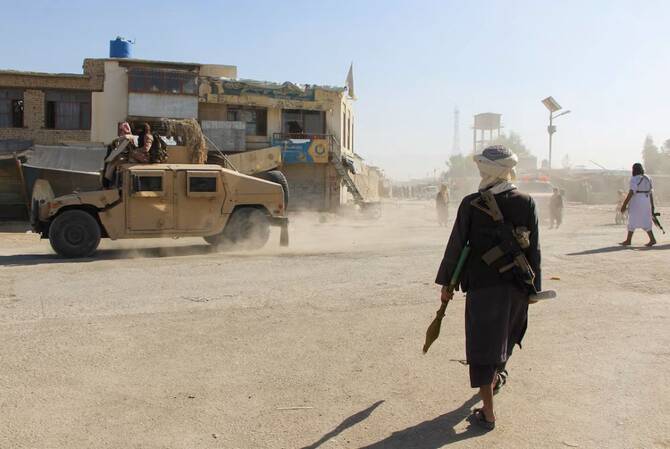

KABUL: Five people were killed and six were wounded in brief cross-border fire between Afghanistan and Pakistan on Thursday, a hospital official on the Afghan side told AFP, in an incident both countries blamed on each other.
The violence was likely to complicate ceasefire negotiations underway in Turkiye, which intended to finalize a truce aimed at ending deadly clashes between the South Asian neighbors.
Security issues are at the heart of their dispute, with Islamabad accusing Kabul of harboring militant groups, particularly the Pakistani Taliban (TTP), that launch attacks in Pakistan. The Taliban government denies these allegations.
According to the anonymous official at the Spin Boldak district hospital in Afghanistan’s southern Kandahar province, “five people died in today’s incident — four women and one man — and six were wounded.”
There was no immediate report of victims from the Pakistani side.
The two countries quickly blamed each other for initiating the fire.
“While the third round of negotiations with the Pakistani side has begun in Istanbul, unfortunately, this afternoon Pakistani forces once again opened fire on Spin Boldak,” Taliban government spokesman Zabihullah Mujahid said.
“The Islamic Emirate’s forces, out of respect for the negotiation team and to prevent civilian casualties, have so far shown no reaction,” the official added on X.
Pakistan denied the accusation and put the blame on Afghanistan.
“We strongly reject claims circulated by the Afghan side,” Pakistan’s Information Ministry said on X. “Firing was initiated from the Afghan side, to which our security forces responded immediately in a measured and responsible manner.”
Talks at an impasse
Hamdullah Fitrat, deputy spokesman for the Taliban authorities, said “we don’t know the reason” for the Pakistani fire, telling AFP that talks in Turkiye were ongoing.
“Pakistan used light and heavy weapons and targeted civilian areas,” said an Afghan military source who spoke on condition of anonymity.
Ali Mohammed Haqmal, head of Kandahar’s information department said the firing was brief. Residents told AFP it lasted 10-15 minutes.
Pakistan confirmed that calm had been restored.
“The situation was brought under control due to responsible action by Pakistani forces and the ceasefire remains intact,” the information ministry said. “Pakistan remains committed to ongoing dialogue and expects reciprocity from Afghan authorities.”
Negotiations in Istanbul reached an impasse last week when it came to finalizing ceasefire details, with each side accusing the other of not being willing to cooperate.
Both sides also warned of a resumption of hostilities in case of failure.
Host Turkiye said at the conclusion of last week’s talks that the parties had agreed to establish a monitoring and verification mechanism to maintain peace and penalize violators.
Fifty civilians were killed and 447 others wounded on the Afghan side of the border during a week of clashes in October, according to the United Nations. At least five people died in explosions in Kabul.
The Pakistani army reported 23 of its soldiers were killed and 29 others wounded, without mentioning civilian casualties.
The Taliban government wants Afghanistan’s territorial sovereignty respected.
Islamabad also accuses the Afghan government of acting with the support of India, its historical enemy, amid closer ties between these two countries.