Egypt, Japan’s Yurtec sign deal for Hurghada solar project 

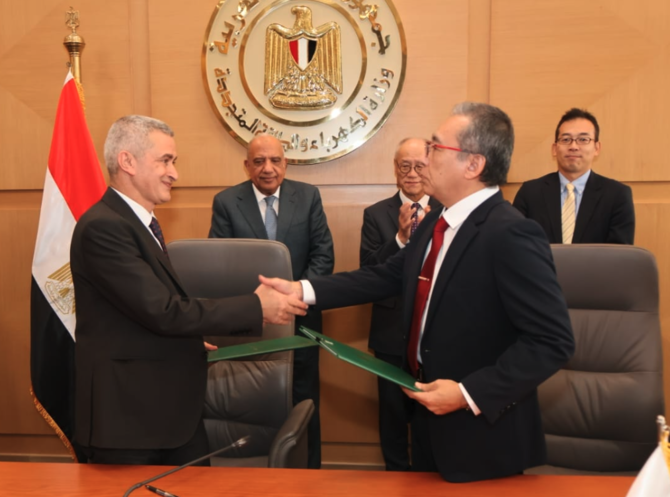
The agreement was signed by NREA Chairman Ehab Ismail and Yurtec representative Osamu Sakagami. Facebook/@EgyptianCabinet
Short Url
Updated 06 November 2025
Follow

Egypt, Japan’s Yurtec sign deal for Hurghada solar project 

RIYADH: Egypt’s New and Renewable Energy Authority signed an agreement with Japan’s Yurtec Co. and local partners to build a 20-megawatt solar plant and battery facility in Hurghada. 

The consortium, which also includes Egypt’s Solar Installer and REDCON Construction, will develop a 30-MWh battery energy storage system alongside the solar farm, the authority said in a statement.  

The project is part of cooperation with the Japan International Cooperation Agency and aligns with Egypt’s plan to raise renewable energy’s share of total power generation to over 42 percent by 2030 and 60 percent by 2040. 

It is also aligned with the North African country’s National Energy Strategy, which aims to reduce reliance on fossil fuels, protect the environment, and boost economic returns. 

Egypt’s Minister of Electricity and Renewable Energy, Mahmoud Esmat, said: “We are working with international partners to promote the use of renewable energy, reduce carbon emissions, and diversify energy sources.”  

He added: “We have an ambitious program to maximize the utilization of new and renewable energy resources… and the state has created an enabling investment environment to support the private sector and attract further investments.”  

The agreement was signed by NREA Chairman Ehab Ismail and Yurtec representative Osamu Sakagami, in the presence of Japan’s Ambassador to Egypt Fumio Iwai, JICA Egypt Chief Representative Yu Ibisawa, and other senior officials. 

The Hurghada facility is expected to generate about 48,000 MW hours of electricity annually — 36,000 MWh from the solar plant and 12,000 MWh from the storage system. It is also projected to cut carbon dioxide emissions by around 26,400 tonnes per year. 

The agreement also covers the establishment of an eco-friendly information and training center adjacent to the plant, relying mainly on renewable energy sources and designed to enhance energy efficiency. 

The statement added that the center will be equipped with modern facilities, equipment, and meeting halls to promote the use of renewable energy and serve as an international training hub for professionals from both the public and private sectors. 

Esmat also praised the partnership and cooperation with JICA, adding that collaboration with the private sector is crucial for Egypt to achieve its renewable energy goals. 

The Hurghada project underscores Cairo’s push to accelerate renewable deployment and expand international partnerships, strengthening the country’s position as a regional clean-energy hub. 


Ceer to sign deals worth $990m at PIF Private Sector Forum

Updated 5 sec ago
Follow

Ceer to sign deals worth $990m at PIF Private Sector Forum

RIYADH: Saudi Arabia’s first homegrown electric vehicle brand Ceer is expected to sign 16 agreements valued at SR3.7 billion ($990 million) at the PIF Private Sector Forum, said the company’s CEO. 

Speaking at the forum, James DeLuca said that 90 percent of these agreements are not memorandums of understanding, but are commercial contracts. 

Saudi Arabia is focused on creating a comprehensive EV ecosystem, and the government is aiming for 30 percent of vehicles in Riyadh to be electrified by 2030.

The official added that the company is expected to contribute over SR30 billion to Saudi Arabia’s gross domestic product as well as creating approximately 30,000 direct and indirect jobs by 2034. 

“The most important part is 90 percent of these agreements are not MoUs. They are in fact commercial contracts, because, we are moving from planning to execution,” said De Luca. 

He added: “Ceer will contribute over SR30 billion by 2034, SR79 billion to trade balance improvement, and we will create approximately 30,000 direct and indirect jobs fulfilling our mandate of putting local nationals to work in value-added positions.” 

Underscoring the progress of the company’s localization strategy, DeLuca said that the company is on track to reach 45 percent local content by 2034. 

“Our robust localization strategy aims to leverage local raw materials, attract advanced technology and foreign investment and localize the production of bulky and labor intensive components to reduce carbon dioxide emissions and to create jobs for Saudi nationals. With the execution of these plans, we are on track to reach 45 percent local content by 2034,” said DeLuca. 

DeLuca said that Ceer is the first automotive company which manages the entire process in car making — from designing and engineering to manufacturing, selling, and servicing a portfolio of battery electric vehicles.

“We will offer a portfolio of battery-electric sedans and SUVs in a variety of sizes for people in the region. I am absolutely confident that this will define electric mobility, not just in Saudi Arabia, but across the countries in the Gulf Cooperation Council region,” said DeLuca. 

He concluded: “I believe, together, we are about to ignite an industry, inspire a nation, and absolutely amaze the world.”