

US says it has regional support for Gaza peace resolution and proposed UN stabilization force

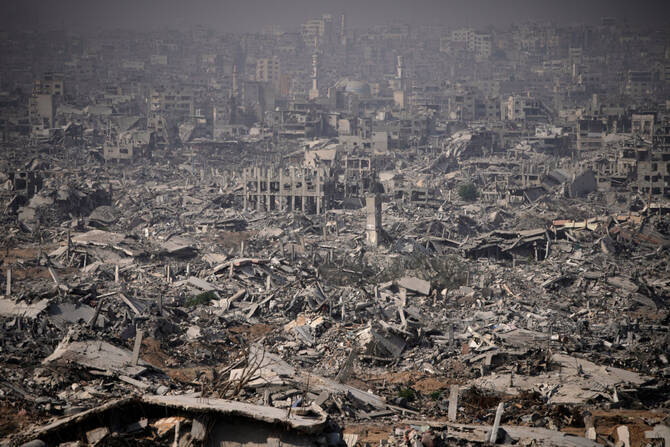
Buildings destroyed by the Israeli military are in ruins in the Shijaiya neighborhood of Gaza City, during an army-organized tour for journalists, on Nov. 5, 2025. (AP Photo)
Short Url
Updated 06 November 2025
Follow

US says it has regional support for Gaza peace resolution and proposed UN stabilization force

  • Under the draft proposal, governance of Gaza would be transferred away from Hamas and demilitarization imposed on the group
  • A copy of the draft resolution was circulated Wednesday night for formal consideration by Security Council

NEW YORK CITY: The US mission to the UN on Wednesday said that key regional partners, including Saudi Arabia, Qatar and the UAE, have thrown their weight behind its draft resolution for Gaza.

The development signals a diplomatic push within the UN Security Council to advance a two-year transitional mandate for the war-torn enclave, and the deployment of an international stabilization force.

During a meeting convened by the US ambassador to the UN, Mike Waltz, the 10 elected, non-permanent members of the council (Algeria, Denmark, Greece, Guyana, Pakistan, Panama, South Korea, Sierra Leone, Slovenia and Somalia), joined by regional states including Saudi Arabia, Egypt, Qatar, Turkiye and the UAE, expressed support for the Washington-led initiative, a spokesperson for the US mission said.

The draft resolution endorses the creation of a transitional governance body, a so-called “Board of Peace.” Control of Gaza would therefore be transferred out of the hands of Hamas, and demilitarization would be imposed on the group.

The draft resolution also authorizes the deployment of an “International Stabilization Force” in Gaza that would operate under a two-year UN mandate. It would have the authority to use “all necessary measures” to protect civilians, oversee flows of humanitarian aid, secure zones along the borders with Israel and Egypt, demilitarize non-state actors, and train a new Palestinian police force.

A copy of the draft resolution was circulated Wednesday night for formal consideration by all 15 members of the Security Council. 

The regional buy-in to the draft reflects the “historic opportunity” to end decades of bloodshed in the Middle East and transform Gaza into a safer, more prosperous territory, the spokesperson continued, and underlines the intent of the US to translate the resolution into results rather than “endless talk.”

The backing of major regional actors is significant because their participation is widely viewed as a prerequisite for authorization of any multinational stabilization force to operate in Gaza, and gain international legitimacy.

The US spokesperson stressed that no US troops would be deployed in Gaza. Instead, Washington has engaged in talks with states including Indonesia, the UAE, Egypt, Qatar, Turkiye and Azerbaijan about contributing troops to an international stabilization force.

The draft text reportedly stipulates that such a force would operate under a unified command, as agreed by the Board of Peace, Egypt and Israel once status-of-mission agreements are reached.

It further outlines a sequence of events through which the force will stabilize the security situation in Gaza, demilitarize non-state armed groups, decommission weapons, and oversee training and support for the newly vetted Palestinian police force.



‘If RSF actions in Al-Fasher are not genocide, then what is?’ Sudan’s UN ambassador tells Arab News

Updated 4 sec ago
Follow

‘If RSF actions in Al-Fasher are not genocide, then what is?’ Sudan’s UN ambassador tells Arab News

  • UN fact-finding mission says RSF atrocities in Darfur bore “hallmarks of genocide” after deadly Al-Fasher assault
  • Sudan’s Permanent Representative to the UN Al-Harith Idriss Al-Harith Mohamed accuses UAE of arming RSF

NEW YORK CITY: When the UN-backed fact-finding mission on Sudan concluded that atrocities committed by the Rapid Support Forces in and around Al-Fasher last October bore the “hallmarks of genocide,” it marked one of the most damning international assessments of the conflict to date.
The investigative report, issued on Thursday, detailed mass killings, sexual violence, rape, torture, abductions and the deliberate targeting of non-Arab communities, particularly the Zaghawa and Fur, during the RSF assault on the Darfuri city in October.
More than 6,000 civilians are known to have been killed in just three days of carnage, while some 40 percent of Al-Fasher’s estimated 260,000 prewar population managed to escape. The fate of the rest remains unknown.
For Al-Harith Idriss Al-Harith Mohamed, Sudan’s permanent representative to the UN, the findings confirm what Khartoum has been saying for months.
“Legally, we are witnessing a genocide,” Al-Harith told Arab News in an exclusive interview.
The war between the Sudanese Armed Forces and the RSF — a powerful paramilitary group that grew out of the Janjaweed militias of Darfur — erupted in April 2023 after months of escalating tensions over security-sector reform and political transition.
Since then, Sudan has descended into what aid agencies have dubbed the world’s worst humanitarian crisis. However, the October assault on Al-Fasher, the last major army stronghold in Darfur, represented a new level of brutality.
“You cannot describe killing 6,000 victims in three days, burying people alive, committing rape and sexual violence, targeting hospital infrastructure, and killing those who escaped Al-Fasher and other towns while they are fleeing the battle zone seeking safety,” Al-Harith said.
“So if this is not genocide, what other thing can be labeled as genocide?”
He pointed not only to the scale of killing but to intent — a key legal element under the Genocide Convention.
The fact-finding mission concluded that at least three of the five legal criteria for genocide had been met by the RSF’s actions: killing members of a protected ethnic group; causing serious bodily or mental harm; and deliberately inflicting conditions calculated to bring about physical destruction in whole or in part.
“Don’t forget the rhetoric they are using,” Al-Harith added. “They post videos killing people based on their ethnic background. They detain people in tanks. They chain women and sell them into slavery. Can you believe this?”
For Al-Harith, the catalogue of abuses — ethnically targeted killings, systematic sexual violence, the destruction of civilian infrastructure — reflects not only battlefield excess but an ideological motive.
“The militia declare themselves racially superior to their victims,” he said. “This is a demonic kind of inculcation in their cultural setup.”
Sudan’s government has repeatedly accused the UAE of supplying weapons and logistical support to the RSF — a charge Abu Dhabi firmly denies.
At the February 2026 Munich Security Conference, Sudanese Prime Minister Kamil Idris publicly accused the UAE of providing arms and assistance to the RSF, saying Sudan possessed evidence “beyond reasonable doubt” from UN and US sources.
Asked what proof Khartoum has to back up this claim, Al-Harith said evidence has already been submitted to the UN Security Council.
“We submitted evidence to the Security Council last year, with successive supplements to the complaint,” he said. “These memos are attached with annexes, videos, photos, figures of the arms — even serial numbers of drones and missiles that would indicate ownership.”
He stressed that Sudan is not alone in raising concerns. “Prestigious Western institutions, monitors, human rights activists, strategic institutes, political analysts, even members of the US Congress, have raised this issue,” he said.
“Some members of Congress have called for stopping the sale of American arms to the UAE because, they argue, the UAE continues to breach contract stipulations by transferring lethal weapons to a third party.”
The UAE has consistently rejected the allegations as baseless. Still, Al-Harith’s message to Abu Dhabi was unequivocal.
“The UAE will bear total legal responsibility for the crimes committed by the militia, which has grown through continuous assistance and provision of lethal arms,” he said. “They need to stop before it is too late.”
He warned that resentment toward the UAE is spreading.
“This has led to a kind of deep hatred toward the UAE, not only in Sudan but across the region,” he said. “And they do not have the courage to say, ‘We are sorry.’ You cannot become a party to mediation; if you want to stop the war and make peace, you have to come with a clear conscience.”
While sharply critical of external support for the RSF, Al-Harith praised Saudi Arabia’s diplomatic engagement.
Since the outbreak of war, Riyadh has played a visible mediation role, hosting talks between the warring parties in Jeddah in 2023 alongside the US. The so-called Jeddah process sought to secure ceasefires and humanitarian access, though agreements repeatedly collapsed.
“Saudi Arabia’s positive involvement is highly welcome,” Al-Harith said. “Their humanitarian pledges and contributions are very considerable. Their political support for the government in Sudan and the army in its war of repelling aggression is huge.”
He also referred to what he described as a “dual peace condominium” that gained momentum after Crown Prince Mohammed bin Salman’s visit to Washington last November, arguing that it helped correct what he views as an “erroneous narrative” about the conflict.
However, he said mediation must be coupled with enforcement. “If you want to stop the war, tell the militia — and enforce them — to abide by their Jeddah commitments of 2023,” he said.
For three years, Sudan’s government has called on the UN Security Council to take stronger action against the RSF, including sanctions and a nationwide arms embargo.
“The war will not stop without a strong stand against the atrocities of the militia,” Al-Harith said. “We have appealed to the international community.”
He said the RSF’s conduct reflects lawlessness unrestrained by moral or legal norms. “Imagine giving a rifle to a loose cannon who does not succumb to any morality or ethos, who does not abide by laws. He will use it,” he said.
Sudan, he emphasized, is “an ancient state,” with a national army that predates the current crisis by more than a century.
“They (the RSF) want to destroy the army through the militia and replace it with the militia — and they call this ‘reform of the military and security sector.’ This is rubbish,” he said.
Al-Harith rejected RSF claims that the army is influenced by Islamists who dominated Sudan under former president Omar Bashir until his removal in 2019.
“Islamists were removed massively after the revolution of 2019,” he said. “The military members of the Sovereign Council were chosen in that revolutionary context. Those who now claim Islamist influence were themselves part of a hybrid government with them. Why did they not say so then?”
Al-Harith also accused external actors of financially backing certain civilian voices opposed to the army.
“They have been bullied by the UAE with lavish payments, what they call financial assistance, to present themselves as Sudanese civilians with a different voice,” he said. “We are not afraid of any different voice.”
On the enforcement of an arms embargo, a step some members of the Sudan “Quintet” — comprising the African Union, the Intergovernmental Authority on Development, the Arab League, the EU and the UN — have advocated, Al-Harith said the tools already exist.
“The UN has mechanisms,” he said. “The Jeddah commitments are there. We can set up a mechanism under UN supervision. It could work.”
He emphasized that Sudan’s government remains engaged with international humanitarian law and UN frameworks addressing sexual violence in conflict.
In April, he noted, the government signed a framework agreement with the UN’s special representative on sexual violence in conflict. “We are aware of our role, its extent and importance, in stopping the war,” he said.
Ultimately, Al-Harith’s appeal to the international community, particularly to the Sudan Quintet — was for unity and decisive pressure.
“If the quintet works united to exert huge pressure on the militia, this will augur well and lead to stopping the war,” he said.
He insisted that the Sudanese Armed Forces are fighting defensively. “The army is not interested in war,” he said. “It has a constitutional duty to repel aggression and stop the violence of the militia. If this stops, the army does not continue the war.”
Protecting borders and civilians, he said, is the army’s mandate. “They have to protect their country and their civilians. They are fighting to repel aggression,” he said. “Of course, they would not deliver bunches of flowers and roses to the militia.”