

Pakistan says new assembly line to produce 500,000 Chromebooks by 2026

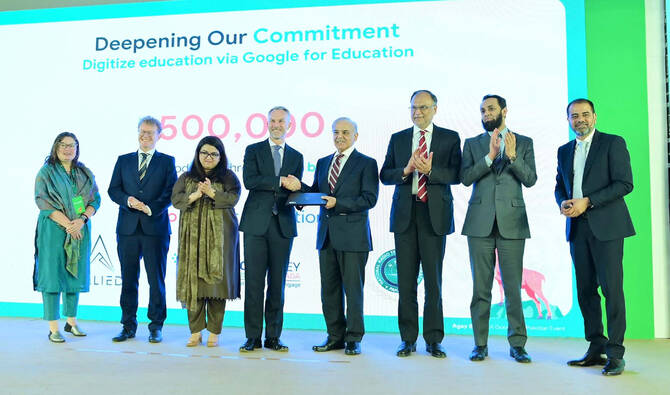
Google’s Asia Pacific President Scott Beaumont presents a locally manufactured Chromebook to Prime Minister Shehbaz Sharif in a ceremony in Islamabad, Pakistan, on September 4, 2025. (PID/File)
Short Url
Updated 05 November 2025
Follow

Pakistan says new assembly line to produce 500,000 Chromebooks by 2026

  • Pakistan inaugurated its first Chromebook assembly line, located in Haripur, on Tuesday
  • Information ministry says initiative will empower students with digital skills, create jobs

ISLAMABAD: Pakistan’s information ministry said on Wednesday that the country’s new Chromebook assembly line is expected to produce half a million devices by 2026, stressing the move would empower students and create job opportunities. 

Chromebooks are a type of computer designed to help users get things done faster through the ChromeOS, an operating system that has cloud storage and multiple layers of security.

Pakistan on Tuesday launched its first Google Chromebook assembly line, which will be located at the National Radio & Tele­com­munications Corpora­tion’s (NRTC) facility in the northwestern city of Haripur. The facility was launched as a result of a public-private partnership involving the Pakistani government, Google and Tech Valley, along with the NRTC and Allied Corporation. 

 “The facility is expected to produce 500,000 Chromebooks by 2026,” the information ministry said in a statement. 

The ministry said the assembly line will provide students and educators in Pakistan with more affordable and high-quality Chromebooks, helping equip them with digital skills. 

It also said the assembly line will create valuable job opportunities for the local youth, adding that Google’s decision to deepen its presence in Pakistan will boost the South Asian country’s digital economy and strengthen its innovation experiences. 

“This local presence will bring Google closer to Pakistan’s developers, startups, and entrepreneurs, enabling direct collaboration, capacity-building, and access to global tools and platforms,” the information ministry said. 

The facility also underscores Pakistan’s growing partnership with Google. Under a strategic memorandum of understanding, Pakistan and Google will train 100,000 developers nationwide and work together on localized, AI-powered services such as Android tools for public safety. 


IMF says has made ‘considerable progress’ as Pakistan funding talks continue

Updated 6 sec ago
Follow

IMF says has made ‘considerable progress’ as Pakistan funding talks continue

  • Discussions covered the impact of the Middle East conflict on Pakistan, balance of payments and external financing needs
  • Pakistan’s program implementation under a $7 billion program remained broadly aligned with authorities’ commitments, IMF says

KARACHI: The International Monetary Fund (IMF) has made “considerable ‌progress” ‌in ​talks with ‌Pakistan ⁠over ​its funding ⁠facilities, the Fund said late Wednesday, adding that discussions will continue in the coming days.

The IMF mission, led by Iva Petrova, had started talks with Pakistani officials on the third review of a $7 billion Extended Fund Facility (EFF) multi-year program and for the second review of the $1.4 billion Resilience and Sustainability Facility (RSF) from Feb. 25 to Mar. 11, according to the IMF.

The mission observed that Pakistan’s program implementation under the EFF remained broadly aligned with the authorities’ commitments through end-Feb., with both sides making progress on policies, including fiscal consolidation, a sufficiently tight monetary policy and advancing energy sector reforms.

“While considerable progress was made in the discussions, these will continue in the coming days, including to more fully assess the impact of recent global developments on Pakistan’s economy and the EFF-supported program,” the IMF quoted Petrova as saying.

Both EFF, secured in Sept. 2024, and the RSF, secured in May 2025, are key programs crucial for stabilizing Pakistan’s fragile economy. The IMF team was in the country to assess fiscal performance, energy-sector reforms, and external financing needs before approving the next disbursement.

The ongoing IMF engagement is seen as vital for Pakistan as geopolitical tensions and rising global oil prices pose renewed risks for its economic recovery.

The IMF mission observed that Islamabad paid “particular attention” to deepening structural reforms and made “good progress” in the implementation of their agenda to strengthen climate resilience, including through the completion of reform measures under the RSF.

“Discussions also covered the impact of the conflict in the Middle East on Pakistan’s economic outlook, the balance of payments and external financing needs amid volatile and rising energy prices and tighter global financial conditions,” Petrova said, adding:

“The IMF team and the authorities will continue these discussions with a view to conclude them in the coming days.”