

Oman, Spain sign 4 deals to boost green energy and trade cooperation 

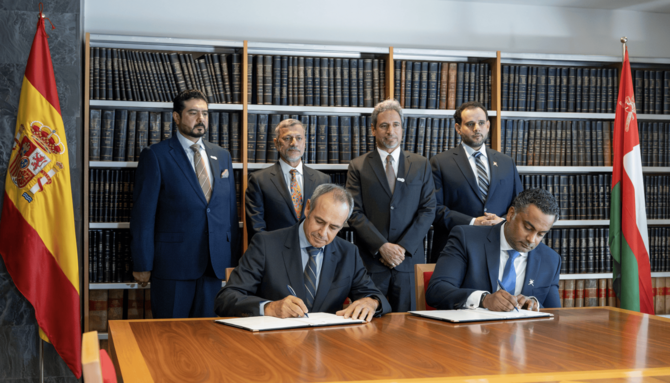
The agreements were signed during the state visit of Sultan Haitham bin Tarik to Spain
Short Url
Updated 05 November 2025
Follow

Oman, Spain sign 4 deals to boost green energy and trade cooperation 

JEDDAH: Oman and Spain are set to expand economic ties after signing four memorandums of understanding in Madrid aimed at boosting cooperation in green energy, water management, liquefied natural gas, and trade. 

The agreements were signed during the state visit of Sultan Haitham bin Tarik to Spain, the Oman News Agency reported. The MoUs mark a new phase in the strategic partnership between the two nations, boosting cooperation in investment, sustainability, and technology, with bilateral trade surpassing 94 million rials ($244 million) in 2024. 

The signing underscores Oman’s efforts to strengthen its global partnerships as it accelerates its Vision 2040 diversification plan, with renewable energy and industrial cooperation forming key pillars. 

“The first MoU was signed between Oman Chamber of Commerce and Industry and the Spanish Chamber of Commerce, Industry, Services, and Navigation,” the ONA report stated. 

It added: “It (MoU) aims to expand cooperation between the private sectors in both countries, encourage the exchange of trade delegations, organize joint exhibitions and seminars, exchange economic and commercial information, and support bilateral investments.” 

The second MoU, signed by Nama Water Services and the Spanish company Aguas de Valencia, seeks to enhance collaboration in water and wastewater management. It includes a pilot project to detect leaks in Nama’s network and a study on non-revenue water, with discussions underway for a potential 10-year partnership for broader projects. 

The third agreement, between Oman LNG and Spanish energy firm Naturgy, aims to explore a long-term LNG sale and purchase agreement that may include the supply of up to 1 million tonnes annually for 10 years starting in 2030. 

The two sides will also consider joint investment in building an LNG carrier with Asyad, alongside cooperation in accessing European regasification terminals and gas pipeline networks. 

The fourth memorandum was signed by the Ministry of Transport, Communications, and Information Technology with an international consortium comprising HIF EMEA, ACCIONA, Nordex Green Hydrogen, and Al-MEERA Investment. 

The deal seeks to develop a project to produce and supply ships with low-carbon green methanol in Dhofar Governorate, strengthening Oman’s push toward carbon neutrality and positioning Dhofar as a regional hub for green fuel and ship bunkering. 

The agreement includes feasibility and technical studies on producing and exporting green methanol using renewable energy, including solar and wind power, and converting captured carbon dioxide into methanol.

The Omani ministry will also coordinate with government entities and provide regulatory support, including land allocation and potential incentives for the project. 


Concierge demand surges as CEOs relocate to Saudi Arabia

Updated 12 November 2025
Follow

Concierge demand surges as CEOs relocate to Saudi Arabia

RIYADH: As Saudi Arabia attracts a growing influx of CEOs and high-net-worth individuals, the demand for concierge and lifestyle management services is soaring — with requests becoming increasingly complex and personalized.

“There’s an avalanche of people, for all the reasons that you would know, relocating to Saudi Arabia,” said Sir Ben Elliot, founder of global luxury concierge firm Quintessentially, in an interview with Arab News during TOURISE — the Saudi Ministry of Tourism-powered global summit held in Riyadh from Nov. 11–13.

For many new arrivals, the focus is on navigating practicalities: opening bank accounts, securing cars and drivers, hiring domestic staff, and finding schools for their children. “You need real proactive help to sort stuff out,” Elliot said. “Some of that stuff is a minefield.”

Over the past 18 months, demand has not only increased but also evolved, prompting Quintessentially to enhance its local operations. Elliot explained that the company is merging international expertise with Saudi talent to ensure high service standards from the outset.

“We brought people from our offices around the world working with young, brilliant, talented Saudis so that the service that you can expect when you arrive is really ticked off,” he said.

Elliot noted that Quintessentially’s outbound support for Saudi members is also expanding, reflecting the growing global mobility of Saudi travelers. “What we’re seeing from Saudis themselves is huge,” he said. “We have great people on the ground servicing that.”

According to Elliot, the definition of luxury is shifting from material possessions to emotion-driven, experiential value — especially among younger consumers. “If you think about the history of luxury, it has often been about things, materials,” he said. “They want to experience, they want to feel.”

He emphasized that brands in hospitality, retail, and travel need to focus on “meaningful human touch and relationships.”

Elliot highlighted Saudi Arabia’s approach to merging sustainability with luxury as a key opportunity for the sector. “The Kingdom of Saudi Arabia is at the forefront of trying to marry sustainable development alongside a kind of luxury experience,” he said.

He pointed to Diriyah as an example of how cultural authenticity can coexist with modern hospitality and retail offerings. “Whenever I take friends who have never been to Saudi Arabia, to Diriyah, that to me is a physical manifestation of where culture (and) sustainability meets a pretty kind of modern experience,” he said. “It feels absolutely real and authentic.”

Elliot said hosting TOURISE in Riyadh was symbolic of the city’s rapid evolution. “Everyone can see what’s happened here in the last 6 or 7 years, it’s kind of seeing is believing,” he said.

He also reframed sustainability as a shared responsibility across industries, warning that leaders who fail to prioritize environmental and social impact risk alienating younger generations.

Despite the rise of technology, Elliot underscored that the essence of travel and tourism remains deeply human. “We humans want to interact with other humans,” he said.