

No deal yet on EU climate targets as COP30 looms

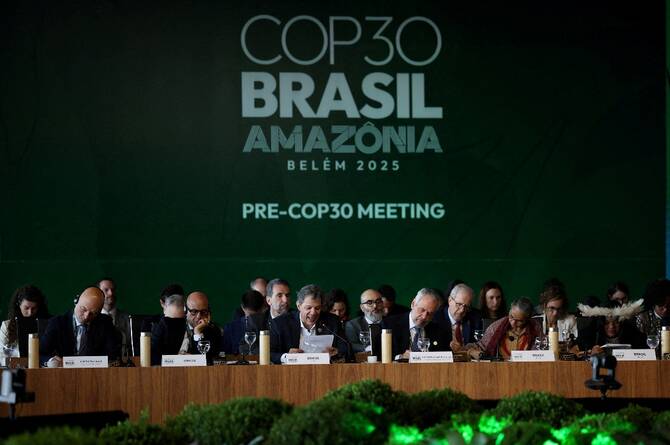
Brazil's Finance Minister Fernando Haddad speaks next to Simon Stiell, Executive Secretary of UN Climate Change (UNFCCC), and Brazil's COP30 President Andre Correa do Lago during the ministerial preparatory meeting (Pre-COP30), ahead of the COP30 Climate Summit, in Brasilia, Brazil. (Reuters)
Short Url
Updated 05 November 2025
Follow

No deal yet on EU climate targets as COP30 looms

  • EU countries have been haggling for months over two separate targets for slashing greenhouse-gas emissions: one for 2035 that they must bring to the UN climate talks, and the other for 2040

BRUSSELS: The European Union’s member states have not yet reached an agreement on key emissions targets before the UN’s COP30 summit in Brazil, and ministers will meet again on Wednesday to thrash out a deal, according to Brussels officials.
EU countries have been haggling for months over two separate targets for slashing greenhouse-gas emissions: one for 2035 that they must bring to the UN climate talks, and the other for 2040.
Talks in Brussels ended on Tuesday without an accord and continued through the night.
“We believe we have the basis for a political deal. We expect to formally conclude a deal when we resume in a few hours,” a spokesman for Denmark, which currently holds the EU’s rotating presidency, said early on Wednesday.
EU officials have stressed the importance of the talks, which come ahead of the COP30 summit next week in Brazil.
French Environment Minister Monique Barbut had warned that turning up empty-handed to the summit would spell “disaster” for the EU.
Behind only China, the United States and India in terms of emissions, the EU has been the most committed of the major polluters to climate action and has already cut emissions by 37 percent compared to 1990 levels.
But after blazing a trail, the EU’s political landscape has shifted right, and climate concerns have taken a backseat to defense and competitiveness — with concerns in some capitals that greening Europe’s economy is harming growth.
“It’s very, very difficult,” said an EU diplomat, summing up the state of play in Brussels late Tuesday.
Denmark was understood to be working hard to win over Italy, one of the countries most skeptical of the proposed targets.
The most urgent challenge for ministers is to reach a unanimous deal on an EU emissions target for 2035, known as a Nationally Determined Contribution (NDC), which Paris Agreement signatories are supposed to bring to the COP30.
“I want our heads of state and government to go to Brazil with a very strong mandate, a clear leadership role for Europe,” German Environment Minister Carsten Schneider said.
The EU also hopes to lock in the support of a weighted majority of countries for the next big climate target set out by the European Commission on the path to carbon neutrality by 2050.
The EU executive said in July it wanted to cut emissions by 90 percent by 2040, compared to 1990 levels — a major stride toward net zero.
But member states have yet to endorse that next step, which would require sweeping changes to industry and daily life at a time of growing concern over adverse impacts on Europe’s economy.
Spain and the Nordic countries support the 2040 proposal, as does Germany, with some caveats. But Hungary, Poland, the Czech Republic and Italy remain opposed, citing risks to their industrial sectors.
Heavyweight France, meanwhile, has kept observers guessing on its position — demanding guarantees that its nuclear sector would not lose out under green transition plans and wiggle room on emissions should Europe’s forests absorb less carbon than expected.

- ‘Not pretty’ -

To win over the staunchest skeptics, Tuesday’s talks covered a range of “flexibilities” for member states, including letting countries count carbon credits purchased to finance projects outside Europe.
A commission pledge for credits to account for up to three percent of a nation’s 2040 emission cuts failed to win over hard-liners, with countries pushing for a higher threshold of five percent.
Some also want the overall objective reassessed every two years.
Environmental groups have accused countries of undermining the EU’s climate ambitions with loopholes.
But a diplomat involved in the process defended the compromise shaping up in Brussels, while conceding it was “not necessarily pretty.”
“In the muddy, messy, nasty real world out there, we are trying to achieve something good,” said the diplomat, granted anonymity to discuss the sensitive deliberations.
The EU insists it remains committed to its role as global climate leader, having mobilized 31.7 billion euros ($36.4 billion) in public climate finance in 2024, making it the world’s largest donor.

I want answers from my ex-husband, Gisele Pelicot tells AFP

Updated 16 February 2026
Follow

I want answers from my ex-husband, Gisele Pelicot tells AFP

  • Gisele Pelicot, the French woman who became a symbol in the global fight against sexual violence, told AFP why she wants to visit her ex-husband in jail and her joy at finding love again

PARIS: Gisele Pelicot, the French woman who became a symbol in the global fight against sexual violence, told AFP why she wants to visit her ex-husband in jail and her joy at finding love again.
In an interview ahead of the publication of her memoirs on Tuesday, she also said she hopes to inspire other rape victims to believe in a brighter future — and to change attitudes along the way.
Her book, titled “A Hymn to Life,” covers the full arc of her 50-year marriage which ended when she discovered that her husband had been repeatedly drugging her and inviting strangers over to their house to rape her.
It will be published in 22 languages.
The title of your book in French is “And the joy of living.” Have you found joy again?
“I’m doing better. After the trial (of her husband and 50 other men in 2024), I took stock of my life and today I am trying to rebuild on this field of ruins.
Despite all these ordeals, even in the darkest periods, I have always sought flashes of joy; I am looking toward the future, toward joy. I know this may surprise some who expect to see me in tatters, but I am determined to remain standing and dignified.”
Some describe you as an icon. Do you embrace that status?
“I do not use that word. I think my story has become a symbol. I know where I come from and who I am. It seems to me that we do not suspect the strength we have inside us until we are forced to draw on it, and that is also what I would like to say to victims.”
Why did you write this book?
“I needed to bear witness to my life journey, to address all those who supported me; it was a way of responding to them. Writing this book with (French author) Judith Perrignon, in whom I had complete trust, was both painful and fascinating.
Beyond the case itself, it retraces my life, the journey of three generations of women: my grandmother, my mother and myself. Their example explains my strength because I experienced tragedies very young. When you lose your mother at age nine, you grow up faster than others.”
Have you had professional psychological help to overcome your trauma?
“Of course, I could not get through this alone. How do you sort through 50 years of memories tainted by this series of crimes? I lived for half a century with Mr. Pelicot and I have no memory of the rapes, only the memory of happy days.
I cannot throw my whole life in the bin and tell myself that those years were nothing but a lie. If I did that, I’d collapse.”
At the end of the book, you announce your intention to visit Mr.Pelicot in prison. Why?
“I would like to do it for myself. That visit would be a stage in my reconstruction, an opportunity, for the first time since his arrest in November 2020, to confront him face to face.
How could he have done this to me? How could he have put our entire family through hell? What did he do to (our daughter) Caroline? He may not answer my questions, but I need to ask them.
For the moment, no date has been set for the visit. I do not think it will take place before the end of the year.”
In the book, you speak about your relationships with your three children. Where do they stand?
“It is wrong to think that such a tragedy brings a family together. It is impossible. Each of my children is now trying to rebuild as best they can.
Caroline’s suffering devastates me. She is in a state of anger that I do not share. And there is this doubt (about whether she was raped by her father) that condemns her to a perpetual hell.
I do not question her word, but I do not have the answers. Today, our relationship is calmer and I am happy about that. I will try to support her as best I can.”
Do you intend to remain a public figure?
“I am in my 74th year. I long for calm. I am not a radical feminist; I am a feminist in my own way. I know there is still a long way to go, despite progress on consent. I leave it to the younger generations to change this patriarchal society.
We can pass all the laws we want, but if we do not change mindsets, we will not succeed. That therefore begins above all with the education of our children. Parents must get involved.”
You are about to begin a tour to present your book. With what message?
“A message of hope. After hardship, you can once again allow yourself happiness and be happy. That is what I am doing. I am lucky enough to love again — it is magnificent. I think a life without love is a life without sunshine.”