

Pakistan minister voices optimism ahead of Istanbul talks with Kabul over militancy

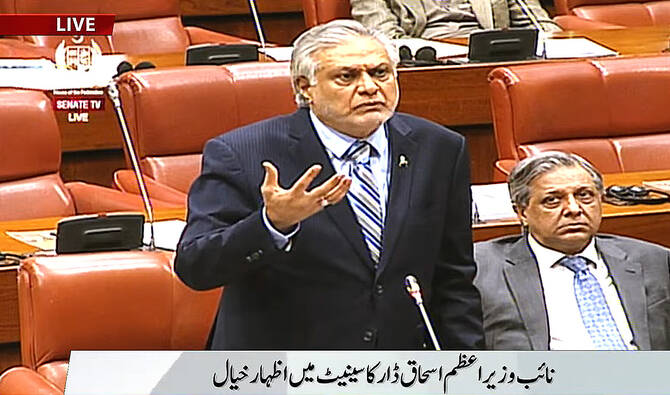
Pakistan’s deputy prime minister and foreign minister Ishaq Dar, gestures while addressing the upper house of parliament in Islamabad, on November 6, 2025. (PTV News/ YT)
Short Url
Updated 04 November 2025
Follow

Pakistan minister voices optimism ahead of Istanbul talks with Kabul over militancy

  • Tensions between Pakistan and Afghanistan have been high in recent months following an uptick in attacks in Pakistan’s western provinces
  • The two countries engaged in fierce fighting last month and are due to meet in Istanbul on Nov. 6 to firm up a ceasefire reached in Doha

ISLAMABAD: Pakistan’s foreign minister on Tuesday expressed optimism ahead of talks with Afghanistan in Istanbul that the two neighbors could work together to address cross-border militancy and strengthen bilateral cooperation.

Tensions between Pakistan and Afghanistan have been high in recent months following an uptick in attacks in Pakistan’s western provinces that border Afghanistan. Islamabad has repeatedly accused the Afghan Taliban of allowing the use of their soil for these attacks, an allegation Kabul denies.

The two countries engaged in fierce fighting last month after Pakistan hit what it called TTP-affiliated targets in Afghanistan. Both sides reached a ceasefire in Doha on Oct. 19 and are due to meet in Istanbul on Nov. 6 to finalize a mechanism to keep militancy along their 2,600-kilometer border in check.

Addressing the upper house of parliament, FM Ishaq Dar said he “received six calls” from his Afghan counterpart Amir Khan Muttaqi on Monday and told him that he supported Afghanistan as a neighboring Muslim country, but the rise in cross-border militancy had left him in a difficult position.

“I am among those who want to move forward positively with Afghanistan, Iran and all our neighboring countries. This is my responsibility on behalf of Pakistan,” Dar said, briefing Senate members about Pakistan’s talks with Afghanistan.

“My wish and prayer is that these matters be resolved and that we help one another.”

The TTP is responsible for some of the bloodiest attacks in Pakistan, including on churches, schools and the shooting of Malala Yousafzai, who survived the 2012 attack after she was targeted for her campaign against the Taliban’s efforts to deny women education. The group has stepped up its attacks against Pakistani security forces and law enforcement agencies in recent years.

Pakistani forces were able to effectively dismantle the TTP and kill most of its top leaders in a string of military operations from 2014 onwards in the country’s northwestern tribal areas, driving most of the fighters into neighboring Afghanistan.

Without naming anyone, Dar blamed the former government of Prime Minister Imran Khan for holding talks with the TTP and providing space to its fighters to regroup in the region.

“That was the biggest mistake. I am not against any person or any government, but this is a fact,” he said. “We must pull ourselves together so that such mistakes are not repeated, whether it’s our government or any other.”

Pakistan speaker raises concern over Afghan militancy in talks with Iranian delegation

Updated 12 November 2025
Follow

Pakistan speaker raises concern over Afghan militancy in talks with Iranian delegation

  • Ayaz Sadiq met Iran’s deputy speaker a day after a suicide bombing in Islamabad blamed on Afghan-based militants
  • Iran offered to mediate between Pakistan and Afghanistan this month following border clashes, failed talks in Istanbul

ISLAMABAD: Pakistan’s National Assembly Speaker Sardar Ayaz Sadiq on Wednesday voiced concern over militant violence emanating from Afghanistan a day after a suicide bombing in Islamabad killed at least 12 people and was blamed by the Pakistani authorities on the proscribed Tehreek-e-Taliban Pakistan (TTP) militant network.

Sadiq’s comments came during a meeting with Iran’s Deputy Speaker Ali Nikzad, who is leading a parliamentary delegation to Islamabad. The Iranian official, whose country also shares a border with Afghanistan, discussed expanding parliamentary and economic cooperation with the National Assembly speaker while addressing regional security challenges.

Pakistan has in recent weeks accused Afghan authorities of harboring militants and facilitating their cross-border attacks on Pakistani security forces and civilians. The tensions triggered border clashes last month, followed by a collapse of peace talks in Istanbul earlier this month that aimed at easing bilateral tensions.

Iran, which maintains relations with both Kabul and Islamabad, subsequently offered to mediate between the two sides.

“Afghanistan’s soil is being used for terrorism in Pakistan,” Sadiq said during his conversation with the Iranian official, according to a statement from the National Assembly Secretariat. “Pakistan remains committed to the complete elimination of terrorism and to resolving conflicts through peaceful means.”

The speaker emphasized that cooperation between Pakistan and Iran was vital for regional peace, describing the two as “brotherly neighbors bound by shared history, religion and culture.”

He also thanked Tehran for its support to Pakistan during a military standoff with India in May and called for unity among Muslim countries in the face of regional crises.

Sadiq condemned Israeli strikes on Iran, noting that Pakistan’s parliament had unanimously passed a resolution denouncing the attacks, and congratulated Iran for its “firm response.”

Nikzad extended condolences over the suicide bombing in Islamabad and praised Pakistan’s “steadfast support” during his country’s war with Israel.

He also noted there were wide-ranging opportunities to expand cooperation between the two countries in multiple sectors.