

Pakistan cancels Eni LNG cargoes, seeks to renegotiate Qatar supplies

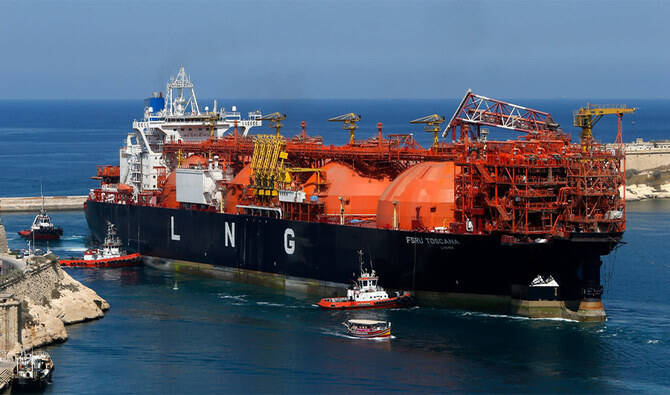
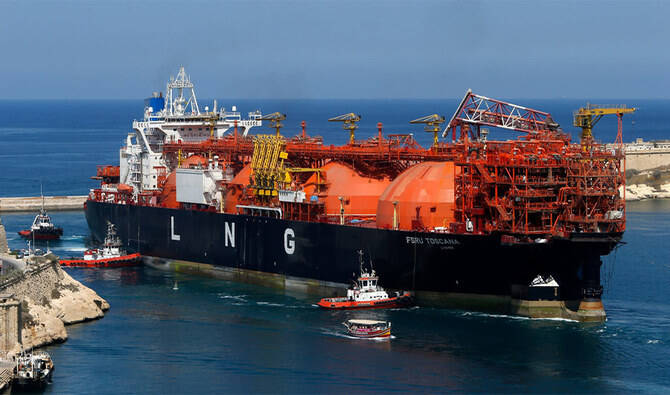
An offshore LNG regasification terminal, the FSRU Toscana, is towed into Valletta's Grand Harbour July 1, 2013. (REUTERS/File)
Short Url
Updated 04 November 2025
Follow

Pakistan cancels Eni LNG cargoes, seeks to renegotiate Qatar supplies

  • Move comes amid surplus gas in Pakistan due to lower industrial demand, higher renewable output
  • Islamabad also in talks with Qatar to defer or resell LNG cargoes under existing supply agreements

KARACHI: Pakistan has struck a deal to cancel 21 liquefied natural gas cargoes under its long-term contract with Italy’s Eni as part of a plan to curb excess imports that have flooded its gas network, according to an official document and two sources.

The document from state-owned Pakistan LNG Ltd. (PLL) to the country’s Ministry of Energy dated October 22 said 11 cargoes planned for 2026 and 10 for 2027 would be canceled at the request of gas distributor SNGPL.

Only the planned January shipment in both years, and the December shipment in 2027, would be retained to meet peak winter demand, according to the document, reviewed by Reuters.

Two sources familiar with the matter in Pakistan said that Eni had agreed to the move under the contract’s flexibility provisions. LNG is in strong demand globally, and suppliers typically stand to earn more by selling cargoes in the spot market than under long-term contracts.

Eni declined to comment. PLL, SNGPL, and Pakistan’s petroleum ministry did not reply to requests for comment.

RENEGOTIATING SUPPLIES FROM QATAR

PLL’s move marks one of Pakistan’s most significant steps yet to rein in LNG purchases as rising renewable generation and lower industrial demand leave it with surplus imported gas.

Eni signed a long-term LNG supply deal with PLL in 2017, committing to deliver one cargo per month until 2032, with the option to divert shipments to other destinations.

The first source, and a third, said that Pakistan was also in talks with Qatar about gas supplies from the Gulf state, with options including deferring some cargoes or reselling them under existing contract clauses. Last week a technical team visited Karachi to schedule the cargoes. The talks are ongoing and no decision has been reached, the first and third sources said.

QatarEnergy did not immediately respond to a request for comment.

TOO MUCH GAS, TOO LITTLE DEMAND

Pakistan’s long-term LNG supply deals with Qatar and Eni together cover around 120 cargoes a year, including on average nine a month from two Qatari contracts and one from Eni.

But Pakistan’s LNG imports have fallen sharply this year as demand from power producers dropped amid higher solar and hydropower output.

Lower gas use by power plants and industrial units generating their own electricity have added to the surplus, leaving the system significantly oversupplied for the first time in years.

The glut has forced Pakistan to sell gas at steep discounts, curb local production, and consider offshore storage or reselling excess cargoes, according to government presentations reviewed by Reuters.

Eni’s last delivered cargo to Pakistan was received at the GasPort terminal on January 3, according to Kpler data. The first source, and a fourth one, said Pakistan had also agreed a deal with Eni not to receive any further cargoes in 2025.

Eni shipped out 12 cargoes to Pakistan in 2024. 


Quit Pakistan routes or lose state support, Afghan deputy premier warns traders

Updated 6 sec ago
Follow

Quit Pakistan routes or lose state support, Afghan deputy premier warns traders

  • Deputy PM Mullah Baradar tells businessmen to seek alternative import and export routes within three months
  • Ties have sharply deteriorated amid border closures, airstrikes, mounting militant attacks blamed on Afghan-based groups

PESHAWAR: Afghanistan’s deputy prime minister for economic affairs, Mullah Abdul Ghani Baradar, on Wednesday urged Afghan traders and industrialists to end their reliance on Pakistan for imports and exports and seek alternative routes within three months, warning that the government would no longer take responsibility for problems arising from commerce through its southern neighbor.

The directive underscores the breakdown of trust between the two neighbors, whose relations have plunged as Islamabad accuses the Kabul government of harboring the Tehreek-e-Taliban Pakistan (TTP), which frequently claims attacks against Pakistani state targets. 

The border between Pakistan and Afghanistan has remained closed since last month following deadly clashes between the two nations and Pakistani airstrikes inside Afghan territory. Relations are likely to grow even more strained after a suicide bombing in Islamabad this week that killed 12 people and an attempted assault on a cadet college in the country’s northwest, which Pakistan has blamed on militants operating from Afghan soil. Kabul denies it harbors insurgent groups. 

“All the country’s traders and industrialists should seek alternative routes for trade… those items that we were buying in Pakistan, now other markets and countries be explored,” Baradar said during a meeting with traders in Kabul. 

“After this notice, if traders continue to export and import items to and from Pakistan, then the Islamic Emirate has no responsibility to hear their grievances or address their issues.”

Baradar gave traders three months to wind up their contracts and accounts in Pakistan, accusing Islamabad of repeatedly exploiting trade and humanitarian matters for political leverage. He cited the closure of routes during Afghan harvest seasons and the import of “low-quality medicines” from Pakistan as major problems.

“Pakistan has repeatedly blocked trade routes… and has politically exploited commercial and humanitarian matters, harming traders and industrialists of both countries,” Baradar said.

Pakistan has long served as Afghanistan’s primary transit corridor for goods and aid, but bilateral commerce, constantly at the mercy of political relations, has been hit hard by escalating tensions, cross-border attacks and visa restrictions.

Afghanistan’s realistic alternatives to Pakistan’s trade routes lie to its north and west, through Iran, Central Asia, and China. The Chabahar Port in Iran, developed with Indian support, offers a viable maritime outlet via the Arabian Sea that bypasses Pakistan entirely, though its use has been limited by sanctions and logistics costs. To the north, Afghanistan has access to Central Asian corridors through Uzbekistan, Turkmenistan, and Tajikistan, connecting to regional transport networks like the Trans-Caspian International Route and China’s Belt and Road corridors. 

However, these routes are longer, more expensive, and less efficient for perishable goods, meaning that while diversification is possible, replacing Pakistan’s short and cost-effective access to Karachi and Gwadar ports remains a major challenge.

Bilateral trade between Pakistan and Afghanistan totaled nearly $2 billion in fiscal year 2024-25, according to official data from both sides. Pakistan exported about $1.14 billion worth of goods, mainly food products, construction materials, textiles, and pharmaceuticals, while importing coal, dried fruits, gemstones, and agricultural produce valued at roughly $850 million from Afghanistan. 

Despite periodic border closures and political tensions, Afghanistan remains one of Pakistan’s top regional trading partners, with much of the commerce conducted through the key Torkham and Chaman crossings that link the two countries’ supply chains and consumer markets.