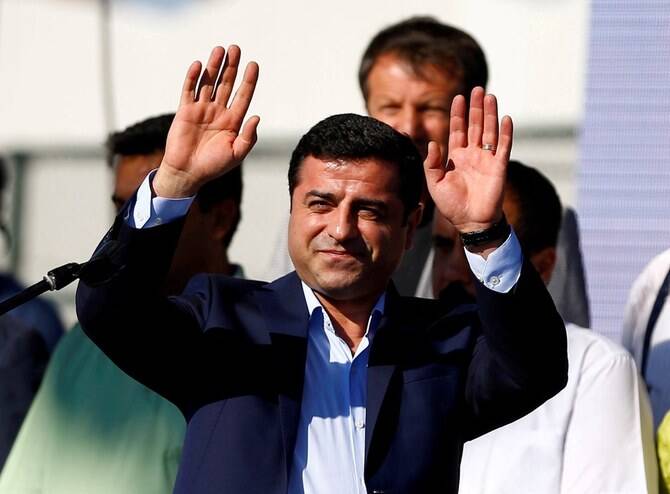

ANKARA: Turkish nationalist leader Devlet Bahceli said on Tuesday it “would be beneficial” to release from prison former pro-Kurdish party leader Selahattin Demirtas, in a rare signal of support by an influential figure long hostile to Kurdish political demands.
The surprise comment before reporters outside parliament came a year after Bahceli — a close ally of President Tayyip Erdogan who has in the past pushed him toward major policy shifts — urged the start of a peace process with the outlawed Kurdistan Workers Party (PKK).
PKK militants have since agreed to disarm and dissolve, opening a rare window for Turkiye to address decades-long grievances among its large Kurdish minority, which has called for greater democratic rights and protections and helped fuel Demirtas’s surging popularity before his 2016 jailing.
Demirtas was detained in November 2016 on terrorism-related charges he denies. In May 2024, a court convicted him over the deadly 2014 protests and sentenced him to more than 40 years in prison; he also received a separate 2-year sentence in 2021 for insulting Erdogan.
The European Court of Human Rights (ECHR) has twice ruled that Demirtas’s rights were violated and called for his immediate release. Ankara’s final appeal was rejected on Monday.
Asked about the court’s decision, Bahceli said: “The legal path has been completed. His release would be beneficial for Turkiye.”
Demirtas had welcomed a recent ECHR ruling on his case as “important and legally binding” and, in a handwritten post on X, urged unity: “This bond of brotherhood will be strengthened by the work we undertake to ensure freedom, justice and peace.”
It was unclear how the government might respond.
In an X post, Vice President Cevdet Yilmaz said he supported the alliance between Bahceli’s Nationalist Movement Party (MHP) and the ruling AK Party, but did not refer specifically to the comments on Demirtas.
PRO-KURDISH PARTY TARGETED FOR YEARS
The opposition pro-Kurdish DEM Party — known as HDP when Demirtas led it — remains parliament’s third-largest bloc and in recent months has cooperated with a government-led peace commission related to the PKK, signalling readiness to support its steps.
Bahceli’s MHP has historically been the fiercest opponent of broader Kurdish rights agendas and has long vilified Kurdish-rooted political groups — making Tuesday’s comment especially striking as Ankara edges toward potential reforms.
Tuncer Bakirhan, DEM’s co-head, said afterward that not only Demirtas but all “political prisoners” should be released as part of a democratic peace process.
The pro-Kurdish movement has been targeted for years in a sweeping crackdown in which thousands of its officials and members have been jailed and many lawmakers and elected mayors removed from office.
As the PKK peace process has progressed over the last year, a new wave of arrests and investigations has targeted the main opposition Republican People’s Party (CHP).
“Bahceli’s remarks mark a striking U-turn,” said Berk Esen, professor of political science at Sabanci University.
“Until recently, the ruling alliance accused the opposition of wanting to free Demirtas and insisted he remain in jail, which underscores how political this case has always been.”
But he added that Bahceli’s comment does not mark “a broader political liberalization or democratization,” given that both the CHP and Kurdish political movement face continued legal pressure.