

Pakistan to import Canadian canola as Ottawa seeks new markets for commodity

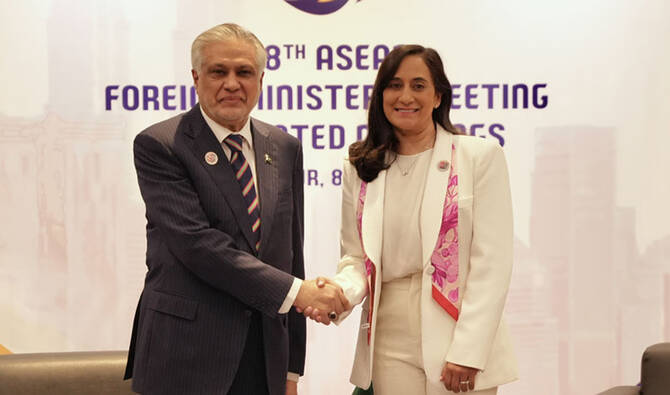
Pakistan’s Deputy Prime Minister and Foreign Minister, Ishaq Dar, meeting Canadian Foreign Minister, Anita Anand (right), on the sidelines of the 32nd ASEAN Regional Forum Ministerial Meeting in Kuala Lumpur, Malaysia, on July 10, 2025. (Radio Pakistan/File)
Short Url
Updated 04 November 2025
Follow

Pakistan to import Canadian canola as Ottawa seeks new markets for commodity

  • Canada has been looking to open new markets for canola after China announced preliminary anti-dumping duties on its import in August
  • While the agreement opens a key export market for Canada, it means a wider array of options for Pakistan’s substantial edible oil consumption

ISLAMABAD: Pakistan and Canada have agreed to facilitate the export of Canadian canola to the South Asian country, they said in a joint statement late Monday, amid Ottawa’s search for new markets for the commodity.

The statement came days after Pakistani Foreign Minister Ishaq Dar held a “productive” telephonic conversation with his Canadian counterpart Anita Anand, emphasizing the importance of deepening cooperation in areas of mutual interest, according to the Pakistani foreign ministry.

Canada has been looking to open new markets for canola after China announced preliminary anti-dumping duties on Canadian canola imports in August, a year after Canada said it would levy a 100 percent tariff on the import of Chinese electric vehicles.

The agreement between Pakistan and Canada to allow Canadian canola imports comes after the two sides held the first round of negotiations toward a Foreign Investment Promotion and Protection Agreement (FIPA) in Sept., which reflected their commitment to fostering trade.

“Pakistan and Canada agreed to facilitate the export of Canadian canola to Pakistan, recognizing the significant potential of Pakistan’s expanding market for this Canadian commodity,” the Pakistani foreign office said in a joint statement.

It said the two sides recognized the strong and growing role of Canadian companies in achieving Pakistan’s ambitious mineral development goals and harnessing its clean energy potential.

“Both sides also expressed keen interest in expanding bilateral cooperation on energy security and critical minerals,” the statement read.

While the agreement opens a key export market for Canada, it means enhanced food security and a wider array of options for Pakistan’s substantial edible oil consumption.

Bilateral trade between Pakistan and Canada crossed the $1 billion mark in 2022, with the balance in favor of Pakistan. In 2023, the overall volume of trade was recorded at $627.17 million out of which, Pakistan’s exports were $461.57 million and imports were $165.59 million, according to the Pakistani high commission in Ottawa.

Pakistan’s exports include textiles, leather products, cotton yarn and cereals and imports mainly consist of oil seeds, oleaginous fruits, industrial and medicinal plants, straw and fodder, edible vegetables, roots and tubers, iron and steel.

Many Canadian companies, including Hatch, Enerflex, Constellation Software, Nortel, Solinst, Enerflex and Bombardier, have a strong presence in Pakistan. Canadian food giant Restaurant Brands International (RBI), one of the largest food chains in North America, has opened multiple branches of its flagship coffee chain, Tim Hortons, in Pakistan, while Second Cup is another popular Canadian coffee retailer that has its outlets in Karachi, Lahore and Islamabad.

The Pakistani foreign office said both countries are looking forward to the upcoming 6th round of bilateral consultations, which will serve as a platform to advance shared priorities, reinforce government-to-government and private sector linkages, and explore new avenues for strategic collaboration.

“Pakistan and Canada remain committed to working together to promote peace, prosperity, and inclusive growth, both bilaterally and on the global stage,” it added.


Pakistan’s Mahnoor Omer named among TIME’s ‘Women of the Year’ for 2026

Updated 01 March 2026
Follow

Pakistan’s Mahnoor Omer named among TIME’s ‘Women of the Year’ for 2026

  • Omer moved a Pakistani court against the so-called ‘period tax’ in Sept. 2025 which has since sparked a national debate
  • Taxes on sanitary pads in Pakistan can add up to 40 percent to retail price, UNICEF says only around 12 percent women use such products

ISLAMABAD: Pakistani women’s rights activist Mahnoor Omer, who fought against taxes on menstrual products, has been named among the TIME magazine’s ‘Women of the Year’ for 2026.

Omer’s efforts have been recognized alongside 16 activists, artists, athletes and businesswomen in the TIME’s Women of the Year 2026 list, including Olympic gold medalist Sydney McLaughlin-Levrone and Oscar-nominated filmmaker Chloe Zhao.

Dissatisfied with the efforts to educate Pakistani girls about sexual violence, Omer founded the Noor Foundation at the age of 14 and held her own workshops with village girls about everything from climate change to menstruation, according to the TIME magazine.

Two years later, a conversation with a domestic worker about the price of pads made her realize that not everyone could afford these essentials. She moved a court against the so-called “period tax” in Sept. 2025 and the case has sparked a national debate on the subject, considered a taboo by many in Pakistan, since its first hearing late last year.

“A decade and one law degree after her interest in activism was sparked, Omer, now 25, is putting her passion and expertise to work in the name of gender equity,” TIME wrote about Omer on its website.

Taxes imposed on sanitary products in Pakistan can add up to 40 percent to the retail price. UNICEF estimates just 12 percent of women in the country use commercially produced pads or tampons. The alternative, using cloth, risks health impacts including rashes and infections, and can make it impossible for girls to attend school while menstruating.

Omer’s suit, which awaits the government response, has sparked a national discussion. She says she spoke about menstruation to her father and male cousins, who thanked her for standing up for their daughters.
The 25-year-old, who is currently enrolled in a master’s degree in gender, peace, and security at the London School of Economics, sees this case as just the first of many.

“I’m not free until every woman is free,” she was quoted as saying by TIME. “I want to leave no stones unturned in terms of what I can do with the next few decades, as a lawyer for the women in my country and gender minorities in general.”