US hailed Spain in NATO after Trump threats: Spanish minister

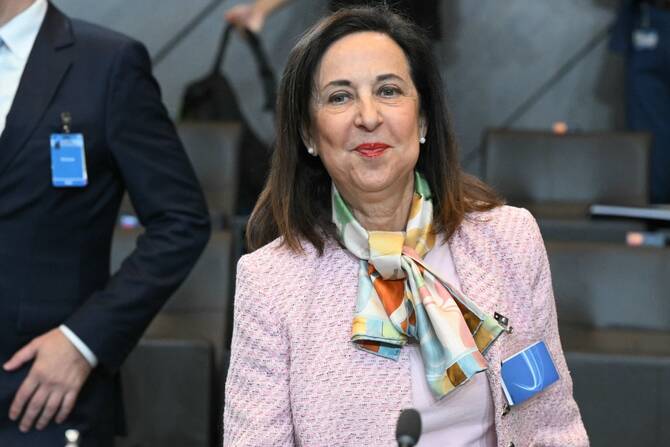
Spanish Defense Minister Margarita Robles looks on before a NATO Ministers of Defense Summit at the NATO headquarters in Brussels, Oct. 15, 2025. (AFP)
Short Url
Updated 04 November 2025
Follow

US hailed Spain in NATO after Trump threats: Spanish minister

  • Spain has sent over 700 troops to Latvia as part of NATO’s efforts in Eastern Europe
  • Pentagon “congratulated Spain” for “contributing to the reinforcement of the Atlantic Alliance”

MADRID: The United States has praised Spain’s contribution to NATO, the Spanish defense minister said Monday, after President Donald Trump suggested expelling the country from the alliance for not meeting his military spending target.
Last week, the United States announced the withdrawal of some troops from the alliance’s sensitive eastern European flank, on the front line against Russia during the invasion of Ukraine.
But the Pentagon simultaneously said Spain’s contingent was playing “a fundamental and essential role for the defense of Europe and policies of deterrence,” Spanish Defense Minister Margarita Robles said.
The Pentagon “congratulated Spain” for “contributing to the reinforcement of the Atlantic Alliance” and its more than 700 troops in Latvia, she added at a security forum in Madrid.
“Faced with those who want to say Spain is not a committed ally, Spain is a committed ally... and the Department of War recognized that last week,” added Robles, referring to the US defense ministry by its new name.
The revelation contrasts with recent remarks by Trump, who threatened to expel and impose tariff “punishment” on Spain, which was NATO’s lowest defense spender in relative terms last year.
In June, the 32-nation alliance agreed to massively boost defense spending to five percent of annual economic output over the next decade under pressure from Trump, who has raised doubts about the US commitment to European security.
But Spain insisted it would not need to hit the headline figure, saying it should meet its capacity objectives rather than fixed spending targets.


Geoeconomic confrontation tops global risks in 2026: WEF report

Updated 20 min 53 sec ago
Follow

Geoeconomic confrontation tops global risks in 2026: WEF report

  • Also armed conflict, extreme climate, public polarization, AI
  • None ‘a foregone conclusion,’ says WEF’s MD Saadia Zahidi

DUBAI: Geoeconomic confrontation has emerged as the top global risk this year, followed by state-based armed conflict, according to a new World Economic Forum report.

The Global Risks Report 2026, released on Wednesday, found that both risks climbed eight places year-on-year, underscoring a sharp deterioration in the global outlook amid increased international competition.

The top five risks are geoeconomic confrontation (18 percent of respondents), state-based armed conflict (14 percent), extreme weather events (8 percent), societal polarization (7 percent) and misinformation and disinformation (7 percent).

The WEF’s Managing Director Saadia Zahidi said the report “offers an early warning system as the age of competition compounds global risks — from geoeconomic confrontation to unchecked technology to rising debt — and changes our collective capacity to address them.

“But none of these risks are a foregone conclusion.”

The report assesses risks across three timeframes: immediate (2026); short-to-medium term (next two years); and long term (next 10 years).

Economic risks show the largest overall increase in the two-year outlook, with both economic downturn and inflation jumping eight positions.

Misinformation and disinformation rank fifth this year but rise to second place in the two-year outlook and fourth over the 10-year horizon.

The report suggests this reflects growing anxiety around the rapid adoption of artificial intelligence, with adverse outcomes linked to AI surging from 30th place in the two-year timeframe to fifth in the 10-year outlook.

Uncertainty dominates the global risk outlook, according to the report.

Surveyed leaders and experts view both the short- and long-term outlook negatively, with 50 percent expecting a turbulent or stormy global environment over the next two years, rising to 57 percent over the next decade.

A further 40 percent and 32 percent, respectively, describe the outlook as unsettled across the two- and 10-year timeframes, while just 1 percent anticipate a calm global outlook in either period.

Environmental risks ease slightly in the short-term rankings. Extreme weather fell from second to fourth place and pollution from sixth to ninth. Meanwhile, critical changes to Earth systems and biodiversity loss dropped seven and five positions, respectively.

However, over the next decade, environmental threats re-emerge as the most severe, with extreme weather, biodiversity loss, and critical changes to Earth systems topping the global risk rankings.

Looking ahead over the next decade, around 75 percent of respondents anticipate a turbulent or stormy environmental outlook, making it the most pessimistic assessment across all risk categories.

Zahidi said that “the challenges highlighted in the report underscore both the scale of the potential perils we face and our shared responsibility to shape what comes next.”

Despite the gloomy outlook, Zahidi signaled a positive shift in global cooperation.

 “It is also clear that new forms of global cooperation are already unfolding even amid competition, and the global economy is demonstrating resilience in the face of uncertainty.”

Now in its 21st year, the Global Risks Report highlights a core message: global risks cannot be managed without cooperation.

As competition intensifies, rebuilding trust and new forms of collaboration will be critical, with the report stressing that today’s decisions will shape future outcomes.

The report was released ahead of WEF’s annual meeting, which will be held in Davos from Jan. 19 to 23.