

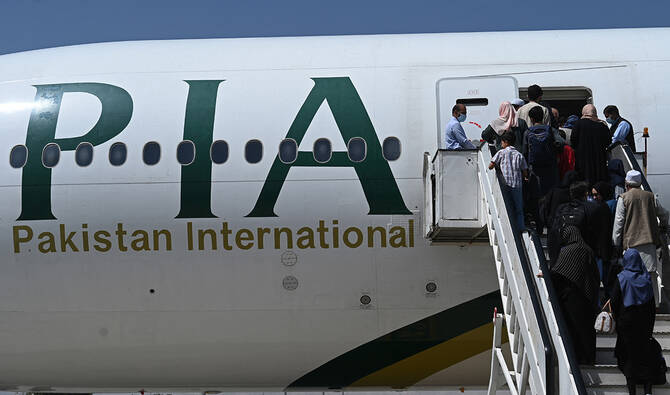

ISLAMABAD: Pakistan’s privatization chief Muhammad Ali announced on Monday that the government aims to complete the sale of Pakistan International Airlines (PIA) by the end of this year, part of a sweeping new privatization program backed by what he called “the highest level of commitment.”
Pakistan’s government has been attempting to privatize the debt-ridden PIA to raise funds and reform state-owned enterprises as envisaged under a $7 billion International Monetary Fund (IMF) program secured last year. Late last year, a deal fell through after a potential buyer reportedly offered $36 million for a 60 percent stake in the national flag carrier, a fraction of the asking price of approximately $303 million.
In July, Pakistan prequalified four investors for the sale of PIA. Among the bidding groups, one is a consortium of major industrial firms Lucky Cement, Hub Power Holdings, Kohat Cement and Metro Ventures. Another is led by investment firm Arif Habib Corp. and includes fertilizer producer Fatima Fertilizer, private education operator The City School, and real estate firm Lake City Holdings. Additionally, Fauji Fertilizer Company, a military-backed conglomerate, and Pakistani airline Airblue, have been approved to bid for PIA.
“We are targeting that we should privatize the PIA before the end of the year,” Ali told reporters at a news conference, flanked by Finance Minister Muhammad Aurangzeb and other members of the government’s economic team.
Ali vowed that the government was dedicated to completing the privatization process quickly, stating that it was hiring sector specialists, lawyers, mergers and acquisitions experts and investment bankers to facilitate transactions.
He said the government had divided the process to privatize state-owned entities into three phases, adding that it had completed all three. Ali said the government was working on several transactions at a time, explaining that it had to consider the market, investors’ appetites, their interest and the health of the companies at stake.
“Keeping all these things in mind, we are working on privatization as fast as we can, at full speed,” he said.
Ali mentioned that the government had sold the state-owned First Women Bank to a UAE group for Rs5 billion [$17.5 million], which had a total equity of Rs3 billion [$10.5 million].
The official spoke of the government’s privatization efforts regarding the state-owned House Building Finance Corporation, saying its privatization process had been underway for the past two years. He disclosed that the government was in discussions with an entity regarding its sale.
“We are getting offers from them. This is a negotiated sale,” Ali said. “And if we get our valuation in this, then we will go ahead in this.”
DISCOS, ROOSEVELT HOTEL
Ali spoke about the privatization of power distribution companies (DISCOs), saying that the government would be careful in their sale as it would affect “every Pakistani.”
“So we have to be sure that when we sell them, we sell them in a way that in the coming times, there is power supply in every area,” he said. “There is less load shedding and power is supplied at the right cost. So, we have made a restructuring plan of all three DISCOs.”
About Pakistan’s plan to sell its Roosevelt Hotel in New York, Ali mentioned that Jones Lang LaSalle (JLL), Islamabad’s financial adviser for the process, had stepped down due to conflict of interest.
“Now that we are going to appoint a [new] adviser, many top names globally have participated in it,” the official said. “Citibank, Morgan Stanley, Cushman and Wakefield, CBRE and Newmark. These are the top names in New York market and they are now interested in advising the Pakistan government.”
The official clarified that Islamabad did not want to sell its airports in the major cities of Karachi, Lahore and Islamabad, saying that authorities were engaging the private sector to manage them.
“In Islamabad, we are talking to the UAE,” he said. “In Karachi and Lahore, we will go to bidding.”


