

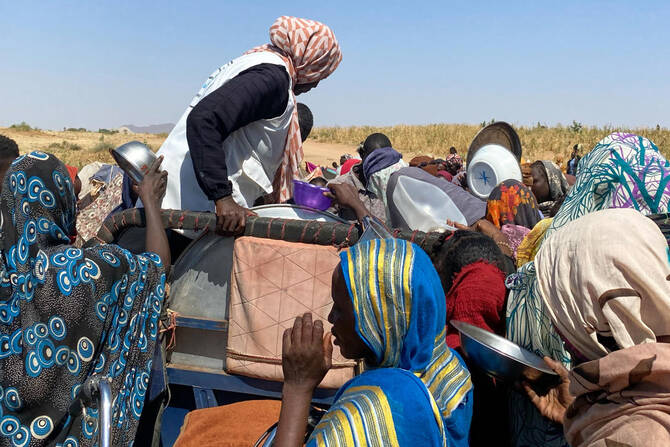

PORT SUDAN, Sudan: Over 36,000 Sudanese civilians have fled towns and villages in the Kordofan region east of Darfur, according to the UN, as the paramilitary warned that its forces were massing along a new front line.
In recent weeks, the central Kordofan region has become a new battleground in the two-year war between Sudan’s army and the paramilitary Rapid Support Forces.
Central Kordofan is strategic because it is located between Sudan’s Darfur provinces and the area around the capital Khartoum.
The widening of the war comes just over a week after the RSF took control of El-Fasher – the army’s last stronghold in Darfur.
The RSF has set up a rival administration there, contesting the pro-army government operating out of the Red Sea city of Port Sudan.
In a statement late Sunday, the UN’s migration agency said an estimated 36,825 people have fled five localities in North Kordofan between October 26 and 31.
Residents on Monday reported a heavy surge in both RSF and army forces across towns and villages in North Kordofan.
The army and the RSF, at war since April 2023, are vying for El-Obeid, the North Kordofan state capital and a key logistics and command hub that links Darfur to Khartoum, and hosts an airport.
The RSF claimed control of Bara, a city north of El-Obeid last week.
“Today, all our forces have converged on the Bara front here,” an RSF member said in a video shared by the RSF on its official Telegram page late on Sunday, “advising civilians to steer clear of military sites.”
‘Afraid of clashes’
Suleiman Babiker, who lives in Um Smeima, west of El-Obeid, said that following the paramilitary capture of El-Fasher, “the number of RSF vehicles increased.”
“We stopped going to our farms, afraid of clashes,” he said.
Another resident, requesting anonymity for fear of reprisal, also said “there has been a big increase in army vehicles and weapons west and south of El-Obeid” over the past two weeks.
Awad Ali, who lives in Al-Hamadi on the road linking West and North Kordofan, said he has seen “RSF vehicles passing every day from the areas of West Kordofan toward El-Obeid since early October.”
Reprisals
Kordofan is a resource-rich region divided administratively into North, South and West Kordofan.
It “is likely the next arena of military focus for the warring parties,” Martha Pobee, assistant UN secretary-general for Africa warned last week.
She cited “large-scale atrocities” perpetrated by the RSF, adding that “these included reprisals against so-called ‘collaborators’, which are often ethnically motivated.”
She also raised the alarm over patterns echoing those in Darfur, where RSF fighters have been accused of mass killings, sexual violence and abductions against non-Arab communities after the fall of El-Fasher.
At least 50 civilians, including five Red Crescent volunteers, were killed in recent violence in North Kordofan, according to the UN.
Both the RSF, descended from Janjaweed militias accused of genocide two decades ago, and the army face war crimes allegations.
The United States under Joe Biden in January this year concluded that “members of the RSF and allied militias have committed genocide in Sudan.”
But international action on Sudan has largely been muted and peace efforts have failed so far.
The conflict has killed tens of thousands of people, displaced nearly 12 million more and created the world’s largest displacement and hunger crises.


