

Pakistan’s competition watchdog urges creation of steel ministry to reform struggling sector

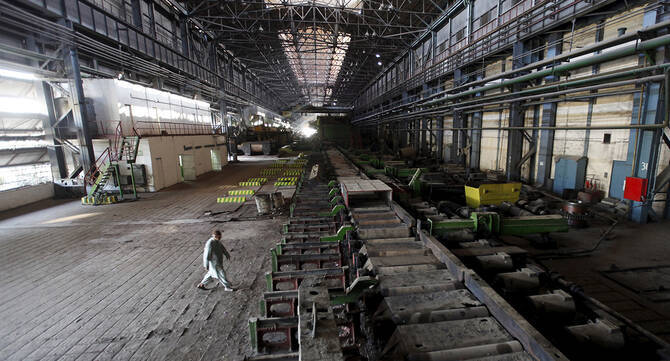
A man walks past machines at the hot strip mill department of the Pakistan Steel Mills (PSM) on the outskirts of Karachi, Pakistan February 8, 2016. (AFP/File)
Short Url
Updated 03 November 2025
Follow

Pakistan’s competition watchdog urges creation of steel ministry to reform struggling sector

  • CCP cites lack of national policy, weak regulation and tax exemptions hurting competitiveness
  • Recommends new ministry, formalization of undocumented units, adoption of green technologies

KARACHI: The Competition Commission of Pakistan (CCP) has called for the establishment of a dedicated steel ministry and the formulation of a national policy to address long-standing distortions in the country’s steel industry, which it says faces weak regulation, unfair tax exemptions and heavy import dependence.

The steel sector remains central to Pakistan’s manufacturing base, contributing significantly to exports and employment but struggling with fragmentation and policy neglect. Large Scale Manufacturing accounts for more than 69 percent of total manufacturing and 8.2 percent of GDP, yet per capita steel consumption is only 47 kilograms, far below regional averages. The industry depends heavily on imported scrap, faces chronic energy shortages and produces nearly 60 percent of its output below standard due to weak enforcement and regulatory oversight.

In light of these challenges, the Competition Commission of Pakistan on Sunday released a report titled “Competition Assessment Study of the Steel Sector in Pakistan,” identifying competition-related bottlenecks and recommending reforms to promote fair market conditions and long-term sustainability.

“The study underscores the absence of a national steel policy and recommends the establishment of a dedicated Steel Ministry, citing successful models from China and India,” the CCP said in the statement.

According to the report, Pakistan’s manufacturing sector contributes 71 percent of total exports and employs around 15 percent of the workforce. In FY24, local steel production reached 8.4 million metric tons (MT), including 4.9 million MT of long steel and 3.5 million MT of flat steel, while imports of steel scrap totaled 2.7 million MT, underscoring the sector’s reliance on imported raw material.

The report said Pakistan Steel Mills (PSM), once a strategic national asset with a 1.1 million-ton annual capacity, has been non-operational since 2015 due to mounting losses and outdated technology, leaving liabilities of Rs400 billion ($1.4 billion). In contrast, countries such as China, India, and Russia advanced through targeted state support, investment in technology, and efficient resource management.

The CCP cited multiple institutional weaknesses, including an Ease of Doing Business Committee that lacks industry expertise and frequent changes in SROs that create policy uncertainty. It noted that tax exemptions in ex-FATA/PATA regions allow 1.5 million tons of untaxed steel to enter settled markets annually, resulting in revenue losses of about Rs40 billion ($144 million).

The commission proposed developing a comprehensive national steel policy, rationalizing taxes and ensuring stable regulatory frameworks. It also recommended expanding the Ease of Doing Business Committee to include industry experts and CCP representation, strengthening the Ministries of Industries and Commerce, and accelerating National Tariff Commission (NTC) processes.

The CCP urged enforcement of quality standards, formalization of undocumented producers, removal of tax distortions, and incentives for Direct Reduced Iron (DRI) technology, green production methods and local iron ore mining.

“The CCP will continue working with all the stakeholders to develop pro-competition reforms to promote competition and long-term sustainability in the steel sector, much in line with the international best practices,” the statement added.


Tens of thousands flee northwest Pakistan over fears of military operation

Updated 28 January 2026
Follow

Tens of thousands flee northwest Pakistan over fears of military operation

  • More than 70,000 people, mostly women and children, have fled remote Tirah region bordering Afghanistan 
  • Government says no military operation underway or planned in Tirah, a town in Khyber Pakhtunkhwa province

BARA, Pakistan: More than 70,000 people, mostly women and children, have fled a remote region in northwestern Pakistan bordering Afghanistan over uncertainty of a military operation against the Pakistani Taliban, residents and officials said Tuesday.

Pakistan’s Defense Minister Khawaja Mohammad Asif has denied the claim by residents and provincial authorities. He said no military operation was underway or planned in Tirah, a town in Khyber Pakhtunkhwa province.

Speaking at a news conference in Islamabad, he said harsh weather, rather than military action, was driving the migration. His comments came weeks after residents started fleeing Tirah over fears of a possible army operation.

The exodus began a month after mosque loudspeakers urged residents to leave Tirah by Jan. 23 to avoid potential fighting. Last August, Pakistan launched a military operation against Pakistani Taliban in the Bajau r district in the northwest, displacing hundreds of thousands of people.

Shafi Jan, a spokesman for the provincial government in Khyber Pakhtunkhwa, posted on X that he held the federal government responsible for the ordeal of the displaced people, saying authorities in Islamabad were retracting their earlier position about the military operation.

Khyber Pakhtunkhwa Chief Minister Suhail Afridi, whose party is led by imprisoned former Prime Minister Imran Khan, has criticized the military and said his government will not allow troops to launch a full-scale operation in Tirah.

The military says it will continue intelligence-based operations against Pakistani Taliban, who are known as Tehrik-e-Taliban Pakistan, or TTP. Though a separate group, it has been emboldened since the Afghan

Taliban returned to power in 2021. Authorities say many TTP leaders and fighters have found sanctuary in Afghanistan and that hundreds of them have crossed into Tirah, often using residents as human shields when militant hideouts are raided.

Caught in the middle are the residents of Tirah, who continued arriving in Bara.

So far, local authorities have registered roughly 10,000 families — about 70,000 people — from Tirah, which has a population of around 150,000, said Talha Rafiq Alam, a local government administrator overseeing the relief effort. He said the registration deadline, originally set for Jan. 23, has been extended to Feb. 5.

He said the displaced would be able to return once the law-and-order situation improves.

Among those arriving in Bara and nearby towns was 35-year-old Zar Badshah, who said he left with his wife and four children after the authorities ordered an evacuation. He said mortar shells had exploded in villages in recent weeks, killing a woman and wounding four children in his village. “Community elders told us to leave. They instructed us to evacuate to safer places,” he said.

At a government school in Bara, hundreds of displaced lined up outside registration centers, waiting to be enrolled to receive government assistance. Many complained the process was slow.

Narendra Singh, 27, said members of the minority Sikh community also fled Tirah after food shortages worsened, exacerbated by heavy snowfall and uncertain security.

“There was a severe shortage of food items in Tirah, and that forced us to leave,” he said.

Tirah gained national attention in September, after an explosion at a compound allegedly used to store bomb-making materials killed at least 24 people. Authorities said most of the dead were militants linked to the TTP, though local leaders disputed that account, saying civilians, including women and children, were among the dead.