

Pakistan eyes 2026 launch for first Chinese submarine in $5 billion arms deal

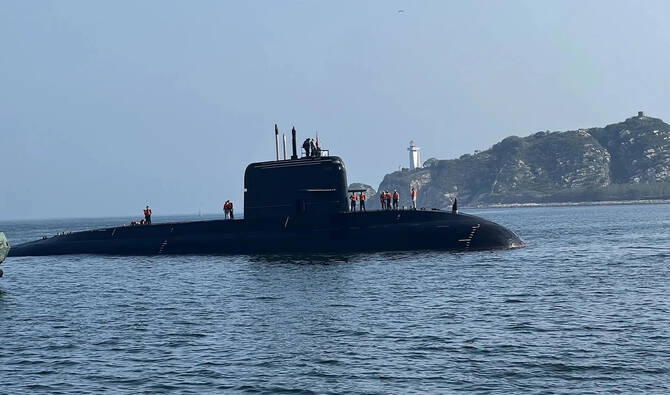
The image shows Hangor-class submarine at an unknown location. (The STRATCOM Bureau)
Short Url
Updated 03 November 2025
Follow

Pakistan eyes 2026 launch for first Chinese submarine in $5 billion arms deal

  • Under terms of $5 billion arms deal, first four attack submarines will be built in China while others will be assembled in Pakistan
  • Pakistan has already launched three of the submarines into China’s Yangtze River from a shipyard in the central province of Hube

BEIJING: The Pakistan Navy expects its first Chinese-designed submarine to enter active service next year, the country’s top admiral told Chinese state media, bolstering Beijing’s bid to counter regional rival India and project power toward the Middle East.

A deal under which Islamabad will take delivery of eight Hangor-class submarines by 2028 is “progressing smoothly,” Admiral Naveed Ashraf told the Global Times in an interview published on Sunday, adding the submarines would boost Pakistan’s ability to patrol the North Arabian Sea and Indian Ocean.

The update on the Chinese submarine deal follows Pakistan’s air force using Chinese-made J-10 fighter jets in May to shoot down an Indian Air Force Rafale aircraft, made by France.

The altercation between the nuclear-armed neighbors surprised many in the military community and raised questions over the superiority of Western hardware over Chinese alternatives.

Under the terms of the submarine agreement — reportedly worth up to $5 billion — the first four diesel-electric attack submarines will be built in China, with the remaining vessels assembled in Pakistan to improve the South Asian nation’s technical capabilities.

Pakistan has already launched three of the submarines into China’s Yangtze River from a shipyard in the central province of Hubei.

“Chinese-origin platforms and equipment have been reliable, technologically advanced and well-suited to Pakistan Navy’s operational requirements,” Ashraf told the tabloid, which is published by the ruling Communist Party’s People’s Daily.

“As modern warfare evolves, emerging technologies such as unmanned systems, AI and advanced electronic warfare systems are becoming increasingly important. The Pakistan Navy is focusing on these technologies and exploring collaboration with China,” Ashraf was also quoted as saying.

Islamabad has long been Beijing’s top arms customer, and over the 2020-2024 period bought over 60 percent of China’s weapons exports, data from the Stockholm International Peace Research Institute shows.

BILLION-DOLLAR BUILD UP

Along with billions in arms sales, Beijing has heavily invested in building out its connections to the Arabian Sea through a 3,000 km (1864.11 miles) economic corridor stretching from China’s Xinjiang to Pakistan’s deep-water port of Gwadar.

The China-Pakistan Economic Corridor, part of President Xi Jinping’s flagship ‘Belt and Road’ infrastructure initiative, aims to secure a route for the world’s largest energy importer to bring in supplies from the Middle East, bypassing the Straits of Malacca — a strategic chokepoint between Malaysia and Indonesia that could be blocked in wartime.

The initiative also extends China’s sphere of influence toward Afghanistan and Iran and onto Central Asia, and effectively encircles India, given Beijing’s ties to the junta in Myanmar and good relations with Bangladesh.

India currently operates three indigenously developed nuclear-powered submarines, along with three classes of diesel-electric attack submarines acquired or developed over decades with France, Germany, and Russia.

“This cooperation (with China) goes beyond hardware; it reflects a shared strategic outlook, mutual trust, and a long-standing partnership,” Ashraf said.

“In the coming decade, we expect this relationship to grow, encompassing not only shipbuilding and training, but also enhanced interoperability, research, technology sharing and industrial collaboration.” 


Pakistan sends vessels to Saudi, UAE ports to secure crude supplies amid regional crisis

Updated 5 sec ago
Follow

Pakistan sends vessels to Saudi, UAE ports to secure crude supplies amid regional crisis

  • The development comes as countries scramble to secure energy supplies amid US-Israeli strikes on Iran and Tehran’s counterattacks
  • If Islamabad arranges, Aramco has assured a large crude carrier can be loaded at Yanbu and stationed near Pakistan, minister says

ISLAMABAD: Pakistan has sent vessels to ports in Saudi Arabia and the United Arab Emirates to secure crude oil supplies, the Pakistani petroleum minister said late Friday, as tensions in the Middle East continue to threaten global energy flows.

Global oil markets have been rattled since the United States and Israeli began pounding Iran last week, prompting retaliatory strikes from Tehran across the region. The conflict has raised fears of disruptions in energy supplies, particularly through the Strait of Hormuz, and pushed petroleum prices.

Pakistani Petroleum Minister Ali Pervaiz Malik and others said Islamabad was monitoring international energy markets and domestic supply conditions as they announced a hike of Rs55 ($0.20) per liter in petrol and diesel prices, promising to bring down the prices as soon as the conflict is resolved.

Describing the situation as “extraordinary,” Malik said they did not know how long the Middle East crisis would last and it was important to stretch Pakistan’s available petroleum reserves as much as they could to ensure a steady supply to consumers during the crisis.

“At the regional and global level, you can clearly see that countries are scrambling to secure energy supplies. Pakistan is also part of this effort because a significant portion of our energy supplies comes through the Strait of Hormuz,” he said, adding that Prime Minister Shehbaz Sharif has engaged the Saudi government to secure alternative sources.

“With the help of the Foreign Office, two Pakistan National Shipping Corporation (PNSC) vessels are currently on their way, one toward Yanbu port and the other toward Fujairah port, to bring crude oil from outside the Hormuz region in order to meet Pakistan’s energy needs.”

In addition, he said, Aramco had assured that if Pakistan arranged, a Very Large Crude Carrier (VLCC) can be loaded at Yanbu and stationed near the Pakistani waters.

“From there, PNSC (Pakistan National Shipping Corporation) feeder vessels will ensure a continuous supply of crude oil to our refineries, so that even during this difficult phase Pakistan’s energy requirements continue to be met,” Malik shared.

The statement came as long queues of vehicles were seen outside petrol stations nationwide as Islamabad moved to raise petroleum prices to keep the supplies in check.

Pakistan, which relies heavily on imported fuel to meet its energy needs, is particularly vulnerable to global oil price shocks that can quickly feed into inflation and pressure the country’s external accounts.

Officials at Friday’s presser said Pakistan, which reviews petroleum prices fortnightly, will be considering them more frequently, potentially on a weekly basis, and any reduction in global oil prices would be passed on to consumers.

Finance Minister Aurangzeb said a high-level government committee formed by PM Sharif had been meeting daily to review developments in global petroleum markets and their potential impact on Pakistan’s economy.

“Pakistan currently maintains adequate energy stocks and macroeconomic stability,” Aurangzeb said, adding that the government’s response was based on preparedness rather than panic.