MAAR SHAMARIN, Syria: In the southern Idlib countryside, once a frontline in Syrian civil war, residents are trickling back to their villages after years in exile.
Repairing and reopening damaged and looted schools is key to the return of the displaced, but nearly a year after former President Bashar Assad was ousted in a rebel offensive, hundreds of schools are still destroyed.
Millions of children in Syria remain out of school, while others are attending class in gutted buildings without basic supplies.
A schoolhouse with no windows or chairs
Safiya Al-Jurok and her family fled the town of Maar Sharamin five years ago when Assad’s army wrested control of the area from opposition forces.
After Assad’s fall last December, the family returned home and are now living in a tent — the same one they stayed in while displaced — next to the remains of their destroyed house.
The local elementary school reopened last month, and Al-Jurok is sending her three children, in 3rd, 4th and 5th grade, to classes there.
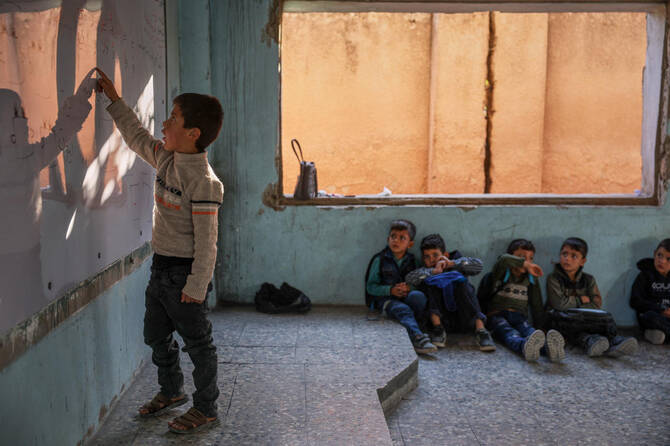
The L-shaped school building is disheveled, its walls riddled with bullet holes and its paint peeling in long strips of gray and blue.
Inside classrooms, sunlight spills through gaping window frames stripped of glass. Students sit cross-legged on thin blankets spread over the cold floor, their backs pressed to the wall for support. A young girl balances her notebook on her knees, tracing the Arabic alphabet.
“If it rains, it’ll rain on my children” through the broken windows, Al-Jurok said, “The school doesn’t even have running water.”
The school’s principal, Abdullah Hallak, said the building has lost nearly everything — desks, windows, doors and even even the steel reinforcement stripped from the building — looted, like in many other towns across southern Idlib, after residents fled.
“Our kids are coming here where there are no seats, no boards and no windows and as you know, winter is coming,” Hallak told The Associated Press. “Some parents call us to complain that their kids are getting sick sitting on the floor, so they have them skip school.”
A massive effort needed to rebuild schools
According to Deputy Education Minister Youssef Annan, 40 percent of schools across Syria remain destroyed, most of them in rural Idlib and Hama, which were the site of fierce battles during the country’s nearly 14-year civil war.
In Idlib alone, 350 schools are out of service, and only about 10 percent have been rehabilitated so far, he said.
“Many schools were stripped bare, with iron stolen from roofs and structures, requiring years and significant funds to rebuild,” he said.
The new school year officially began in mid-September, alongside an emergency education plan to accommodate the growing number of returnee students, Annan said, adding that the ministry intends to launch a remote learning program to expand access to education, though it “requires more time” and hasn’t yet been implemented.
Across Syria, 4 million students are currently enrolled in school, Annan said, while roughly 2.5 to 3 million children remain out of school, according to Meritxell Relano Arana, the UNICEF representative in Syria.
“The access to education by many children in Syria is difficult. Many of the schools have been destroyed, many of the teachers did not go back to educate and many of the children don’t even have money to buy the school materials,” she said.
That is the case for Al-Jurok’s family.
“My eldest daughter is very smart and loves to study, but we can’t buy books,” she added, noting that the children help pick olives after school as the family makes a living from olive oil production.
Students falling behind
Hallak said Maar Shamarin Elementary now hosts around 450 students from first to fourth grade, but demand continues to grow.
“We have more students applying, but there is no more space,” he said.
Teacher Bayan Al-Ibrahim said that many of the children who are attending have fallen behind academically after years of displacement.
“Some families had been displaced to areas where education wasn’t supported or their circumstances didn’t allow them to follow up on their kids’ education,” she said.
The lack of seating and school materials makes it harder for teachers to keep order, she added, while parents struggle to stay involved.
“There are no books, so parents aren’t aware what their kids are studying,” she added.
Relaño said that UNICEF is working on rebuilding schools, providing temporary classrooms and training teachers to ensure they have the tools needed for quality education.
The task is particularly urgent with hundreds of thousands of refugees returning from abroad, she said. More than one million refugees have come back to Syria, according to the UN refugee agency.
Beyond infrastructure, Relaño said schools play a key role in the nation’s psychological recovery.
“Many children were traumatized by years of conflict, so they need to go back to safe schools where psychosocial support is available,” she said, adding that catch-up classes are being offered to help students who missed years of schooling reintegrate into the education system.


![]()

Syrian students return to schools stripped bare by conflict
Short Url
https://arab.news/g733d
Syrian students return to schools stripped bare by conflict
- Millions of children in Syria remain out of school, while others are attending class in gutted buildings without basic supplies
- The new school year officially began in mid-September, alongside an emergency education plan to accommodate the growing number of returnee students


Latest updates




© 2026 SAUDI RESEARCH & PUBLISHING COMPANY, All Rights Reserved And subject to Terms of Use Agreement.