

Lahore ranks world’s most polluted city as thick smog blankets Pakistani metropolis

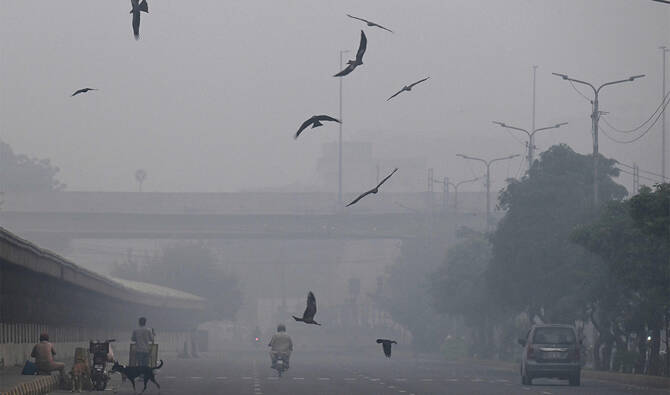
Birds fly past on a street amid dense smog in Lahore on November 1, 2025. (AFP)
Short Url
Updated 03 November 2025
Follow

Lahore ranks world’s most polluted city as thick smog blankets Pakistani metropolis

  • The Punjab government has taken various steps, including deploying anti-smog guns that spray water to curb air pollution
  • Locals urge a stronger government response such as providing free public transport to reduce number of vehicles on roads

Lahore was ranked the world’s most polluted city on Sunday, according to Swiss monitoring group IQAir, as thick smog engulfed Pakistan’s second largest city.

IQAir’s reading for Lahore was 237 at noon local time (0700 GMT) and labelled as ‘very unhealthy’, far above the ‘good’ air threshold of 0-50.

Despite the conditions, residents still gathered for Sunday morning cricket.

“We come to the ground for fresh air,” said local resident Mohammad Zubair. “If we have to wear masks here too, where will fresh air come from?“

The Punjab government has taken various steps including deploying anti-smog guns spraying water to curb pollution but it offers temporary relief only.

Plain areas of Pakistan’s province of Punjab, of which Lahore is capital, are prone to thick smog every winter as cold, heavy air traps construction dust, vehicle emissions and smoke from agricultural fires.

Locals urged a stronger government response such as providing free public transport, and accused authorities of unequal implementation of anti-smog measures across the city.

“Government is spraying [mist through anti-smog guns] but that is happening in posh areas. Here in these areas, in inner Lahore, there are no anti-smog guns, nothing has been done,” said Kashif Butt.

“The government should make transport free [of cost], so that there are less bikes [on roads].”

— With input from Reuters


Pakistan plans to cut Islamabad entry points to 25 in major security overhaul

Updated 5 sec ago
Follow

Pakistan plans to cut Islamabad entry points to 25 in major security overhaul

  • The development follows two suicide blasts in the capital as well as deadly protests over Iranian Supreme Leader Ali Khamenei’s killing
  • Authorities earlier enforced an electronic tagging system in Islamabad to regulate traffic, improve record-keeping and enhance surveillance

ISLAMABAD: Authorities have decided to reduce the number of entry points in Islamabad to 25 as part of a major security overhaul of the Pakistani capital, the interior ministry said on Friday.

The development follows a suicide blast that last month killed at least 32 people and injured more than 100 others at a mosque in Islamabad. In November last year, a suicide bomber struck outside a court in the capital, killing 12 people.

The Islamabad Capital Territory (ICT) introduced an electronic tagging system late last year as part of a broader effort to regulate traffic, improve record-keeping and enhance surveillance in a city that hosts the country’s main government institutions, foreign missions and diplomatic enclaves.

On Friday, Interior Minister Mohsin Naqvi presided over a meeting to review law and order situation in the capital and directed officials formulate an effective strategy in this regard, according to his ministry.

“The number of entry points in Islamabad will be reduced from 109 to 25 gradually,” the ministry said, adding that officials were asked to make the Red Zone, which houses key government institutions and foreign missions, practically active.

The directives also come days after deadly protests against the killing of Iranian Supreme Leader Ali Khamenei in Islamabad, when several protesters were injured in clashes with police after they had barged into the Red Zone.

Naqvi ordered foolproof security in the city through strict monitoring at checkpoints and entry points.

“Law and order will have to be ensured in the federal capital at all costs,” he added.

Late last year, the Islamabad Capital Territory (ICT) administration also introduced an electronic tagging system as part of a effort to regulate traffic, improve record-keeping and enhance surveillance in Islamabad.

Under the system, vehicles are fitted with electronic tags that can be read automatically by scanners installed at checkpoints across the capital, allowing authorities to identify unregistered vehicles without manual inspections. Vehicles already equipped with a motorway tag, or m-tag, are exempt from the requirement.