

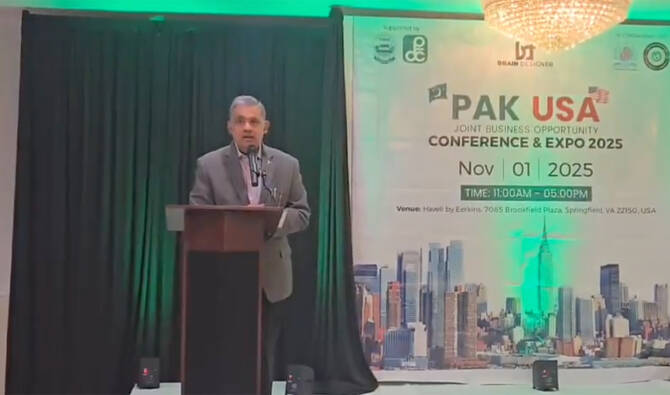
Pakistan eyes IT, trade, tourism opportunities during Pak-USA Joint Business Conference 

Pakistan’s Ambassador to the United States Rizwan Saeed Sheikh is addressing Pak-USA Joint Business Conference in Springfield on November 1, 2025. (Pakistan Embassy US)
Short Url
Updated 02 November 2025
Follow

Pakistan eyes IT, trade, tourism opportunities during Pak-USA Joint Business Conference 

  • Day-long conference in Virginia brings together Pakistani traders, investors and business leaders in the US
  • Conference pivotal “seed-sowing exercise” to cultivate bilateral ties with US, says Pakistan’s envoy to the US

ISLAMABAD: Pakistani business leaders, traders and investors explored opportunities in trade, tourism, IT and other sectors this week at the Pak-USA Joint Business Conference and Expo 2025 organized in Virginia, as Islamabad eyes greater economic collaboration with Washington. 

The event was organized by Brain Designer Pakistan, an organization that promotes Pakistan’s bilateral trade with other countries, and the Rawalpindi Chamber of Small Traders & Small Industries, in collaboration with US Pakistan International Chamber of Commerce (USPICC).

The conference brought together business leaders, traders, and investors from Pakistan to explore trade, investment, and commercial opportunities in the US, state broadcaster Radio Pakistan reported on Saturday. 

“The day-long event brought together a good number of Pakistani companies from diverse sectors, including tourism, real estate, textiles, furniture, leather goods, pharmaceuticals & IT, to explore business opportunities and strengthen economic ties between Pakistan and the United States,” Radio Pakistan reported. 

The conference was inaugurated by Pakistan’s Ambassador to the United States Rizwan Saeed Sheikh, who spoke of the potential the US market held for Pakistani businesspersons and investors. 

“He praised the efforts of the Pakistani community and local associations, noting the event as a pivotal ‘seed-sowing exercise’ to cultivate enduring bilateral relations,” the state media said. 

Sheikh reaffirmed the Pakistan embassy’s commitment to supporting participants and refining their business models tailored to the US market. 

Pakistan has sought stronger trade and investment ties with the US in recent months as it cozies up to President Donald Trump. 

Islamabad also seeks closer economic, trade and investment ties with Washington as it seeks to escape a prolonged economic crisis that has triggered a balance of payments crisis and drained Pakistan’s financial resources.


Pakistan’s president condemns Kabul blast, accuses Taliban of allowing militant ‘safe havens’

Updated 12 sec ago
Follow

Pakistan’s president condemns Kabul blast, accuses Taliban of allowing militant ‘safe havens’

  • President Zardari links attack on Chinese-run restaurant to Kabul’s failure to meet Doha commitments
  • He highlights the ‘failure’ of Afghanistan’s Taliban to establish a ‘broad-based and inclusive government’

KARACHI: President Asif Ali Zardari on Monday condemned a blast that ripped through a Chinese-run restaurant in Kabul, killing at least seven people, while criticizing Afghanistan’s Taliban administration for allowing “safe havens” to militant groups to export extremist violence in the region.

The explosion struck the restaurant in Kabul’s Shahr-e-Naw commercial district, an area considered one of the safest in the Afghan capital, killing one Chinese national and six Afghans and wounding several others, including a child, according to Afghan authorities.

The Afghan affiliate of Daesh militant group claimed responsibility, saying the attack was carried out by a suicide bomber.

“The Taliban regime in Afghanistan has failed to honor the commitments made under the Doha Peace Agreement, particularly the obligation to prevent the use of Afghan soil for the export of terrorism,” Zardari said in a statement circulated by his office.

“Pakistan has repeatedly stressed that no terrorist groups should be allowed safe havens in Afghanistan and that regional peace and security must be upheld,” he continued, adding that “it is not just Pakistan but other neighbors of Afghanistan, including Tajikistan, [that] have recently been affected by the terrorists operating out of Afghan soil.”

Pakistan has frequently accused Afghanistan of sheltering proscribed armed factions such as the Tehreek-e-Taliban Pakistan and the Balochistan Liberation Army, and of facilitating attacks on Pakistani civilians and security forces, allegations the Taliban deny.

The two countries witnessed major border skirmishes in October last year, followed by talks mediated by Qatar and Türkiye.

Pakistan subsequently closed its border and suspended bilateral and transit trade with Afghanistan, a move that led to a 17% drop in “cross-border attacks,” according to the Center for Research and Security Studies.

Late November also saw a series of deadly incidents along the Tajikistan–Afghanistan border, with militants on the Afghan side firing across the frontier into Tajikistan, killing five Chinese workers employed on Chinese–Tajik mining and construction projects.

In December, Tajik border forces clashed with armed individuals who crossed from Afghanistan, killing several assailants but losing a border guard in the fighting.

Zardari paid tribute to Chinese nationals working in Afghanistan “despite rising insecurity” and expressed solidarity with the victims and their families, while reiterating calls for political reform in Kabul.

“The failure to establish a broad based and inclusive government by the Taliban is contrary to the Doha Agreement,” he said in the statement.