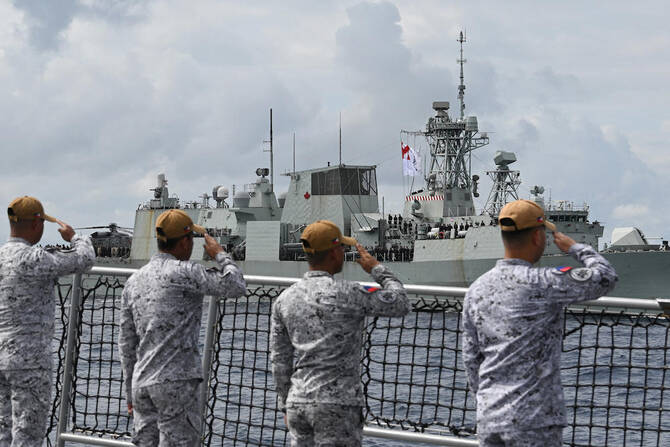
MANILA: Canada and the Philippines, both staunch critics of China’s increasingly coercive actions in the disputed South China Sea, were to sign a key defense agreement on Sunday that would allow their forces to hold joint battle-readiness drills and expand a web of security alliances to deter aggression, Philippine officials said.
Canada and other Western nations have been bolstering their military presence in the Indo-Pacific to help promote the rule of law and expand trade and investment in the region. The moves dovetail with President Ferdinand Marcos Jr.’s efforts to build defense ties with other countries to help his country’s underfunded military face a militarily superior China in the disputed waters.
There was no immediate comment from China, which has accused the Philippines of being a “troublemaker” and a “saboteur of regional stability” for staging joint patrols and combat drills with the United States and other countries in the South China Sea. Beijing claims the waterway, a major trade route, virtually in its entirety despite a 2016 arbitration ruling that invalidated those claims based on the 1982 UN Convention on the Law of the Sea.
China has dismissed the ruling and continues to defy it. It has employed powerful water cannons and dangerous blocking maneuvers against Philippine coast guard and fisheries vessels in the disputed waters. resulting in minor collisions and injuries to Filipino personnel. Vietnam, Malaysia, Brunei and Taiwan have also been involved in the long-simmering territorial disputes.
Philippine Defense Secretary Gilberto Teodoro Jr. would sign the Status of Visiting Forces Agreement with his Canadian counterpart, David McGuinty, after a meeting in Manila on Sunday, the Department of National Defense in Manila said. The agreement takes effect after ratification.
Such agreements provide a legal framework for temporary visits by foreign troops with their weapons and large-scale combat exercises in either territory of the signatory countries.
The Philippines signed the first such defense pact with its longtime treaty ally, the United States, in 1998, followed by a similar accord with Australia nine years later. The agreement with Canada would be the third signed under Marcos after similar ones with Japan and New Zealand.
Talks are ongoing with France and Singapore for similar agreements. Efforts are also underway to launch similar negotiations with the United Kingdom and possibly with Germany and India, Teodoro and other officials said.
Teodoro renewed his criticisms of China’s actions in the South China Sea in an annual meeting of defense ministers of the Association of Southeast Asian Nations with Asian and Western counterparts on Saturday in Malaysia. He condemned a recent announcement by China that it would establish a “nature reserve” in the Scarborough Shoal, a rich fishing area claimed by Manila and Beijing.
“This, to us, is a veiled attempt to wield military might and the threat for use of force, undermining the rights of smaller countries and their citizens who rely on the bounty of these waters,” Teodoro said.
Canada criticized China’s plan when it was announced in September, saying it opposes “attempts to use environmental protection as a way to take control” of Scarborough. When Chinese ships tried to forcibly drive away Philippine vessels in the shoal, also in September, Canada expressed concern, criticizing “China’s dangerous use of water cannons,” which injured a civilian Filipino fisheries officer during the Scarborough face-off.
Canadian Ambassador to Manila David Hartman has said his country has “been vocal in confronting the provocative and unlawful actions of the People’s Republic of China in the South China Sea and the West Philippine Sea” and “will continue to do so.”
Last year, Canada signed an agreement on defense cooperation with the Philippines. Another agreement signed in Ottawa in 2023 gave the Philippines access to data from Canada’s “Dark Vessel Detection System,” which harnesses satellite technology to track illegal vessels even if they switch off their location-transmitting devices.
The Philippine coast guard has used the high-tech Canadian technology to track Chinese coast guard ships and fishing vessels in the South China Sea.


![]()

Canada and Philippines to sign defense pact to boost combat drills and deter China’s aggression
Short Url
https://arab.news/2e4qk
Canada and Philippines to sign defense pact to boost combat drills and deter China’s aggression
- Canada and other Western nations have been bolstering their military presence in the Indo-Pacific
- The moves dovetail with President Ferdinand Marcos Jr.’s efforts to build defense ties with other countries


Latest updates




© 2026 SAUDI RESEARCH & PUBLISHING COMPANY, All Rights Reserved And subject to Terms of Use Agreement.