

Tens of thousands protest in Serbia on anniversary of deadly roof collapse

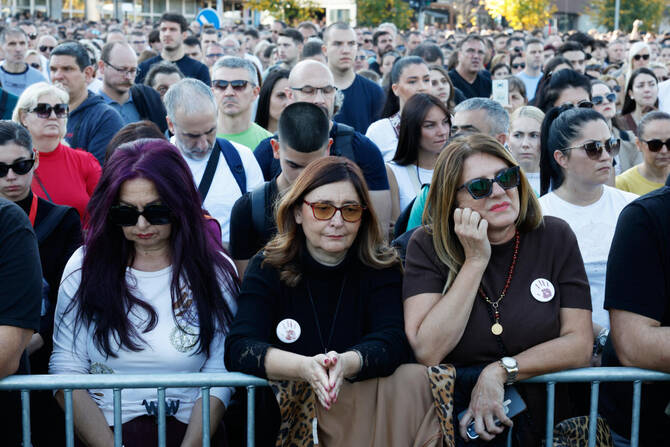
People observe 16 minutes of silence in memory of the victims, outside the train station, on the first anniversary of the disaster that killed 16 people, in Novi Sad, Nov. 1, 2025. (AP)
Short Url
Updated 01 November 2025
Follow

Tens of thousands protest in Serbia on anniversary of deadly roof collapse

  • Protesters streamed into the northern city of Novi Sad, where the disaster occurred, in cars, buses or on foot, some having walked long distances
  • Protesters held up large red hearts bearing the names of the collapse victims

NOVI SAD, Serbia: Tens of thousands of protesters poured into Serbia’s second city on Saturday a year after a railway station roof collapse that killed 16 people, unleashing discontent over alleged corruption and a lack of accountability many blame for the disaster.
Months of protests across Serbia, stoked by anger over the failure so far to prosecute those responsible for the roof collapse have rattled President Aleksandar Vučić’s long grip on power and raised calls for early elections.
Protesters streamed into the northern city of Novi Sad, where the disaster occurred, in cars, buses or on foot, some having walked long distances, witnesses said. One of Novi Sad’s main boulevards was packed with people.
The protesters — many of them young people — observed 16 minutes of silence — one for every victim — from 11:52 a.m. (1052 GMT), when the roof caved in following renovation work on November 1, 2024.
Protesters held up large red hearts bearing the names of the collapse victims, clutched white flowers and laid wreaths in front of the railway station.
The tearful father of one of the victims, dressed in black, stood for hours staring at his daughter’s name affixed among others to the station’s perimeter fence.
There were no reports of violence, which had marred some protests during the summer when riot police used stun grenades and tear gas to break up rallies.

’WE SAY THAT THIS IS ENOUGH’
“This is a major tragedy for the Serbian people. We cannot bring those people back but we can feel the pain with their families and say that this is enough,” said Sladjana Burmaz, a 51-year-old economist from the central town of Valjevo.
“These people were not killed by accident, their deaths were the result of a poor system, poor politics ... Justice would be served if those responsible were held accountable,” she said.
Vučić, in an Instagram post, published a photo of himself in a church holding a candle at a commemoration ceremony in the capital Belgrade for the victims of the disaster.
“Let the names of those killed be a reminder that human life is above any divisions (in society),” Vučić wrote. The government, he added, had designated Saturday as a day of national mourning.
The protest movement, led by students, academics and opposition leaders, accuse Vucic and his populist nationalist party of presiding over corruption, shoddy public services, nepotism and curbs on media freedoms. They deny the accusations.

INDEPENDENT REPORT TO EUROPEAN PARLIAMENT
An independent commission of professors, judges, and technical experts that investigated the disaster reported to the European Parliament last week that it had found high-level state graft that led to poor construction standards and the hiring of unqualified subcontractors.
Government officials have denied such accusations. Recently, Vučić and Parliament Speaker Ana Brnabic said the roof collapse could have been an act of terrorism.
Prosecutors have indicted several senior state officials on charges of endangering public safety, but a court has yet to confirm the indictment, preventing a trial from going ahead.


New Trump strategy vows shift from global role to regional

Updated 8 sec ago
Follow

New Trump strategy vows shift from global role to regional

WASHINGTON: President Donald Trump’s administration said in a long-awaited new strategy document Friday that the United States will shift from its historic global role toward increasing dominance in Latin America and vigorously fighting migration.
The national security paper, meant to flesh out Trump’s norms-shattering “America First” worldview, signals a sharp reorientation from longstanding US calls to refocus on Asia, although it still identifies China as a top competitor.
The strategy also brutally criticized allies in Europe and said that the United States will champion opponents to European Union-led values, including on immigration.
Breaking with decades of attempts to be the sole superpower, the strategy said that the “United States rejects the ill-fated concept of global domination for itself.”
It said that the United States would also prevent other powers from dominating but added: “This does not mean wasting blood and treasure to curtail the influence of all the world’s great and middle powers.”
The strategy called for a “readjustment of our global military presence to address urgent threats in our Hemisphere, and away from theaters whose relative import to American national security has declined in recent decades or years.”
The strategy speaks in bold terms of pressing US dominance in Latin America, where the Trump administration has been striking alleged drug traffickers at sea, intervening to bring down leftist leaders including in Venezuela, and loudly seeking to take charge of key resources such as the Panama Canal.
The strategy cast Trump as modernizing the two-century-old Monroe Doctrine, in which the then young United States declared Latin America off-limits to rival powers, then from Europe.
“We will assert and enforce a ‘Trump Corollary’ to the Monroe Doctrine,” it said.

- Championing Europe ‘resistance’ -

Trump has sharply reversed many longstanding US principles since returning to office in January.
He rose to political prominence demanding sweeping curbs on immigration to the United States, fanning fears that the white majority was losing its status, and since taking office has ordered drastic and high-profile raids to deport undocumented people.
“The era of mass migration must end. Border security is the primary element of national security,” the strategy said.
The strategy made clear that the United States under Trump would aggressively pursue similar objectives in Europe, in line with far-right parties that have made strong gains in much of the continent.
In extraordinary language in speaking of close allies, the strategy said: “Cultivating resistance to Europe’s current trajectory within European nations.”
Germany quickly hit back, saying that it does not need “outside advice.”
The strategy pointed to Europe’s lower share of the global economy — which is the result largely of the rise of China and other emerging powers — and said: “This economic decline is eclipsed by the real and more stark prospect of civilizational erasure.
“Should present trends continue, the continent will be unrecognizable in 20 years or less.”
As Trump seeks an end to the Ukraine war that would likely favor Russia gaining territory, the strategy accused Europeans of weakness and said the United States should focus on “ending the perception, and preventing the reality, of NATO as a perpetually expanding alliance.”

- Less on Middle East and Africa -

The strategy paid comparatively little attention to the Middle East, which has long consumed Washington.
Pointing to US efforts to increase energy supply at home and not in the oil-rich Gulf, the strategy said: “America’s historic reason for focusing on the Middle East will recede.”
The paper said it was a US priority for Israel to be secure, but stopped short of the fulsome language on Israel used even in the first Trump administration.
On China, the strategy repeated calls for a “free and open” Asia-Pacific region but focused more on the nation as an economic competitor.
After much speculation on whether Trump would budge on Taiwan, the self-ruling democracy claimed by Beijing, the strategy made clear that the United States supports the decades-old status quo, but called on allies Japan and South Korea to contribute more to ensure Taiwan’s defense from China.
The strategy predictably puts little focus on Africa, saying the United States should transition away from “liberal ideology” and an “aid-focused relationship” and emphasize goals such as securing critical minerals.