

Republican leaders reject Trump’s demands to scrap the Senate filibuster to end the shutdown

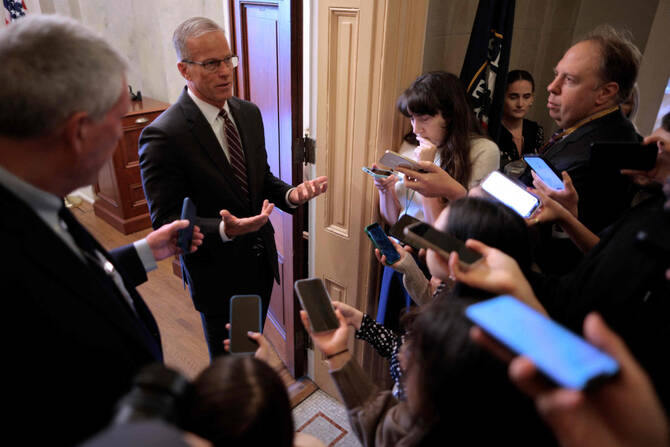
Senate Majority Leader John Thune (R-SD) talks to reporters while standing in the doorway of his office at the US Capitol on the 29th day of the federal government shutdown on October 29, 2025 in Washington, DC. (Getty Images via AFP)
Short Url
Updated 01 November 2025
Follow

Republican leaders reject Trump’s demands to scrap the Senate filibuster to end the shutdown

  • Senate Majority Leader John Thune argued that the filibuster is vital to the Senate and has allowed them to halt Democratic policies when they are in the minority
  • House Speaker Mike Johnson also defended the filibuster Friday, while conceding “it’s not my call,” from his chamber across the Capitol

WASHINGTON: Republican leaders in the US Senate on Friday swiftly rejected President Donald Trump's call to scrap the filibuster rule and reopen the government.

Back from a week abroad, Trump threw himself into the shutdown debate, pushing his Republican Party to get rid of the Senate rule that requires 60 votes to overcome objections and gives the minority Democrats a check on GOP power.

In the chamber that’s currently split, 53-47, Democrats have had enough votes to keep the government closed while they demand an extension of health care subsidies. Neither party has seriously wanted to nuke the rule.
“THE CHOICE IS CLEAR — INITIATE THE ‘NUCLEAR OPTION,’ GET RID OF THE FILIBUSTER,” Trump said in a late night social media post Thursday.
Trump’s sudden decision to assert himself into the shutdown now in its 31st day — with his highly charged demand to end the filibuster — is certain to set the Senate on edge. It could spur senators toward their own compromise or send the chamber spiraling toward a new sense of crisis. Or, it might be ignored.
Republican leaders responded quickly, and unequivocally, setting themselves at odds with Trump, a president few have dared to publicly counter.
Senate Majority Leader John Thune has repeatedly said he is not considering changing the rules to end the shutdown, arguing that it is vital to the institution of the Senate and has allowed them to halt Democratic policies when they are in the minority.
The leader’s “position on the importance of the legislative filibuster is unchanged,” Thune spokesman Ryan Wrasse said Friday.
A spokeswoman for Wyoming Sen. John Barrasso, the No. 2 Republican, said his position opposing a filibuster change also remains unchanged. And former GOP leader Mitch McConnell, who firmly opposed Trump’s filibuster pleas in his first term, remains in the Senate.
House Speaker Mike Johnson also defended the filibuster Friday, while conceding “it’s not my call,” from his chamber across the Capitol.
“The safeguard in the Senate has always been the filibuster,” Johnson said, adding that Trump’s comments are “the president’s anger at the situation.”


Broad GOP support for filibuster
Even if Thune wanted to change the filibuster, he would not currently have the votes to do so in the divided Senate.
“The filibuster forces us to find common ground in the Senate,” Republican Sen. John Curtis of Utah posted on X Friday morning, responding to Trump’s comments and echoing the sentiments of many of his Senate Republican colleagues. “Power changes hands, but principles shouldn’t. I’m a firm no on eliminating it.”
Debate has swirled around the legislative filibuster for years. Many Democrats pushed to eliminate it when they had full power in Washington, as the Republicans do now, four years ago. But ultimately, enough Democratic senators opposed the move, predicting such an action would come back to haunt them.
Little progress on shutdown
Trump’s demand comes as he has declined to engage with Democratic leaders on ways to end the shutdown, on track to become the longest in history.
He said in his post that he gave a “great deal” of thought to his choice on his flight home from Asia and that one question that kept coming up during his trip was why “powerful Republicans allow” the Democrats to shut down parts of the government.
But later Friday, he did not mention the filibuster again as he spoke to reporters departing Washington and arriving in Florida for a weekend at his Mar-a-Lago home.
While quiet talks are underway, particularly among bipartisan senators, Trump has not been seriously involved. Democrats refuse to vote to reopen the government until Republicans negotiate an extension to the health care subsidies. The Republicans say they won’t negotiate until the government is reopened.
House Democratic Leader Hakeem Jeffries said on CNN that Trump needs to start negotiating with Democrats, arguing the president has spent more time with global leaders than dealing with the shutdown back home.
From coast to coast, fallout from the dysfunction of the shuttered federal government is hitting home. SNAP food aid is scheduled to shut off. Flights are being delayed. Workers are going without paychecks.
And Americans are getting a first glimpse of the skyrocketing health care insurance costs that are at the center of the stalemate.
“People are stressing,” said Sen. Lisa Murkowski of Alaska, as food options in her state grow scarce.
“We are well past time to have this behind us.”
Money for military, but not food aid
The White House has moved money around to ensure the military is paid, but refuses to tap funds for food aid. In fact, Trump’s “big, beautiful bill” signed into law this summer, delivered the most substantial cut ever to the Supplemental Nutrition Assistance Program, known as SNAP, projected to result in some 2.4 million people off the program.
Agriculture Secretary Brooke Rollins said Friday the agency cannot release contingency funds to keep SNAP running, but two judges ruled nearly simultaneously Friday that the administration must continue to fund the food aid program. How quickly that might happen remains to be seen, as further consultation with the courts is expected on Monday.
Trump, in a social media post, said administration lawyers will be asking the courts “to clarify how we can legally fund SNAP as soon as possible.”
“If we are given the appropriate legal direction by the Court, it will BE MY HONOR to provide the funding,” Trump said.
“We are holding food over the heads of poor people so that we can take away their health care,” said Rev. Ryan Stoess during a prayer with religious leaders earlier this week at the US Capitol.
“God help us,” he said, “when the cruelty is the point.”
Deadlines shift to next week
The House remains closed under Johnson with no plans to resume the session, and senators left for the weekend and are due back Monday.
The next inflection point comes after Tuesday’s off-year elections — the New York City mayor’s race, as well as elections in Virginia and New Jersey that will determine those states’ governors. Many expect that once those winners and losers are declared, and the Democrats and Republicans assess their political standing with the voters, they might be ready to hunker down for a deal.
If the shutdown continues into next week, it could surpass the 35-day lapse that ended in 2019, during Trump’s first term, over his demands to build the US-Mexico border wall.


Trump takes unconventional approach to communicating to the public about war in Iran

Updated 03 March 2026
Follow

Trump takes unconventional approach to communicating to the public about war in Iran

  • The communications strategy opened Trump to criticism that he hadn’t done enough to explain the rationale and objectives of the war

Typical of an unconventional presidency, the Trump administration waited more than 48 hours to make any live, public communication to the American people about why it had decided to go to war with Iran.
President Donald Trump discussed why he launched the attack prior to a White House ceremony honoring military heroes on Monday but took no questions from reporters. Earlier in the day, Defense Secretary Pete Hegseth and Joint Chiefs of Staff Chairman Dan Caine briefed journalists at the Pentagon.
The two days previous, Trump delivered two pretaped statements that were released on Truth Social, the social media site owned by the president’s media company, and granted telephone interviews to more than a dozen journalists — several of which produced fragmented responses that, to some, clouded as much as they cleared up.
The communications strategy opened Trump to criticism that he hadn’t done enough to explain the rationale and objectives of the war, even as the American military suffered its first casualties. By contrast, Israeli Prime Minister Benjamin Netanyahu, who has teamed with the US against Iran, delivered two statements the day the war began and addressed reporters Monday at the site of a missile attack that killed nine people. The Israeli military has held multiple press briefings each day.
“The American people need a commander in chief, and he has been absent in that role,” Rahm Emanuel, White House chief of staff under President Barack Obama, said on CNN Monday. Emanuel, a Democrat, is contemplating a run for the presidency in 2028.
An unconventional strategy leads to criticism
Peter Baker, chief White House correspondent for The New York Times, wrote on social media that “after Trump launched a new war on Iran, he did not rush back to the White House to make an Oval Office address to rally the nation as other presidents have done. He stayed at Mar-a-Lago to attend a glitzy political fundraiser.”
That post provoked a response from Steven Cheung, White House communications director. “Imagine being a reporter so consumed with Trump Derangement Syndrome that he wants President Trump to mimic the failed policies of the past. The truth is that President Trump spent the majority of his time monitoring the situation in a secure facility, in constant contact with world leaders, and made multiple addresses to the nation that garnered hundreds of millions of views. He also took dozens of calls with reporters.”
The calls included one with Baker’s colleague at The Times, Zolan Kanno-Youngs. Trump’s mobile phone number is known to many of the reporters who cover him, and the president often takes their calls for on-the-spot interviews. Besides The Times, he spoke in the aftermath of the attack to journalists for ABC, CBS, NBC, CNN, CNBC, Fox News Channel, The Atlantic, The Washington Post, Axios, Politico and an Israeli television station.
Most of the calls were brief and marginally illuminating; Politico’s Dasha Burns said Trump answered but said he was too busy to talk. The public couldn’t hear what Trump said in the interviews and was dependent upon what the journalists chose to report on the conversations.
“I spoke to President Trump today and he told me that the operation in Iran is going to go very fast,” Libby Alon, a reporter for Channel 14 News in Israel, wrote about her interview on X. “It’s doing very well, and (will) make the people of Israel very happy, and the people of the world very happy.”
The Times reported that in its six-minute chat, Trump “offered several seemingly contradictory visions of how power might be transferred to a new government — or even whether the existing Iranian power structure would run that government or be overthrown.”
In one of his two conversations with Trump, ABC News’ Jonathan Karl said when he asked about the death of Iranian Ayatollah Ali Khamenei, the president said: “I got him before he got me. They tried twice. Well I got him first.” CNN’s Jake Tapper went on the air minutes after his conversation Monday, saying Trump told him “the big one is coming soon,” an apparent reference to a future attack.
Asked for comment, White House spokeswoman Anna Kelly said: “President Trump is the most transparent and accessible president in American history. The American people have never had a more direct and authentic relationship with a president of the United States than they have with President Trump.”
Hegseth briefing concentrates on friendly reporters
Pentagon reporters learned late Sunday about Hegseth’s briefing. Reporters from The Associated Press, Reuters, ABC, CBS, NBC, CNN, Fox News Channel and Stars & Stripes were permitted into the briefing room, but Hegseth did not call on them. Instead, he took questions from NewsNation and Trump-friendly outlets like the Daily Caller, Daily Wire, One America News and the Christian Broadcasting Network. Most mainstream news outlets left their regular stations at the Pentagon last fall rather than agree to Hegseth’s rules restricting their work.
Hegseth denounced the “foolishness” of people wanting to know details of the operation in advance, such as whether Americans would commit to more than air power, and said the operation would continue as long as it took to achieve objections. He initially ignored NBC News’ Courtney Kube when she called out a question: “President Trump put a four-week time limit on it. Are you saying he’s wrong?”
Later, Hegseth denounced Kube for asking “the typical NBC sort of gotcha-type question. President Trump has all the latitude in the world to talk about how long it might take — four weeks, two weeks, six weeks, it could move up, it could move back. We’re going to execute at his command the objectives he set out to achieve.”
Unlike Pentagon briefings in past administrations, reporters were given assigned seats, with the Trump-friendly outlets seated in front. Jennifer Griffin, Hegseth’s former colleague at Fox News Channel who left the Pentagon with other reporters after not accepting his new rules, was seated in the last row.