CAIRO: Groups of gunmen who reportedly killed at least 460 people at a hospital in Sudan attacked in several waves, abducting doctors and nurses, then gunning down staff, patients and people sheltering there, the World Health Organization said Friday.
The attack Tuesday in the country’s Darfur region was part of a reported rampage by the Rapid Support Forces, a powerful paramilitary group, as it captured the key city of el-Fasher after besieging it for 18 months.
Witnesses have reported fighters going house-to-house, killing civilians and committing sexual assaults.
Many details of the hospital attack and other violence in the city have been slow to emerge, and the total death toll remains unknown.
The fall of el-Fasher heralds a new phase of the brutal, two-year war between the RSF and the military in Africa’s third-largest country.
The war has killed more than 40,000 people, according to UN figures, but aid groups say that is an undercount and the true number could be many times higher. The war has displaced more than 14 million people and fueled outbreaks of diseases believed to have killed thousands. Famine has been declared in parts of Darfur, a region the size of Spain, and other parts of the country.
Escaping El-Fasher
Communications are down in el-Fasher, located deep in a semi-desert region some 800 kilometers (500 miles) southwest of Khartoum, the capital. Aid groups that had been operating there have largely been forced out.
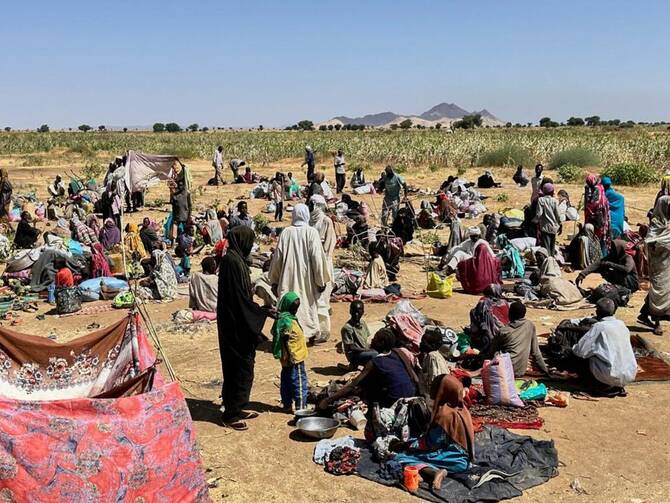
Some survivors have staggered into a refugee camp about 40 miles away in the town of Tawila.
More than 62,000 people are believed to have fled el-Fasher between Sunday and Wednesday, the UN migration agency said. But far fewer have made it to Tawila. The Norwegian Refugee Council, which manages the camp, put the number at around 5,000 people, raising fears over the fate of tens of thousands.
Fatima Abdulrahim, 70, fled el-Fasher with her grandchildren a few days before it was captured to escape the siege. She described to The Associated Press a harrowing five-day journey to reach Tawila, hiding in trenches, dodging bullets and gunmen behind walls and empty buildings.
“We ran on the streets, hiding for ten minutes behind the berm, then charging out, running until we made it out,” she said, adding that she kept falling and getting up amid gunfire and shelling. Her companions carried her at times, she said.
“Thirst almost killed us,” she said, describing picking grass to eat from the side of the road.
Along the way, she said she also witnessed militiamen shoot and kill young men trying to bring food into the city.
“The people dead on the streets were countless,” she said. “I kept covering the eyes of the little ones so they don’t see. Some were injured and beaten and could not move. We pulled some to the paved road, hoping a car would come and take them.”
She said some fighters stopped her, and the group she was traveling with, and took all their belongings and beat the children.
At least 450 people have been admitted to the hospital in Tawila, some suffering from severe malnutrition and sexual violence, said Adam Rojal, spokesperson for a local group that works with displaced people in Darfur.
The Norwegian Refugee Council said people were arriving at the camp with broken limbs and other wounds, and some with injuries sustained months ago. Many children arrived at the camp who had lost their parents in the fighting.
Hospital attack
Christian Lindmeier, a WHO spokesman, provided new details about the killings at el-Fasher’s Saudi Hospital, which had been the only hospital in the city still providing limited services during the siege.
Gunmen returned to the facility at least three times, Lindmeier told a UN press briefing in Geneva. At first, the fighters came and abducted a number of doctors and nurses, and at least six are still being held, he said. They later returned and “started killing,” he said.
They came a third time and “finished off what was still standing, including other people sheltering in the hospital,” Lindmeier said, without specifying who the attackers were.
A number of grisly videos from the hospital have circulated online showing bodies and at least one fighter shooting a man. The Associated Press has not been able to independently verify the details of the assault.
The RSF denied committing killings at the hospital. On Thursday, it posted on social media a video filmed at the hospital, showing what it said were some patients at the facility. A person speaking in the video said RSF fighters were caring for the patients, offering them change of wounds and food. At least one wounded man spoke to the reporter.
It was not immediately clear when the video was filmed, although a timestamp stated it was Thursday.
Dr. Teresa Zakaria, WHO’s unit head for humanitarian operations, told the briefing that the hospital was offering “limited service” now. But he said that since el-Fasher’s seizure on Sunday, “there is no longer any humanitarian health presence in the city, and access has remained blocked.”
Militia accused of repeated mass killings
El-Fasher was the Sudanese military’s last stronghold in Darfur, and its fall secures the RSF’s hold over most of the large western region. That raises fears of a new split in Sudan, with the military holding Khartoum and the country’s north and east.
The RSF and its allied militias have been accused of repeated mass killings and rapes when it controlled the capital Khartoum, and as it has seized towns across Darfur and further south over the past two years – mostly targeting civilians of Central and East African ethnicities.
The RSF is largely made up of fighters from the Arab Janjaweed militia, which is accused of carrying out a government-backed genocidal campaign in Darfur in the 2000s in which some 300,000 people were killed.
The Janjaweed were initially recruited by the military to fight Darfur insurgents, who were rebelling against power concentrated in the north. The militia later were reorganized into the RSF as an official force.
The military and the RSF were briefly allied in ruling Sudan following popular protests that ousted longtime leader Omar Al-Bashir. They had a falling out in 2023 in a struggle for power.

Militia attack on hospital in Darfur came in waves: WHO
Short Url
https://arab.news/gxrqh
Militia attack on hospital in Darfur came in waves: WHO
- Gunmen returned to the facility at least three times, Lindmeier told a UN press briefing in Geneva
- At first, fighters came and abducted a number of doctors and nurses, and at least six still being held, he said
Gazans long for reopening of ‘lifeline’ Rafah crossing
- The border crossing between Gaza and Egypt is the Palestinian territory’s only gateway to the outside world
- If Rafah opens in coming days, residents of the territory are hoping to reunite with family, or are looking to leave themselves
GAZA CITY: With Gaza’s vital Rafah border crossing expected to soon reopen, residents of the war-shattered territory are hoping to reunite with family members, or are looking to leave themselves.
The Rafah crossing between Gaza and Egypt is the Palestinian territory’s only gateway to the outside world that does not lead to Israel and is a key entry point for both people and goods.
It has been closed since Israeli forces took control of it in May 2024, except for a limited reopening in early 2025, and other bids to reopen failed to materialize.
Following a US-brokered ceasefire that took effect in October, Rafah is expected to reopen for pedestrians, after visiting US envoys reportedly pressed Israeli officials to reopen the crossing.
“Opening the Rafah crossing means opening the door to life for me. I haven’t seen my wife and children for two years since they left at the beginning of the war and I was prevented from traveling,” said 48-year-old Mahmud Al-Natour, who hails from Gaza City.
“My children are growing up far away from me, and the years are passing by as if we are cut off from the world and life itself,” he told AFP.
Randa Samih, 48, also called the crossing “the lifeline of Gaza,” but is worried about whether she would be able to leave.
She had applied for an exit permit to get treatment for her injured back, which she fears might not be serious enough to be allowed out.
“There are tens of thousands of injuries in Gaza, most of them more serious than mine,” she said.
“We’ll die or our health will decline before we get to travel.”
- ‘Limited reopening’ -
Gaza, a tiny territory surrounded by Israel, Egypt and the Mediterranean Sea, has been under Israeli blockade even before Hamas’s attack sparked the war.
Palestinian militants took 251 people hostage on October 7, 2023, in an attack that killed 1,221 others, most of them civilians.
Israel’s retaliatory offensive has killed at least 71,662 Palestinians, according to figures from the health ministry in Hamas-run Gaza that the United Nations considers reliable. The ministry does not say how many of the dead were fighters, though its data shows that more than half were women and children.
Ali Shaath heads the National Committee for the Administration of Gaza (NCAG), created as part of the ceasefire agreement. He announced last week that Rafah would reopen in both directions.
Israel said it would only allow pedestrians to travel through the crossing as part of its “limited reopening” once it had recovered the remains of the last hostage, Ran Gvili.
His remains were brought back to Israel later on Monday.
A Palestinian official told AFP on condition of anonymity that “estimates indicate that the Rafah crossing could be opened in both directions by the end of this week or early next week.”
A member of the NCAG told AFP that the technocratic committee would be responsible for sending lists of travelers’ names to the Israeli authorities for approval.
Outward travel will intially be limited to patients, the injured, students with university admission and visas, and holders of Egyptian citizenship or other nationalities and residency permits, the source said.
- ‘Burning with anticipation’ -
Gharam Al-Jamla, a displaced Palestinian living in a tent in southern Gaza, told AFP she counted on the crossing’s opening for her future.
“My dreams lie beyond the Rafah crossing. I applied for several scholarships to study journalism in English at universities in Turkiye. I received initial acceptance from two universities there,” the 18-year-old said.
She added she would then want to return to Gaza “to be one of its voices to convey the truth to the world.”
Gaza’s civil defense agency spokesman, Mahmud Bassal, appealed for the full reopening of Rafah to allow the entry of unlimited aid and equipment for reconstruction.
“There are thousands of bodies under the rubble, including children, women and people with disabilities, which have not been recovered since the beginning of the war,” he said.
The civil defense is a rescue force operating under Hamas authority.
Mohammed Khaled, 18, said he wanted to move on from the war.
“I’m burning with anticipation,” he told AFP.
“I haven’t seen my mother and sisters for two years. My mother traveled for medical treatment, and they only allowed my sisters to accompany her.”
Khaled said he also hoped to be able to travel to have surgery for a shrapnel injury sustained during the war.
The Rafah crossing between Gaza and Egypt is the Palestinian territory’s only gateway to the outside world that does not lead to Israel and is a key entry point for both people and goods.
It has been closed since Israeli forces took control of it in May 2024, except for a limited reopening in early 2025, and other bids to reopen failed to materialize.
Following a US-brokered ceasefire that took effect in October, Rafah is expected to reopen for pedestrians, after visiting US envoys reportedly pressed Israeli officials to reopen the crossing.
“Opening the Rafah crossing means opening the door to life for me. I haven’t seen my wife and children for two years since they left at the beginning of the war and I was prevented from traveling,” said 48-year-old Mahmud Al-Natour, who hails from Gaza City.
“My children are growing up far away from me, and the years are passing by as if we are cut off from the world and life itself,” he told AFP.
Randa Samih, 48, also called the crossing “the lifeline of Gaza,” but is worried about whether she would be able to leave.
She had applied for an exit permit to get treatment for her injured back, which she fears might not be serious enough to be allowed out.
“There are tens of thousands of injuries in Gaza, most of them more serious than mine,” she said.
“We’ll die or our health will decline before we get to travel.”
- ‘Limited reopening’ -
Gaza, a tiny territory surrounded by Israel, Egypt and the Mediterranean Sea, has been under Israeli blockade even before Hamas’s attack sparked the war.
Palestinian militants took 251 people hostage on October 7, 2023, in an attack that killed 1,221 others, most of them civilians.
Israel’s retaliatory offensive has killed at least 71,662 Palestinians, according to figures from the health ministry in Hamas-run Gaza that the United Nations considers reliable. The ministry does not say how many of the dead were fighters, though its data shows that more than half were women and children.
Ali Shaath heads the National Committee for the Administration of Gaza (NCAG), created as part of the ceasefire agreement. He announced last week that Rafah would reopen in both directions.
Israel said it would only allow pedestrians to travel through the crossing as part of its “limited reopening” once it had recovered the remains of the last hostage, Ran Gvili.
His remains were brought back to Israel later on Monday.
A Palestinian official told AFP on condition of anonymity that “estimates indicate that the Rafah crossing could be opened in both directions by the end of this week or early next week.”
A member of the NCAG told AFP that the technocratic committee would be responsible for sending lists of travelers’ names to the Israeli authorities for approval.
Outward travel will intially be limited to patients, the injured, students with university admission and visas, and holders of Egyptian citizenship or other nationalities and residency permits, the source said.
- ‘Burning with anticipation’ -
Gharam Al-Jamla, a displaced Palestinian living in a tent in southern Gaza, told AFP she counted on the crossing’s opening for her future.
“My dreams lie beyond the Rafah crossing. I applied for several scholarships to study journalism in English at universities in Turkiye. I received initial acceptance from two universities there,” the 18-year-old said.
She added she would then want to return to Gaza “to be one of its voices to convey the truth to the world.”
Gaza’s civil defense agency spokesman, Mahmud Bassal, appealed for the full reopening of Rafah to allow the entry of unlimited aid and equipment for reconstruction.
“There are thousands of bodies under the rubble, including children, women and people with disabilities, which have not been recovered since the beginning of the war,” he said.
The civil defense is a rescue force operating under Hamas authority.
Mohammed Khaled, 18, said he wanted to move on from the war.
“I’m burning with anticipation,” he told AFP.
“I haven’t seen my mother and sisters for two years. My mother traveled for medical treatment, and they only allowed my sisters to accompany her.”
Khaled said he also hoped to be able to travel to have surgery for a shrapnel injury sustained during the war.
© 2026 SAUDI RESEARCH & PUBLISHING COMPANY, All Rights Reserved And subject to Terms of Use Agreement.