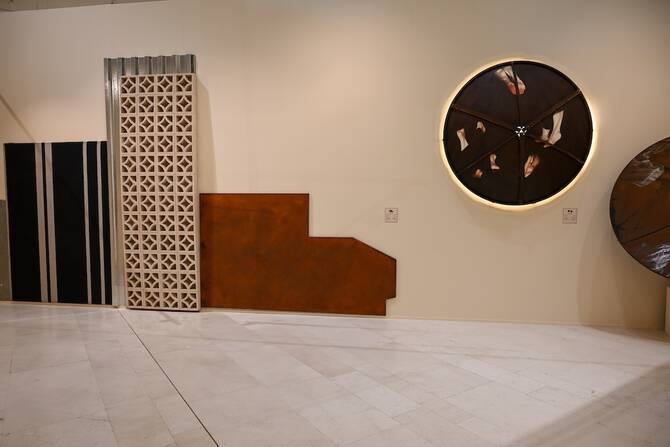


DHAHRAN: The King Abdulaziz Center for World Culture, commonly known as Ithra, this week presents “Echoes of the Familiar,” a new exhibition exploring the meaning of home. The exhibition runs from Oct. 31 to Sept. 1, 2026.
Although the official opening coincides with Halloween, it is not a haunted house — rather, it asks visitors to ponder what constitutes a Saudi home.
Gaida Al-Mogren, curator of the exhibition and artistic director of the Noor Riyadh Festival, spoke to Arab News about the project. An architect and a leading voice in Saudi contemporary art, she brings more than two decades of experience merging architecture, culture and art.
“We were thinking of the house and how the walls hold memory. And actually, in certain places, you can hear the whispers of these walls,” she said. “They can tell us the stories of the people that lived in it, and all the things that happened within these walls. And then, of course, we started thinking about walking on the tiles and the noises these places make. And so, from that, the echo started coming up.”
The exhibition opens with a vibrant red door, a stylistic choice that also serves as a transitional door, reflecting the era when Saudi homes moved from wooden doors in mud houses to aluminum doors with colored glass in concrete homes. Al-Mogren said the door was chosen to resonate across regions, connecting Najdi, Hasawi, and other traditional patterns throughout Saudi Arabia.

Gaida Al-Mogren, curator of the exhibition and artistic director of the Noor Riyadh Festival. (Supplied)
“Before we enter the exhibition, we have the timeline that tells you the story of Saudi, in the past century and all the changes, the big changes that we went through.”
Al-Mogren welcomed visitors by saying, “our house is your house.”
The gallery is divided into six sections: The Building, The Living Room, The Kitchen, The Hallway of Memories, The Bedroom, and The People of the Home.
Each space reimagines familiar domestic environments as thresholds between the personal and the collective, where memory and identity continuously intertwine. Some will trigger a lived memory, others will evoke nostalgic vibes.
The exhibition features 28 Saudi artists: Ahmed Mater, Abdullah Al-Jahdhami, Abdullah Al-Othman, Abeer Sultan, Alaa Tarabzouni, Arwa Al-Neami, Palestinian-Saudi artist Ayman Yossri Daydban, and Daniah Al-Saleh, winner of the 2019 Ithra Art Prize. Others featured are Filwa Nazer from Jeddah, Hassan Jassim Al-Jassim from Al-Ahsa, Rashed Al-Shashai — founder of the Tasami Center for Visual Arts — and Obaid Al-Safi.
There are additional works by Maram Al-Suliman, Madhawi and Hayfa Al-Gwaiz, Noor Al-Saif, Nawaf Al-Dohan, and Meshari Abdulaziz Al-Dosari, with Dana Al-Turki, Norah Saud, Rashed Al-Subaie, Kawthar Al-Atiyah, Roaa Mofreh, Saad Al-Howede, Saddek Wasil, Shaima Saleh, Skna Hassan and Turki Al-Qahtani completing the line-up.
The artists represent diverse backgrounds, from boomers to Gen-Z, and come from various regions, including Sharqiya, Jeddah, and Riyadh, with work in various styles and mediums, reflecting the diversity of the Kingdom.
The exhibition explores domestic life as lived, remembered, and imagined, turning private spaces into layered stories.
Satellite dishes, once prominent fixtures on rooftops, are part of the narrative, evoking the past while highlighting how we interact with technology in our homes. Cassette tapes and VHS tapes recall the tactile memory of media.
Objects in the “junk drawer” illustrate everyday domesticity.
“I call it ‘the drawer of memories,’ because you have the stubs and receipts — we hold on to these things because it makes us feel safe,” Al-Mogren said.
The exhibition includes echoes of smells, sounds and textures: the lingering scent of cardamom, lost laughter, wiped fingerprints on doorknobs, and spaces that once held faces but now remain absent. As well as the philosophical spaces in between rooms — the hallways.
It is a live archive from the 1970s, ’80s, and ’90s, and a meditation on belonging.
Al-Mogren described the process of working with a multigenerational group of artists.
“My practice is the intersection between art, architecture, and culture. And so this project is exactly in that intersection,” she said. “And a lot of these artists they have practices that I was exposed to that have similar ideas. And so, I met with them, and we discussed how can we bring their practices and even create things that are out of the norm, but still stay true to them.”
Al-Mogren reflected on her personal journey and putting on the exhibition at Ithra — which is a true center of world culture, as its name alludes.
“I grew up in Sharqiya. So my home was here — so I’m coming back home. Full circle. My family had their older house, and then I got married, and I moved to the States, and I lived abroad. So for 16 years, I felt like I lacked that whole ‘feeling of home’ which I yearned for. And I had this longing to have an actual home instead of being in Europe, or in the States.
“When I moved back (to Saudi), my family moved to a new home. So I felt like I lost those whispers in the walls. I lost my memories, in a way, in that transition. And with me moving from one city to the other, I felt like I didn’t have one place to build that memory, as well. And even for my kids. So now, I’m working really hard to create these rituals and these things for my children to have that feeling of home.”
Reflection on her children’s concept of home, she said: “It’s funny, because they say ‘home’ is where you are, mommy. So it’s not about the space. It’s more about the people.”