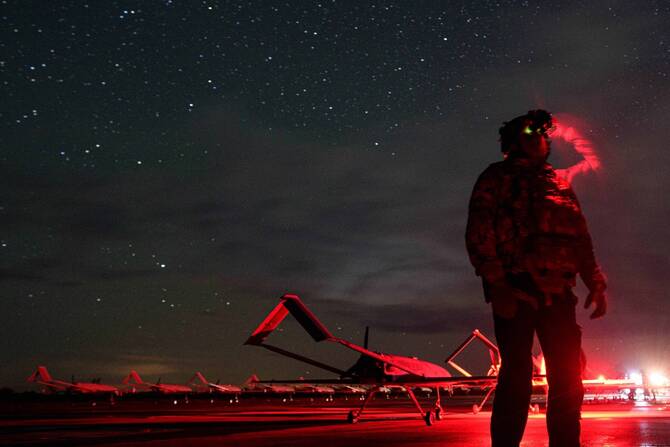
KYIV: At a secret location in rural Ukraine, columns of attack drones are assembled at night and in near silence to strike deep inside Russia.
Their targets are strategic: oil refineries, fuel depots, and military logistics hubs. Since the summer, Ukraine’s long-range drone campaign has ramped up dramatically, pounding energy infrastructure across Russia and stretching Moscow’s air defenses thin.
Built from parts made in a scattered network of workshops, these drones now fly much further than at any point in the war.
Officers in body armor move with quick precision; headlamps glow red to stay hidden. Engines sputter like old motorcycles as exhaust fumes drift into the moonless night. Minutes later, one after another, the drones lift from a makeshift runway and head east. The strikes have caused gasoline shortages in Russia, even forcing rationing in some regions and underscoring a growing vulnerability in the country’s infrastructure.
Drones hammer refineries
Western analysts say the attacks on energy infrastructure so far have had a serious — but not crippling — effect. Ukrainian drones have repeatedly hit 16 major Russian refineries, representing about 38 percent of the country’s nominal refining capacity, according to a recent review by the Carnegie Endowment, a US-based think tank.
But it argues the actual impact has been considerably more limited: most plants resumed operations within weeks, and Russia’s refining output has been cushioned by idle capacity and existing fuel surpluses.
The deep strikes have, however, given Kyiv the initiative at an important moment. The United States and Europe are ramping up sanctions on Russia’s oil industry even as Kyiv’s request for US long-range Tomahawk missiles has stalled. President Volodymyr Zelensky says Ukraine’s improved long-range strike capability is causing real damage – forcing the Kremlin to import fuel and curb exports. “We believe they’ve lost up to 20 percent of their gasoline supply — directly as a result of our strikes,” he told reporters at a briefing in Kyiv.
At the secret launch site, the commander overseeing the operation — a broad-shouldered man identified by his call sign, “Fidel,” in accordance with Ukrainian military regulations — watches through night-vision goggles as the drones climb into the star-filled sky.
“Drones are evolving,” Fidel told The Associated Press. “Instead of flying 500 kilometers (310 miles), now they fly 1,000 ... Three factors go into a successful operation: the drones, the people and the planning. We want to deliver the best result. For us, this is a holy mission.”
Ukraine thrives on no-frills weapons
Much of Ukraine’s fleet is homegrown. The Liutyi, a workhorse of the nightly attacks, is a waist-high craft with a sausage-shaped body, a propeller at the back, and a distinctive triangular tail.
It looks neither sleek nor intimidating — more Home Depot than Lockheed Martin — but the ease of assembly means it can be kept hidden and constantly tweaked: optimized to slip through heavily monitored frontline airspace.
Typical of Ukraine’s no-frills war production philosophy, the Liutyi — whose name means “fierce” in Ukrainian — has become a symbol of national pride and recently featured on a local postage stamp.
The reach of these drones — with some models doubling in range over the past year to routinely strike targets within a 1,000-kilometer radius of the border — marks a shift in the geography of the conflict. Attacks a year ago damaged refineries in a much narrower range, mostly in western Russian border regions. Costs have also come down, further testing expensive air defense systems, with long-range drones now being produced in Ukraine for as little as $55,000.
A shift in conflict geography
“What we’re seeing is that Ukraine is getting better at taking the war inside Russia,” said Adriano Bosoni, director of analysis at RANE, a global risk analysis firm. “For most of the war, Russia operated on the assumption that its own territory was safe. That’s no longer the case.”
The strategic logic is attrition by logistics, he argued: by forcing Russia to reroute supplies and commit air defenses to a wider area, Kyiv seeks to degrade Moscow’s capacity to sustain large-scale operations.
The Paris-based International Energy Agency says repeated drone strikes have cut Russia’s refining capacity by about 500,000 barrels a day. That’s triggered domestic fuel shortages and curbed exports of diesel and jet fuel, even as overall global oil production remains steady and prices stable.
Kyiv’s homegrown strike capability allows independent drone launches, bypassing the Western approval required for imported long-range weapons. That autonomy preceded tougher sanctions on Russia: allies escalated only after Ukraine had spent months hitting Russian refineries.
On the ground, each mission is a study in tradeoffs. Fewer than 30 percent of drones even reach the target area, so meticulous planning is essential, said Fidel, who reflected on the human cost. “War has fallen to our generation so that we can fight for our kids and they can live in a free democratic country,” he said. “We are currently obtaining experience that will be used by every country in the world, and we are paying the price with our lives and the lives of our friends.”


![]()

Drones, oil and escalation: Ukraine’s deep strikes impact Russia, altering war calculations
Short Url
https://arab.news/nvqwr
Drones, oil and escalation: Ukraine’s deep strikes impact Russia, altering war calculations
- The United States and Europe are ramping up sanctions on Russia’s oil industry even as Kyiv’s request for US long-range Tomahawk missiles has stalled


Latest updates


© 2026 SAUDI RESEARCH & PUBLISHING COMPANY, All Rights Reserved And subject to Terms of Use Agreement.