

Pakistan and Afghanistan agree to maintain ceasefire after peace talks in Istanbul

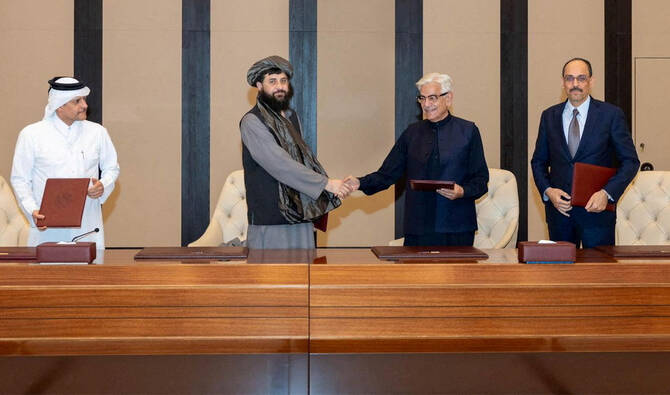
fghan Defence Minister Mullah Mohammad Yaqoob Mujahid and Pakistani Defence Minister Khawaja Muhammad Asif shake hands following the signing of a ceasefire agreement mediated by Qatar and Turkey, in Doha, Qatar on October 19, 2025. (Qatar Ministry Of Foreign Affairs/Handout via REUTERS/File)
Short Url
Updated 30 October 2025
Follow

Pakistan and Afghanistan agree to maintain ceasefire after peace talks in Istanbul

  • Next high-level meeting is scheduled in Istanbul on Nov. 6 to finalize implementation of the ceasefire
  • Parties agree to establish a joint monitoring mechanism to ensure compliance and penalize violations

ANKARA: Pakistan and Afghanistan have agreed to maintain a ceasefire following peace talks in Istanbul, Turkiye’s Foreign Ministry announced Thursday, after a dialogue between the two sides collapsed earlier in the week.

The sides plan to meet again at a higher-level gathering in Istanbul on Nov. 6 to finalize how the ceasefire will be implemented, the ministry said in a statement released on behalf of Pakistan, Afghanistan and mediators Turkiye and Qatar.

“All parties have agreed to put in place a monitoring and verification mechanism that will ensure maintenance of peace and imposing penalty on the violating party,” the statement read.

The new round of negotiations, facilitated by Turkiye and other friendly nations, was aimed at easing border tensions between the two sides who earlier this month exchanged fire, leaving dozens of soldiers, civilians and militants dead.

Despite the collapse of the previous round of talks, a ceasefire has largely held and no new border clashes were reported this week. However, both countries have kept major crossings closed, leaving hundreds of trucks carrying goods and refugees stranded on each side.

Pakistan’s Defense Minister Khawaja Mohammad Asif told the Geo news channel the decision to give peace another chance was made by Pakistan at the request of Qatar and Turkiye, and that the Pakistani delegation, set to return home Wednesday night, was asked to stay in Istanbul.

According to Pakistani state-run television, Islamabad said the talks will be based on Pakistan’s central demand that Afghanistan take clear, verifiable and effective action against militant groups.

In Islamabad, two senior security officials told The Associated Press that Pakistan has once again stressed that Afghan soil should not be used for what it called “terrorism” against Pakistan and that it appreciates the constructive role of its hosts and remains committed to seeking a peaceful resolution in good faith.

The officials spoke on condition of anonymity because they were not authorized to discuss the matter with the media on the record.

Tensions flared earlier this month after explosions were heard in Kabul, and Afghanistan’s Taliban government accused Pakistan of carrying out airstrikes in the capital and bombing a market in the country’s east.

Afghan officials on Oct. 12 said they retaliated by targeting Pakistani military posts, claiming 58 Pakistani soldiers were killed. However, Pakistan’s military said the fighting left 23 of its soldiers dead and that its operations were targeting militant hideouts inside Afghanistan.

The clashes prompted Qatar to host emergency talks between the two neighbors, resulting in a ceasefire on Oct. 19. That was followed by four days of negotiations in Istanbul that ended inconclusively on Tuesday. Since then, Qatar and Turkiye have been working to bring the delegations back to the negotiating table, the Pakistani officials said.

On Thursday, Pakistan’s army chief, Field Marshal Asim Munir, told a gathering of tribal elders in Peshawar that Pakistan seeks peace with all its neighbors, including Afghanistan, but will not tolerate cross-border terrorism from Afghan soil.

He said Pakistan in recent years exercised restraint and made diplomatic and economic overtures to improve ties, but the Taliban government instead supported the TTP, which was listed as a terrorist group by the United Nations and the United States over a decade ago.

Pakistan has witnessed a surge in militant attacks in recent months, most claimed by the Pakistani Taliban, or Tehreek-e-Taliban Pakistan, a group closely allied to the Taliban in Afghanistan. Many of their leaders and fighters are believed to be sheltering in Afghanistan since the Taliban’s return to power in 2021.

The Pakistani military said Thursday it killed 18 militants in two separate operations in the southwestern province of Balochistan. In a separate statement, it said four Pakistani Taliban, including a high-value target, were killed as they attempted to sneak into Bajaur, a city bordering Afghanistan.


Pakistan raises India's suspension of water-sharing treaty with UNGA president, seeks action

Updated 7 sec ago
Follow

Pakistan raises India's suspension of water-sharing treaty with UNGA president, seeks action

  • New Delhi said in April last year it was holding the treaty in abeyance after a gun attack in Indian-administered Kashmir
  • Official says such actions threaten lives of 240 million Pakistanis, particularly at a time of climate stress, water scarcity

ISLAMABAD: Pakistan has taken up India’s suspension of a decades-old water-sharing treaty with the president of the United Nations General Assembly (UNGA), urging action over the move that Islamabad said sets "dangerous precedents."

The Indus Waters Treaty (IWT) divides control of the Indus basin rivers between the two nuclear-armed neighbors. India said in April last year it would hold the treaty “in abeyance” after a gun attack in Indian-administered Kashmir killed more than 26 tourists. New Delhi blamed the assault on Pakistan, Islamabad denied it.

The attack led to a four-day military conflict between the neighbors last May that say them attack each other with fighter jets, missiles, drones and artillery before the United States-brokered a ceasefire. Tensions have remained high between the nuclear-armed neighbors.

During a meeting on the sidelines of the Inter-Parliamentary Union (IPU) annual hearing, Pakistan Senate Chairman Yusuf Raza Gilani told UNGA President Annalena Baerbock that India's unlawful action constituted a blatant violation of the treaty’s provisions and principles of customary international law.

"Such actions threaten the lives and livelihoods of over 240 million Pakistanis and set dangerous precedents, particularly at a time when climate stress and water scarcity demand cooperation and strict respect for international agreements," he was quoted as saying by the Pakistani information ministry.

The treaty, mediated by the World Bank, grants Pakistan rights to the Indus basin’s western rivers — Indus, Jhelum, and Chenab — for irrigation, drinking, and non-consumptive uses like hydropower, while India controls the eastern rivers — Ravi, Beas, and Sutlej — for unrestricted use but must not significantly alter their flow.

Highlighting the adverse impacts of climate change, Gilani said countries like Pakistan remain among the most severely affected and underscored the urgency of collective action, climate justice and strengthened international cooperation.

"The United Nations provides an indispensable platform for addressing these interconnected challenges," he said at the meeting.

Gilani, who was leading a six-member parliamentary delegation, this week delivered the national statement at the IPU annual hearing at the UN headquarters, calling for democratic, transparent, and accountable decision-making in order to enhance the UN’s credibility, according to the Senate of Pakistan.

“Parliaments are indispensable partners in ensuring national ownership of international commitments,” he was quoted as saying by the Senate. “Reform is essential. But it must be ‘Reform for All, Privilege for None’.”

The Senate chairman highlighted the continuing importance of the United Nations as the cornerstone of multilateral cooperation, stressing that the organization’s universal membership and Charter-based mandate remain central to promoting global peace and security.