

‘Violations’ against Pakistani journalists surged 60% in past year - watchdog 

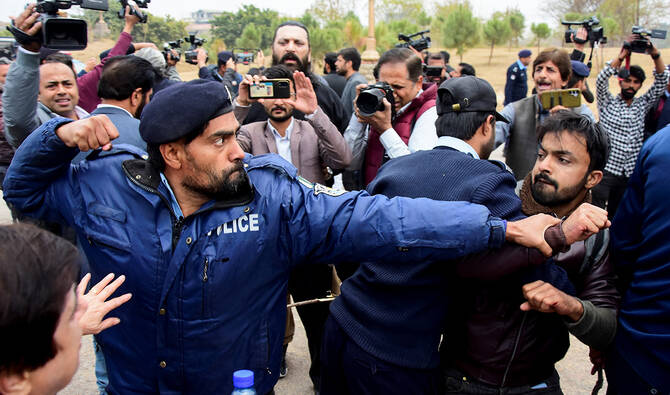
Police officers react while stopping a Journalist who, along with others protest against what they call, curbing press freedom and controlling the digital landscape, in Islamabad, Pakistan January 28, 2025. (REUTERS/ file)
Short Url
Updated 30 October 2025
Follow

‘Violations’ against Pakistani journalists surged 60% in past year - watchdog 

  • Freedom Network report finds 142 cases of media violations, highest in years
  • Watchdog's findings say amended cybercrime law being used to silence critical voices

ISLAMABAD: Violations against journalists in Pakistan jumped nearly 60 percent over the past year, a media watchdog said on Thursday, warning of a "worsening environment" for press freedom under Prime Minister Shehbaz Sharif’s government.

The findings are part of the Annual State of Impunity Report 2025 by Freedom Network, a Pakistan-based media rights and civil liberties organization that monitors and advocates for press freedom, journalist safety, and digital rights across the country. The report has been produced with support from International Media Support (IMS) and was released ahead of the UN-designated International Day to End Impunity for Crimes against Journalists on November 2. 

Freedom Network documented at least 142 cases of violations against journalists and media professionals between November 2024 and September 2025, a nearly 60 percent rise from the previous year. In the watchdog's framework, “violations” include physical assaults, legal cases, harassment and censorship against journalists and media workers, covering both physical and non-physical threats to press freedom.

The report noted that 36 legal cases were filed against 30 journalists under Pakistan’s Prevention of Electronic Crimes Act (PECA) and Pakistan Penal Code, many in Punjab province, the country's most populous and richest region. The government amended PECA in early 2025 to make its punitive provisions harsher, prompting concern from rights groups that it is being used to target dissenting voices online. The government denies this. 

“The use of legal framework to crack down on free expression is a tool the federal government is now using excessively, targeting critical voices,” Freedom Network Executive Director Iqbal Khattak was quoted as saying in the report.

“Pakistan cannot afford to silence critical media, which is equally important in a democratic dispensation.”

The watchdog said the post-election climate after the February 2024 general polls had “made almost every region in Pakistan unsafe for journalism,” with attacks reported across all provinces and territories.

Punjab and Islamabad emerged as the most dangerous places for journalists, accounting for 28 percent each of all recorded violations, followed by Khyber Pakhtunkhwa, Sindh, Balochistan, and Azad Jammu and Kashmir. No incidents were reported from the northern Gilgit-Baltistan region. 

Television journalists were the most frequently targeted, followed by those working in print and digital outlets.

Freedom Network said the surge in threats and cases has created “a hostile environment for media,” urging authorities to strengthen protections and end impunity for attacks on journalists. 

The findings of the watchdog, it said, “indicate a worsening environment of freedom of expression and safety of journalists in the country under Prime Minister Shehbaz Sharif government.”


Pakistan reports current account surplus in Jan. owing to improved trade, remittances

Updated 17 February 2026
Follow

Pakistan reports current account surplus in Jan. owing to improved trade, remittances

  • Pakistan’s exports crossed the $3 billion mark in Jan. as the country received $3.5 billion in remittances
  • Last month, IMF urged Pakistan to accelerate pace of structural reforms to strengthen economic growth

ISLAMABAD: Pakistan recorded a current account surplus of more than $120 million in January, the country’s finance adviser said on Tuesday, attributing it to improved trade balance and remittance inflows.

Pakistan’s exports rebounded in January 2026 after five months of weak performance, rising 3.73 percent year on year and surging 34.96 percent month on month, according to data released by the country’s statistics bureau.

Exports crossed the $3 billion mark for the first time in January to reach $3.061 billion, compared to $2.27 billion in Dec. 2025. The country received $3.5 billion in foreign remittances in Jan. 2026.

Khurram Schehzad, an adviser to the finance minister, said Pakistan reported a current account surplus of $121 million in Jan., compared to a current account deficit of $393 million in the same month last year.

“Improved trade balance in January 2026, strong remittance inflows, and sustained momentum in services exports (IT/Tech) continue to reinforce the country’s external account position,” he said on X.

Pakistan has undergone a difficult period of stabilization, marked by inflation, currency depreciation and financing gaps, and international rating agencies have acknowledged improvements after Islamabad began implementing reforms such as privatizing loss-making, state-owned enterprises (SOEs) and ending subsidies as part of a $7 billion International Monetary Fund (IMF) loan program.

Late last month, the IMF urged Pakistan to accelerate the pace of these structural reforms to strengthen economic growth.

Responding to questions from Arab News at a virtual media roundtable on emerging markets’ resilience, IMF’s director of the Middle East and Central Asia Jihad Azour said Islamabad’s implementation of the IMF requirements had been “strong” despite devastating floods that killed more than 1,000 people and devastated farmland, forcing the government to revise its 4.2 percent growth target to 3.9 percent.

“What is important going forward in order to strengthen growth and to maintain the level of macroeconomic stability is to accelerate the structural reforms,” he said at the meeting.

Azour underlined Pakistan’s plans to privatize some of the SOEs and improve financial management of important public entities, particularly power companies, as an important way for the country to boost its capacity to cater to the economy for additional exports.

“This comes in addition to the effort that the authorities have made in order to reform their tariffs, which will allow the private sector of Pakistan to become more competitive,” the IMF official said.