

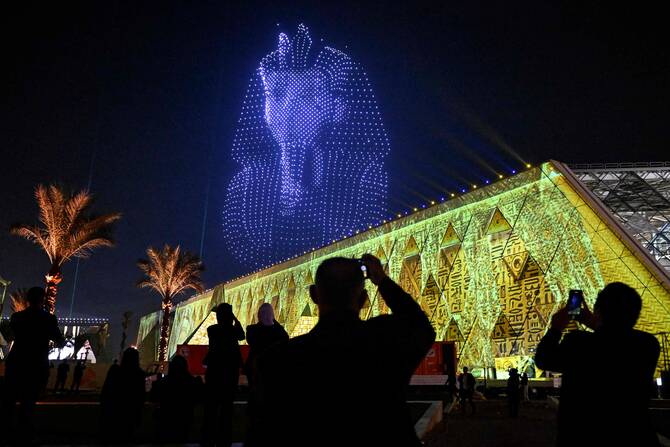


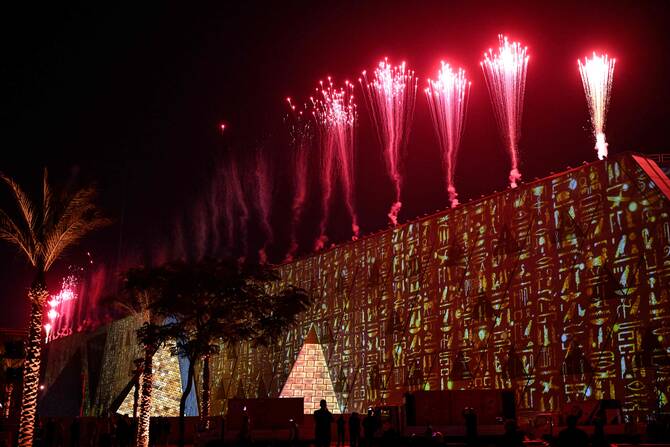


CAIRO: The Grand Egyptian Museum — the largest archaeological museum in the world dedicated to a single civilization — has officially opened its doors.
The launch event was attended by international dignitaries including German President Frank-Walter Steinmeier, King Philippe of Belgium and Greek Prime Minister Kyriakos Mitsotakis.
High-ranking Arab officials in attendance were led by Saudi Arabia’s Minister of Culture Prince Badr bin Abdullah, who was joined by Crown Prince Theyazin of Oman and Palestinian President Mahmoud Abbas.
Egyptian President Abdel Fattah El-Sisi opened the museum, a long-awaited, billion-dollar showcase for pharaonic treasures, saying that its inauguration opened “a new chapter in history” for the country.
“Today, as we celebrate together the opening of the Grand Egyptian Museum, we are writing a new chapter in the history of the present and the future, in the cause of this ancient homeland,” El-Sisi told a gathering of princes, queens, heads of state and other dignitaries at a ceremony in the museum’s square.
Saturday’s lavish spectacle saw shafts of light illuminating both the pyramids and the museum’s colossal facade, huge musical set-pieces and joint performances betwee Cairo and Tokyo, Paris and New York City.
The site, around 2 kilometers from the Giza Pyramids, covers a total of 490,000 sq. meters. The design is a blend of modernity and history, thanks to Irish firm Heneghan Peng Architects.

The site, around 2 kilometers from the Giza Pyramids, covers a total of 490,000 sq. meters. (Supplied)
The museum is the brainchild of former Egyptian Minister of Culture Farouk Hosny, who first proposed the idea in 1992. The museum’s construction began in 2005, but work stopped for three years during the political turmoil that followed the 2011 uprising.
However, the desire to highlight Egypt’s ancient heritage on an unprecedented scale came with challenges; the process has been mired by political upheaval and the global pandemic, which saw the museum’s grand opening delayed four times.

The Grand Egyptian Museum in Giza on the southwestern outskirts of the capital Cairo. (Supplied)
“To say that the Grand Egyptian Museum is Egypt’s gift to the world is not an exaggeration, as the legacy of ancient Egyptian civilization represents a global heritage,” the country’s prime minister, Mostafa Madbouly, said.
That heritage and history will be shown across 40,000 sq. meters of exhibition space, with a whopping 7,500 sq. meters dedicated to the treasures of King Tutankhamun, all of which were discovered in his tomb on Luxor’s West Bank in 1922 by British archaeologist and Egyptologist Howard Carter.
The museum houses more than 57,000 artifacts across the Tutankhamun Galleries, Main Galleries, Grand Hall, Grand Staircase and Khufu’s Boat Museum. The 4,600-year-old solar boat of King Khufu, the pharaoh who is credited with building the Great Pyramid of Giza is a particular draw. The 43-meter-long (140-foot) wooden boat, discovered in the 1950s, was buried next to the Great Pyramid for Khufu — or Cheops as he is also known — to use in the afterlife.
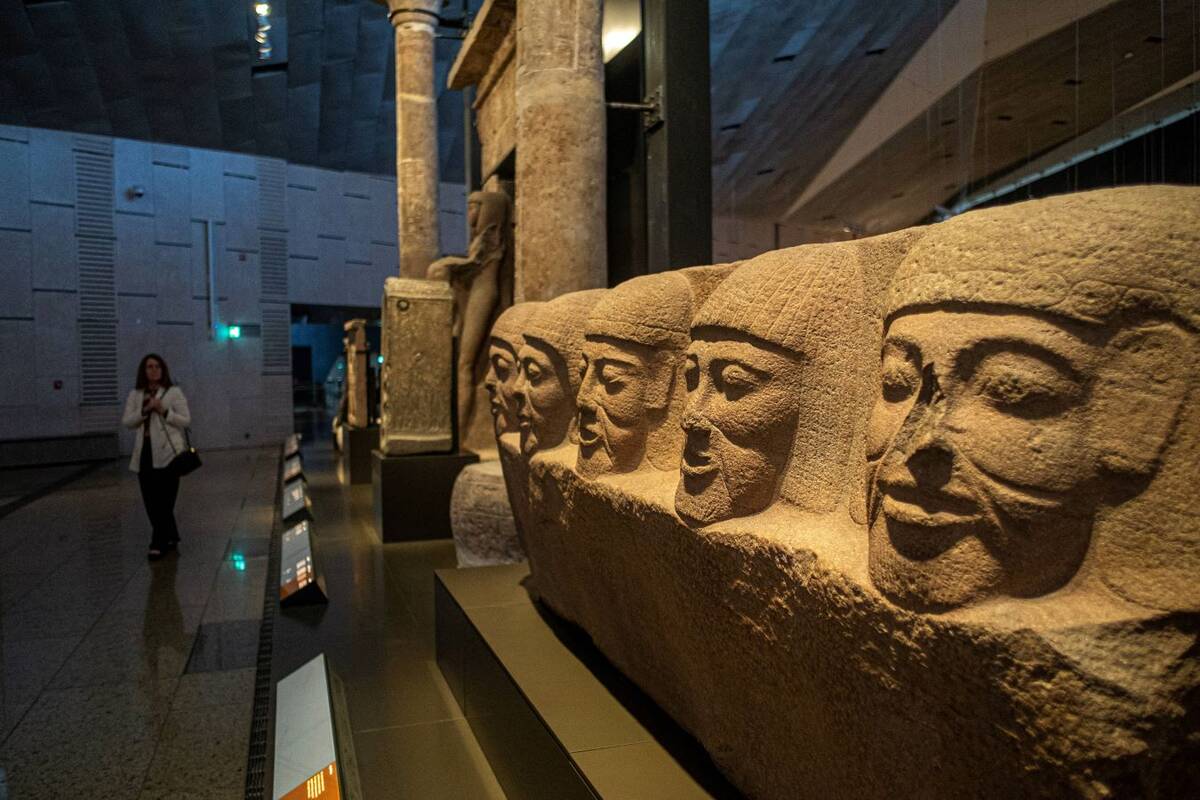
A visitor tours the Grand Egyptian Museum in Giza on the southwestern outskirts of the capital Cairo. (AFP)
But “what truly distinguishes the Grand Egyptian Museum is its remarkable display of the complete collection of the King Tutankhamun — more than 5,000 artifacts showcased together for the first time. The items have been gathered from various storages — the Egyptian Museum in Tahrir and the Luxor Museum,” GEM’s former director, Dr. Tarek Tawfik, told Arab News.
Saturday’s grand opening included the inauguration of two halls dedicated to the 5,000 artifacts from the collection of King Tutankhamun.
“Visitors will be amazed by the museum’s modern presentation techniques, which narrate the story of the king through a fresh curatorial philosophy that differs from traditional exhibition styles,” Tawfik added.
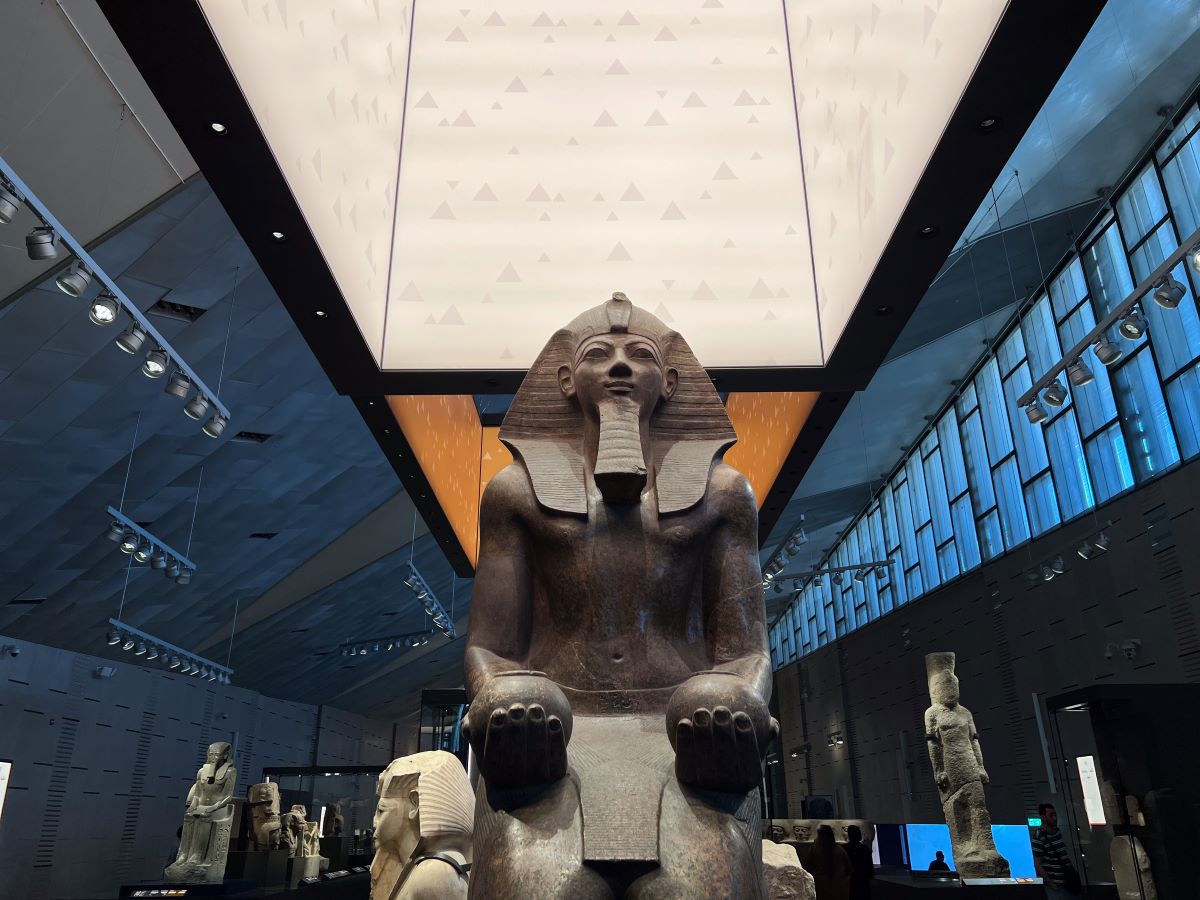
The statue of queen Hatshepsut at the museum. (Supplied)
Some sections of the museum have been open to the public since 2024, with new galleries and exhibition spaces due to open on Nov. 4 which it is hoped will attract both local visitors and international tourists.
On entering, the journey begins with the hanging obelisk of King Ramses II in the museum’s courtyard. Visitors will also be able to view a large-scale statue of the pharaoh in the entrance hall before ascending the Grand Staircase — the 3,200-year-old, 11-meter-tall (36-foot-tall) statue was moved to the museum after decades of standing in the center of a traffic-clogged roundabout in front of Cairo’s main train station.

The Main Galleries cover three central topics — beliefs, society and kingship — spanning different periods of ancient Egypt, from the prehistoric era and old, middle and new kingdoms through to the Greco-Roman period. (Supplied)
The Main Galleries cover three central topics — beliefs, society and kingship — spanning different periods of ancient Egypt, from the prehistoric era and old, middle and new kingdoms through to the Greco-Roman period.
Of note is the museum’s vast restoration center, which at 32,000 sq. meters is the largest restoration hub in the Middle East and features 16 specialized laboratories for artifact examination and restoration. In a move that sets the museum apart from its international counterparts, the restoration center will be open to the public.
Billed as a bridge between Egypt’s ancient legacy and its modern vision, the Grand Egyptian Museum will offer invaluable insight into one of the world’s most talked about ancient civilizations.


