



BEIRUT: Attacks by the Israeli army on Lebanese territory escalated on Thursday, prompting Lebanese President Joseph Aoun to order the army to confront such aggression.
Israeli forces carried out heavy airstrikes on the outskirts of Aaichiyeh, Jarmaq and Khardale, and a municipal employee was killed in the border town of Blida.
The strikes followed an earlier raid by Israeli warplanes on the village of Al-Labouneh, near the town of Naqoura, just 200 meters from a Lebanese army position.
The Israeli escalation coincided with intensive flyovers at low altitude by Israeli warplanes that extended as far as Beirut and its southern suburbs, even breaching airspace over the Presidential Palace in Baabda and the prime minister’s office in the heart of the capital.
The Israeli army infiltrated the area around the town of Blida, about a kilometer from the border, shortly before 4 a.m. on Thursday, in breach of the ceasefire agreement between Beirut and Tel Aviv. The soldiers opened fire on a municipal building, killing employee Ibrahim Salameh who was asleep in one of its rooms.
Residents told local media they heard screams and cries for help during the raid, which lasted for several hours and ended around dawn when Israeli troops withdrew. An Agence France-Presse journalist reported bullet holes in the walls and windows of the room where Salameh had been sleeping, along with bloodstains and scattered personal belongings.
The Lebanese Army Command said: “Once notified of the incursion and the shooting, an army patrol was dispatched to the location” where it “determined that an enemy ground unit had entered the town, opened fire on the municipal building, and targeted one of its employees.”
It called on the mechanism established for monitoring the cessation of hostilities agreement to take action to end the ongoing violations of the ceasefire by Israel.
“The Israeli enemy’s actions constitute a criminal act, a blatant violation of Lebanese sovereignty, and a breach of the cessation of hostilities agreement and UN Security Council Resolution 1701,” the Army Command said.
“These attacks occur within the broader context of ongoing assaults against innocent civilians. The enemy’s excuses are groundless, they only aim to legitimize its violations against our nation and our citizens.”
It added that it has been “monitoring the enemy’s violations in coordination with” the UN Interim Force in Lebanon.
The situation in and around Blida remained tense later on Thursday, with residents staging a protest on the town’s main road. When a UNIFIL patrol passed by, locals blocked its path and forced it to retreat. A UNIFIL delegation arrived to assess the situation, accompanied by the Lebanese army. However, residents objected to the presence of the UN force in their town, citing its lack of cooperation with the army during the Israeli incursion.
The escalation by Israeli forces appeared to take Lebanese authorities by surprise, with one official source telling Arab News the incursion was a clear breach of the peace accord between the two countries.
“What happened was unjustified and unexpected, and can only be interpreted as a violation of the existing agreement, which Lebanon has been fully complying with,” the source said.
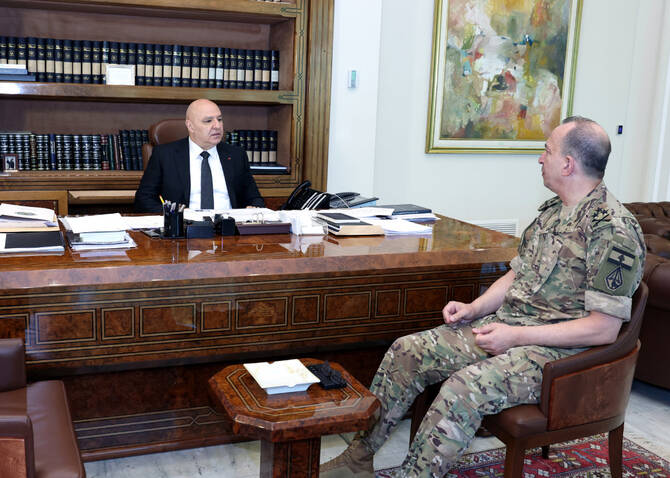
In a forceful response during a meeting with the army commander, Gen. Rodolphe Haykal, President Aoun directed the armed forces to confront any further Israeli incursions into southern Lebanon.
“This aggression, part of a series of Israeli violations, came the day after the Mechanism Committee meeting, which is meant to do more than record facts; it should pressure Israel to respect the Nov. 27 agreement and end its violations of Lebanese sovereignty,” Aoun said.
Prime Minister Nawaf Salam described the Israeli incursion and the killing of the municipal employee as “a blatant attack on Lebanese state institutions and sovereignty.”
He emphasized “the steadfastness of the people of the south and border villages in defending their land, and their right to live in safety and dignity under the sovereignty and authority of the Lebanese state.”
Salam affirmed that Beirut continues “to exert pressure with the United Nations and the countries sponsoring the cessation of hostilities agreement to ensure an end to the repeated violations, and the implementation of a complete Israeli withdrawal from our territory.”
Hezbollah condemned what it described as a “new Israeli crime” as the “Zionist enemy continues its series of crimes on Lebanese territory,” and said Israeli forces “cold-bloodedly executed” Salameh while he slept.
The group accused the US of complicity in the Israeli aggression, saying Washington had given “the green light to every Israeli escalation.” In a rare consensus, Hezbollah called on the Lebanese state to adopt a unified and responsible national stance against the aggression, and praised Aoun’s decision to instruct the army to confront Israeli incursions.
The Israeli military confirmed the operation in Blida took place. It said forces had been targeting Hezbollah infrastructure in the area and fired on a “suspect” after identifying an “immediate threat.” It said the incident was under review, and accused Hezbollah of using the municipal building “for terrorist activity under the guise of civilian infrastructure.”
Avichai Adraee, a spokesperson for the Israeli army added: “This is yet another example of Hezbollah's modus operandi, which endangers the Lebanese population by cynically exploiting civilian facilities for terrorist purposes.”
The presence of “terrorist infrastructure” in the area constitutes a violation of the understandings between Israel and Lebanon, he said.
In a separate strike early on Thursday, Israeli forces blew up a hall used for religious ceremonies in the nearby border village of Adaisseh, Lebanon’s National News Agency reported.
Israel has repeatedly violated the ceasefire agreement through incursions into Lebanese territory, causing tensions to rise in the region. The death toll since the peace deal between Lebanon and Israel came into effect nearly a year ago stands at about 390. The majority of those killed were Hezbollah members and the remainder civilians, including women and children.


