

China-Saudi relations entering new phase driven by tech, innovation, say business leaders

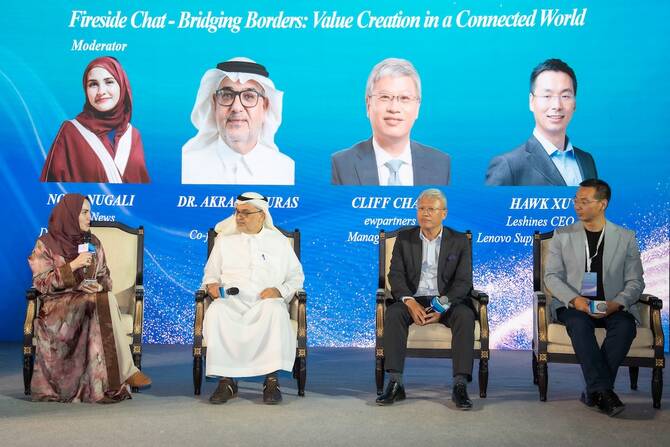
Arab News Deputy Editor-in-Chief Noor Nugali, Aces CEO Akram Aburas, ewpartners managing partner Cliff Chau and Leshines CEO Hawk Xu speak during a panel at ewpartners' China Night in Riyadh on Wednesday. (AN Photo)
Short Url
Updated 30 October 2025
Follow

China-Saudi relations entering new phase driven by tech, innovation, say business leaders

  • Noor Nugali, Deputy Editor-in-Chief of Arab News, moderates talk
  • Construction, health, trade, logistics on the agenda at ‘China Night’

RIYADH: Business leaders from China and Saudi Arabia say cooperation between the two countries is entering a new phase, driven by technology transfer, joint innovation and large-scale infrastructure projects.

They were speaking during a panel discussion at ewpartners’ “China Night” in Riyadh on Wednesday evening, with Arab News is a media partner.

Noor Nugali, Arab News’ Deputy Editor-in-Chief, moderated the discussion.

Aces CEO Akram Aburas said that China has become an important reference point for the Kingdom as it undertakes massive development projects.

“In Saudi Arabia now, obviously everybody knows that we are going to make larger scale projects in construction, airport facilities, and healthcare facilities,” he said.

“China is a very good role model for us, because when it comes to China, any project implemented there is usually implemented on a massive scale and high-tech scale. It means that you have a robust, you have a very strong system installation base.

“It’s very good to get some of these technologies and implement them in Saudi Arabia … the potential success, is extremely high once we use it in Saudi.”

Aburas said the perception of Chinese technology has shifted dramatically over the past decade, with China now recognized for its large-scale deployment and technological maturity.

“We have to admit, and we have to realize the Chinese technology is an age of technology. The perception 10 years ago doesn’t exist,” he said.

“China has massive installations, they have massive deployment and massive investment in terms of technology.”

He noted that as a Saudi Arabia operator responsible for managing large infrastructure projects, such work demands extensive technological integration and large-scale system deployment.

Aburas also discussed how Saudi Arabia firms are starting to co-develop intellectual property with Chinese partners under government-supported initiatives.

“We are capitalizing our installation, but also our technical knowledge, with the support of the government to create an IP. And then we approach multiple technology partners, partnered with China, and now we start using for our own but also go (to) the international market.”

Hawk Xu, Leshine’s CEO and CTO of Lenovo Supply Chain, said Saudi Arabia’s geographic position makes it one of the world’s most strategic gateways for global trade and logistics.

“If you look at physical locations, definitely, it’s sitting almost at the center of Asia Pacific, GCC, and even for Europe.”

“So we believe the global trade is offering, I think, more opportunities for global supply chains, and also definitely as logistics for cross ordering … So this is definitely one of our most important strategic countries, a market we will focus (on) and we committed to continue the best.”

Xu noted that companies from across East Asia are increasingly drawn to the Kingdom’s industrial and green technology ambitions.

“We hope to bring our capabilities here and empower more companies to root here, to grow up here, and also to, really, I think, get more business here,” he said. “The green energy and also recycling economy are also key focuses for us.”

Cliff Chau, managing partner at ewpartners, emphasized the pace of China’s progress in healthcare and pharmaceutical development, describing how rapid innovation has reshaped the sector over the past decade.

“I would say that in the last 10 years, we narrowed the gap between China and US very quickly. Ten years ago, China healthcare, service, standards, equipment, pharmaceutical, (were) probably 20 years behind the US. Today, in some areas, we are ahead of the US.”

“So I understand that healthcare industry is a big thing here too, to extend the longevity of people, to prevent diseases. And I think the healthcare will have a big opportunity in this country too.”

He said that China’s progress was driven by policy support and the return of internationally trained experts.

“That’s one big important factor, is talent infusion and policy driven. And I think the two, second factor, is the kind of the China speed.”


Ethiopian Cultural Days brings aroma of coffee, flavorful food to Alsuwaidi Park

Updated 3 sec ago
Follow

Ethiopian Cultural Days brings aroma of coffee, flavorful food to Alsuwaidi Park

  • The Global Harmony Cultural Series is open to visitors every day from 4:00 p.m. until midnight

RIYADH: Ethiopian Ambassador to Saudi Arabia Muktar Kedir Abdu attended the opening of Ethiopian Cultural Days at Alsuwaidi Park in Riyadh on Thursday.

The Ministry of Media and the General Entertainment Authority organized Ethiopian Cultural Days as part of the Global Harmony Cultural Series, which has focused on several other countries so far, including Yemen, Indonesia, Syria, and Uganda.

The event witnessed the presence of the Ethiopian ambassador to Saudi Arabia, Muktar Kedir Abdu. (AN photo Huda Bashatah)

The Global Harmony Cultural Series is open to visitors every day from 4:00 p.m. until midnight.

During Ethiopian Cultural Days, guests will see Ethiopian dance groups showcasing diverse folk dances from various regions of Ethiopia.

The Global Harmony Cultural Series opens its doors for visitors every day from 4:00 PM until midnight, welcoming visitors from all nationalities and age groups to enjoy food, culture, live performances, and more. (AN photo Huda Bashatah)

“What caught my attention the most was the DJ. My friends and I come almost every day for the DJ,” Turki Mesmeh, a frequent visitor to Global Harmony, told Arab News. “They brought their cultures to us, all the way to the Alsuwaidi neighborhood.”

Ethiopia has an enormously rich history. According to National Geographic, the ancient African kingdom of Aksum was based in what is now northern Ethiopia and parts of Eritrea. It emerged as a powerful and wealthy civilization from the 1st to the 10th century CE, controlling the trade routes between the Roman Empire, India, and the Arabian Peninsula. Ethiopia was also among the first countries in Africa to adopt Christianity.

The Global Harmony Cultural Series opens its doors for visitors every day from 4:00 PM until midnight, welcoming visitors from all nationalities and age groups to enjoy food, culture, live performances, and more. (AN photo Huda Bashatah)

Guests to Ethiopian Cultural Days will also discover a range of Ethiopian cuisine.

“The most important dishes are tibs and kitfo. Tibs is meat, fried with tomatoes and other ingredients,” Welday Meles, owner of the Ethiopian restaurant Lucy, told Arab News. 

The Global Harmony Cultural Series opens its doors for visitors every day from 4:00 PM until midnight, welcoming visitors from all nationalities and age groups to enjoy food, culture, live performances, and more. (AN photo Huda Bashatah)

Kitfo is raw minced beef mixed with chili and clarified butter, and is similar to steak tartare.

Another popular dish is beyaynetu, a dish — or series of small dishes — made from a wide variety of ingredients and served with injera — Ethiopia’s famous spongy flatbread made from fermented teff flour.

It is widely known that Ethiopia is the origin of coffee, the beverage that dominates global consumption, and this goes back to an ancient story about a goat herder named Kaldi, who noticed his goats becoming unusually energetic after eating red berries from a particular tree. These red berries were coffee beans. (AN photo Huda Bashatah)

And no celebration of Ethiopia would be complete without coffee. Not only because the coffee plant originated there — legend has it that a goat herder named Kaldi discovered coffee when he noticed that his animals became unusually energetic after eating red berries from a particular tree — but also because the country has preserved its traditional rituals, diverse varieties, and deep cultural connection to coffee, remaining one of its most significant global producers.

Rahika Mohammed, a participant at the event, explained that, in Ethiopia, coffee is commonly served with “popcorn and mastic incense,” adding that “the cup must be full when served.”