Israel bans Red Cross visits to detained Palestinian combatants

1 / 2
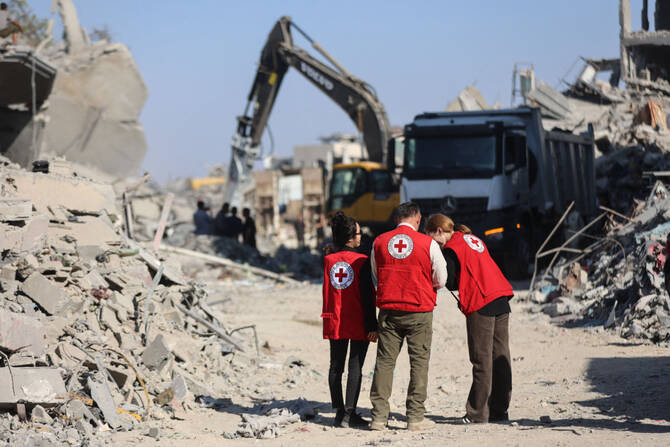
Red Cross staff are seen amid the rubble of destroyed buildings in the al-Tuffah neighborhood of Gaza City, where a recovery operation of the bodies of Israeli hostages was ongoing, on October 27, 2025. (AFP)
2 / 2
A Red Cross ambulance transports the body of a deceased hostage, who had been held in Gaza since the deadly October 7, 2023, attack, after it was handed over by Hamas militants as part of a ceasefire and a hostages-prisoners swap deal with Israel, on October 27, 2025. (Reuters)
Short Url
Updated 30 October 2025
Follow

Israel bans Red Cross visits to detained Palestinian combatants

  • ICRC says the purpose of its visits to places of detention and those deprived of their liberty "is purely humanitarian” 
  • But Defense Minister Israel Katz says "Red Cross visits to terrorists in prisons would seriously harm the state’s security"

JERUSALEM: Israel has banned the International Committee of the Red Cross (ICRC) from visiting Palestinian prisoners detained under a law targeting “unlawful combatants,” the country’s defense minister said on Wednesday.
“The opinions presented to me leave no doubt that Red Cross visits to terrorists in prisons would seriously harm the state’s security. The safety of the state and our citizens comes first,” Israel Katz said, according to a statement from his office.
The order, which was issued just hours before the country’s top court had a hearing on the issue, prohibits the ICRC from visiting thousands of detainees named in a list attached to it.
In practice, the order will make law of the status quo that has prevailed since the war in Gaza started after Hamas’s unprecedented October 7, 2023 attack on Israel.
Under Israeli law, the category of “unlawful combatants,” introduced in 2002, allows for indefinite detention of individuals without charge in military detention centers.
The ICRC says it has not been allowed to visit detainees in jail since then, save for pre-release interviews conducted under Gaza ceasefire and prisoner exchange deals.
“The purpose of the ICRC visits to places of detention and those deprived of their liberty is purely humanitarian,” it said.
“We aim to assess the treatment and conditions of detainees and work with the detaining authorities on ensuring these conditions are according to international standards, as well as restoring contact between the detainees and their families.”
Several NGOs had already told AFP, even before the decree, of delays and complications faced by lawyers seeking to visit Palestinian prisoners.

‘Violation’ 

According to the NGOs, the Israeli prison administration argues that such visits could be used to send or receive messages to and from Palestinian Islamist groups.
During Wednesday’s court hearing the state’s lawyer Ron Rosenberg said that a decision had been made to allow the “transfer of information to the Red Cross,” which would be implented “in the coming days.”
“The information will only include names and detention facilities,” Rosenberg said, and would only be given for prisoners not associated with Gaza or Hamas.
However, Rosenberg said that access to prisoners would be prevented “until all hostages are back” from Gaza.
The Association for Civil Rights in Israel (ACRI), which filed a petition to grant the ICRC access to Israeli prisons, told AFP that some of the combatants are held in military detention centers, and others in regular Israeli jails.
It said that before the ceasefire deal that began on October 10, the Israeli Prison Service “was holding 2,673 prisoners categorized as unlawful combatants.”
It added that hundreds were released under the deal in exchange for hostages held in the Gaza Strip.
In a statement, Hamas said the ban on ICRC visits “constitutes a violation of a fundamental right of our prisoners.”
“This adds to a series of systematic and criminal violations they are subjected to, including killing, torture, starvation, medical neglect, and the withholding of information,” the Palestinian Islamist movement added.
On Tuesday, the Israeli military accused Hamas of faking its search for the bodies of deceased hostages still in Gaza in order to stall the return process.
Providing drone footage as evidence, it said that Hamas staged a body’s discovery in front of ICRC staff, who have facilitated the transfer of hostages and prisoners.
The ICRC said it was unaware the body had been pre-positioned ahead of its team’s arrival, and called the staged discovery “unacceptable,” noting “so much depends on this agreement being upheld.”


Saad Hariri pledges to contest May election

Updated 15 sec ago
Follow

Saad Hariri pledges to contest May election

  • Beirut rally draws large crowds on anniversary of his father’s assassination

BEIRUT: Lebanon’s former Prime Minister Saad Hariri announced on Saturday that his movement, which represents the majority of Lebanon’s Sunni community, would take part in upcoming parliamentary elections scheduled for May.

The Future Movement had suspended its political activities in 2022.

Hariri was addressing a large gathering of Future Movement supporters as Lebanon marked the 21st anniversary of the assassination of his father and former Prime Minister Rafik Hariri, at Martyrs’ Square in front of his tomb.

He said his movement remained committed to the approach of “moderation.”

A minute’s silence was observed by the crowd in Martyrs’ Square at the exact time when, in 2005, a suicide truck carrying about 1,000 kg of explosives detonated along Beirut’s seaside road as Rafik Hariri’s motorcade passed, killing him along with 21 others, including members of his security guards and civilians, and injuring 200 people.

Four members of Hezbollah were accused of carrying out the assassination and were tried in absentia by the Special Tribunal for Lebanon.

The crowd waved Lebanese flags and banners of the Future Movement as they awaited Saad Hariri, who had returned to Beirut from the UAE, where he resides, specifically to commemorate the anniversary, as has been an annual tradition.

Hariri said that “after 21 years, the supporters of Hariri’s approach are still many,” denouncing the “rumors and intimidation” directed at him.

He added: “Moderation is not hesitation … and patience is not weakness. Rafik Hariri’s project is not a dream that will fade. He was the model of a statesman who believed, until martyrdom, that ‘no one is greater than their country.’ The proof is his enduring place in the minds, hearts and consciences of the Lebanese people.”

Hariri said he chose to withdraw from political life after “it became required that we cover up failure and compromise the state, so we said no and chose to step aside — because politics at the expense of the country’s dignity and the project of the state has no meaning.”

He said: “The Lebanese are weary, and after years of wars, divisions, alignments and armed bastions, they deserve a normal country with one constitution, one army, and one legitimate authority over weapons — because Lebanon is one and will remain one. Notions of division have collapsed in the face of reality, history and geography, and the illusions of annexation and hegemony have fallen with those who pursued them, who ultimately fled.”

Hariri said the Future Movement’s project is “One Lebanon, Lebanon first — a Lebanon that will neither slide back into sectarian strife or internal fighting, nor be allowed to do so.”

He added that the Taif Agreement is “the solution and must be implemented in full,” arguing that “political factions have treated it selectively by demanding only what suits them — leaving the agreement unfulfilled and the country’s crises unresolved.”

He said: “When we call for the full implementation of the Taif Agreement, we mean: weapons exclusively in the hands of the state, administrative decentralization, the abolition of political sectarianism, the establishment of a senate and full implementation of the truce agreement. All of this must be implemented — fully and immediately — so we can overcome our chronic problems and crises together.

“Harirism will continue to support any Arab rapprochement, and reject any Arab discord. Those who seek to sow discord between the Gulf and Arab countries will harm only themselves and their reputation.

“We want to maintain the best possible relations with all Arab countries, starting with our closest neighbor, Syria — the new Syria, the free Syria that has rid itself of the criminal and tyrannical regime that devastated it and Lebanon, and spread its poison in the Arab world.”

Hariri said he saluted “the efforts of unification, stabilization and reconstruction led by Syrian President Ahmad Al-Sharaa.”

When asked about the Future Movement’s participation in parliamentary elections following his withdrawal from politics, he said: “Tell me when parliamentary elections will be held, and I will tell you what the Future Movement will do. I promise you that, when the elections take place, they will hear our voices, and they will count our votes.”

The US Embassy in Lebanon shared a post announcing that Ambassador Michel Issa laid a wreath at the grave of Rafik Hariri.

Hariri’s legacy “to forge peace and prosperity continues to resonate years later with renewed significance,” the embassy said.