

Israel bans Red Cross visits to detained Palestinian combatants

1 / 2
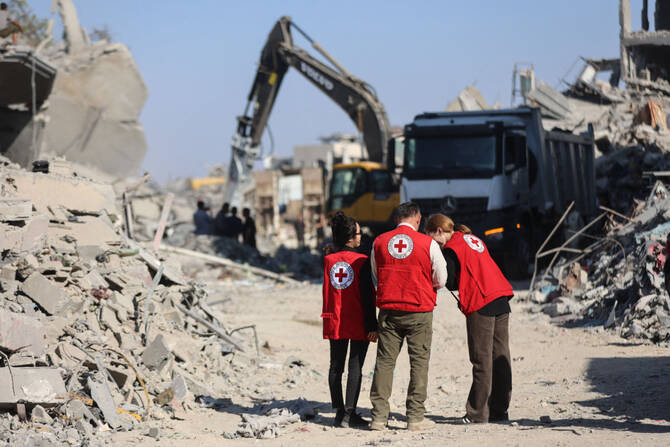
Red Cross staff are seen amid the rubble of destroyed buildings in the al-Tuffah neighborhood of Gaza City, where a recovery operation of the bodies of Israeli hostages was ongoing, on October 27, 2025. (AFP)
2 / 2
A Red Cross ambulance transports the body of a deceased hostage, who had been held in Gaza since the deadly October 7, 2023, attack, after it was handed over by Hamas militants as part of a ceasefire and a hostages-prisoners swap deal with Israel, on October 27, 2025. (Reuters)
Short Url
Updated 30 October 2025
Follow

Israel bans Red Cross visits to detained Palestinian combatants

  • ICRC says the purpose of its visits to places of detention and those deprived of their liberty "is purely humanitarian” 
  • But Defense Minister Israel Katz says "Red Cross visits to terrorists in prisons would seriously harm the state’s security"

JERUSALEM: Israel has banned the International Committee of the Red Cross (ICRC) from visiting Palestinian prisoners detained under a law targeting “unlawful combatants,” the country’s defense minister said on Wednesday.
“The opinions presented to me leave no doubt that Red Cross visits to terrorists in prisons would seriously harm the state’s security. The safety of the state and our citizens comes first,” Israel Katz said, according to a statement from his office.
The order, which was issued just hours before the country’s top court had a hearing on the issue, prohibits the ICRC from visiting thousands of detainees named in a list attached to it.
In practice, the order will make law of the status quo that has prevailed since the war in Gaza started after Hamas’s unprecedented October 7, 2023 attack on Israel.
Under Israeli law, the category of “unlawful combatants,” introduced in 2002, allows for indefinite detention of individuals without charge in military detention centers.
The ICRC says it has not been allowed to visit detainees in jail since then, save for pre-release interviews conducted under Gaza ceasefire and prisoner exchange deals.
“The purpose of the ICRC visits to places of detention and those deprived of their liberty is purely humanitarian,” it said.
“We aim to assess the treatment and conditions of detainees and work with the detaining authorities on ensuring these conditions are according to international standards, as well as restoring contact between the detainees and their families.”
Several NGOs had already told AFP, even before the decree, of delays and complications faced by lawyers seeking to visit Palestinian prisoners.

‘Violation’ 

According to the NGOs, the Israeli prison administration argues that such visits could be used to send or receive messages to and from Palestinian Islamist groups.
During Wednesday’s court hearing the state’s lawyer Ron Rosenberg said that a decision had been made to allow the “transfer of information to the Red Cross,” which would be implented “in the coming days.”
“The information will only include names and detention facilities,” Rosenberg said, and would only be given for prisoners not associated with Gaza or Hamas.
However, Rosenberg said that access to prisoners would be prevented “until all hostages are back” from Gaza.
The Association for Civil Rights in Israel (ACRI), which filed a petition to grant the ICRC access to Israeli prisons, told AFP that some of the combatants are held in military detention centers, and others in regular Israeli jails.
It said that before the ceasefire deal that began on October 10, the Israeli Prison Service “was holding 2,673 prisoners categorized as unlawful combatants.”
It added that hundreds were released under the deal in exchange for hostages held in the Gaza Strip.
In a statement, Hamas said the ban on ICRC visits “constitutes a violation of a fundamental right of our prisoners.”
“This adds to a series of systematic and criminal violations they are subjected to, including killing, torture, starvation, medical neglect, and the withholding of information,” the Palestinian Islamist movement added.
On Tuesday, the Israeli military accused Hamas of faking its search for the bodies of deceased hostages still in Gaza in order to stall the return process.
Providing drone footage as evidence, it said that Hamas staged a body’s discovery in front of ICRC staff, who have facilitated the transfer of hostages and prisoners.
The ICRC said it was unaware the body had been pre-positioned ahead of its team’s arrival, and called the staged discovery “unacceptable,” noting “so much depends on this agreement being upheld.”


Japan, UNOPS sign $4.6m project to restore customs capacity at major Yemeni ports

Updated 9 sec ago
Follow

Japan, UNOPS sign $4.6m project to restore customs capacity at major Yemeni ports

  • The notes for the project were signed and exchanged in Riyadh on Thursday

RIYADH: Japan and the United Nations Office for Project Services have signed an agreement for a new grant aid project aimed at improving customs functions at key ports in Yemen.

The notes for the project were signed and exchanged in Riyadh on Thursday by Yoichi Nakashima, Japan’s ambassador to Yemen, and Muhammad Usman Akram, representative and director of the UNOPS Operational Hub in Amman. The grant amounts to 732 million yen (approximately $4.6 million).

The initiative, titled “The Project for the Improvement of Customs Functions at Major Ports,” seeks to address mounting operational challenges facing Yemen’s customs authorities after years of conflict.

Officials said damage to cargo inspection infrastructure, particularly X-ray screening systems, has significantly reduced inspection capacity at customs facilities. As a result, only about 20 percent of cargo entering through affected ports can be scanned, while the remaining shipments are subject to manual inspection.

This imbalance has contributed to prolonged clearance times and increased risks, including the potential smuggling of weapons, narcotics and other prohibited goods, according to statements delivered at the ceremony.

The project will focus on three major entry points: Aden Sea Port in Aden Governorate, Al-Shihn Land Port in Al-Mahra, and Al-Wadiah Land Port in Hadramout.

Under the agreement, Japan will fund the rehabilitation of X-ray inspection systems and the provision of modern detection equipment. The program also includes capacity development measures, including specialized training for Yemeni customs officials.

Speaking at the event, Nakashima said the project was designed to strengthen the operational capabilities of the Yemeni Customs Authority over an 18-month period. Improving inspection efficiency would help accelerate procedures while reducing reliance on manual checks.

Strengthening customs systems was expected to facilitate smoother trade flows and improve the handling of humanitarian shipments, which remain critical amid Yemen’s ongoing humanitarian crisis, he added.

UNOPS representative Akram described the agreement as a significant step forward in supporting Yemen’s customs authorities through Japanese funding.

“Today marks a significant step forward in strengthening the Yemeni Customs Authority through vital and much appreciated funding from our longstanding partner, the Government of Japan,” he said during the ceremony.

He added the project aimed to address key operational challenges facing the Yemen Customs Authority and enhance efficiency by strengthening institutional capacity in cargo inspection and clearance procedures.

According to Akram, the initiative is expected to reduce the time and costs associated with importing goods into Yemen, including humanitarian assistance.

To achieve these objectives, UNOPS will draw on its procurement expertise to acquire cargo inspection devices and critical spare parts required to restore existing vehicle and container scanners, alongside other necessary equipment.

Akram added that the program will also include capacity-building and training components to support effective operationalization of the upgraded systems.

He said Yemen had a historical role as a major trading crossroads linking the Red Sea and the Gulf of Aden, describing the measures under the project as an important step toward revitalizing and modernizing the country’s customs infrastructure.

The improvements, he said, were expected to facilitate trade, strengthen revenue collection and support the Yemeni government’s broader reconstruction and development priorities.

Akram also expressed appreciation to the Government of Japan for its continued partnership, as well as to Yemeni authorities for their cooperation in facilitating operational and logistical processes related to UNOPS projects.

“UNOPS remains committed to supporting the efforts of the Government of Yemen towards reconstruction and sustainable development with the valuable support of the international community,” he said.

Yemen’s Deputy Finance Minister Hani Wahab welcomed the agreement, describing the project as a major step in improving customs infrastructure and operational efficiency.

Speaking during the ceremony, he said the initiative would contribute to modernizing automated inspection systems, providing spare parts for equipment and supporting personnel training. He added improved customs capacity would help facilitate trade, strengthen revenue collection and combat the trafficking of illegal goods.

Nakashima also highlighted Japan’s broader development engagement with Yemen, saying the country had provided technical support in customs management through training programs implemented by JICA in recent years.

With the latest grant, total Japanese assistance to Yemen since 2015 has reached approximately $497 million. Japan said it would continue working with UN agencies and international partners to support peace and institutional resilience in Yemen.

This article also appears on Arab News Japan