Pakistan calls for stronger ties with Iran on border security, drug trafficking

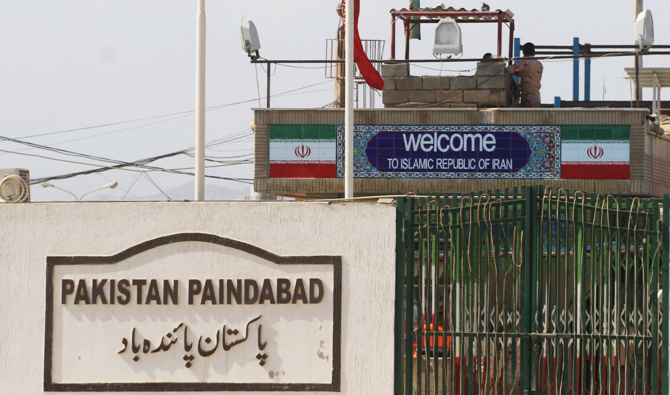
General view of a closed gate at Pakistan and Iran's border posts, after Pakistan sealed its border with Iran as a preventive measure following the coronavirus outbreak, at the border post in Taftan, Pakistan February 25, 2020. (Reuters/File)
Short Url
Updated 29 October 2025
Follow

Pakistan calls for stronger ties with Iran on border security, drug trafficking

  • Interior Minister Mohsin Naqvi holds meetings in Iran on the sidelines of the ECO ministerial conference
  • Pakistan and Iran seek to strengthen security cooperation amid the challenge of rising militant violence

ISLAMABAD: Pakistan’s Interior Minister Mohsin Naqvi has called for closer cooperation with Iran on countering militancy and drug trafficking along with border management, state media reported on Wednesday.

Naqvi’s remarks came during his day-long visit to Iran to attend the Economic Cooperation Organization’s (ECO) Ministerial Conference, where he held separate meetings with his Iranian counterpart Eskandar Momeni and Iran’s Supreme National Security Council Secretary Ali Ardeshir Larijani.

The meetings focused on counterterrorism, anti-narcotics efforts, and improved border management between the two countries, according to the Associated Press of Pakistan (APP).

“We are keen to expand cooperation with Iran, especially in the areas of security and counter-narcotics,” APP quoted Naqvi as saying.

“We wish to benefit from each other’s experiences on internal security matters.”

During the meetings, both sides called for “closer collaboration and institutional linkages” to address shared challenges, with Larijani describing the talks as “encouraging and constructive.”

Earlier in October, Pakistan and Iran agreed to form a joint committee to resolve border trade and logistics issues between the two nations.

The two countries share a 900-kilometer porous border, which they hope can help boost their transport and energy sectors as part of broader efforts to enhance regional connectivity and economic integration.

However, militancy along the shared border encompassing Pakistan’s southwestern Balochistan province and Iran’s southeastern Sistan-Baluchestan province has hindered trade and logistics.

Both regions are restive, mineral-rich and largely underdeveloped due to decades of insurgencies.

Islamabad and Tehran have also voiced their desire in recent months to increase bilateral trade to $10 billion.


Pakistan warns of heavy rain, snowfall and landslide risks in northern districts from today

Updated 5 sec ago
Follow

Pakistan warns of heavy rain, snowfall and landslide risks in northern districts from today

  • Khyber Pakhtunkhwa says snowfall can make roads slippery in tourist resorts like Naran, Kaghan and Kalam
  • Provincial authorities warn tourists and travelers to avoid unnecessary movement during the weather spell

PESHAWAR: The Provincial Disaster Management Authority (PDMA) of Pakistan’s Khyber Pakhtunkhwa warned Friday heavy rains and snowfall expected from today through Dec. 15 could trigger landslides, road closures and hazardous travel conditions across the northern districts.

The alert follows forecasts of widespread precipitation in the province’s mountainous regions, where steep slopes and winter road conditions routinely heighten the risk of disruption.

Dense fog is also expected in the plains, including Peshawar, Mardan, Nowshera and Swabi, potentially affecting visibility and slowing motorway traffic.

“The Provincial Disaster Management Authority has issued alerts to all relevant departments to take advance precautionary measures,” the agency said.

It warned that snowfall could make roads slippery in areas such as Naran, Kaghan, Kalam and Jabba, while heavy rain and snow “may increase the risk of landsliding.”

Residents living close to rivers, streams and seasonal water channels were advised to remain vigilant.

Rain and snowfall are also forecast in Chitral, Dir, Swat, Shangla, Kohistan, Mansehra, Abbottabad, Galyat, Haripur, Buner, Mohmand, Khyber, Orakzai, Kurram and North and South Waziristan.

Tourists and travelers were urged to avoid unnecessary movement during the weather spell. Daytime temperatures are expected to fall sharply as the cold system intensifies.

Local administrations have also been instructed to keep drainage systems active ahead of the expected rainfall.

Pakistan has faced a series of extreme-weather emergencies in recent years — from devastating floods in 2022 to recurring droughts and record heatwaves — despite contributing less than one percent to global carbon emissions.

Officials say climate volatility has made mountainous regions more prone to landslides and flash floods, highlighting the importance of early warnings and local preparedness.