

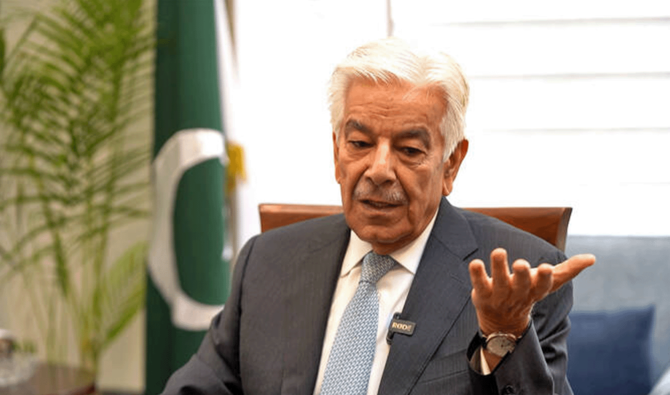

ISLAMABAD: Pakistan’s Defense Minister Khawaja Asif on Wednesday warned that Islamabad would carry out strikes “deep into Afghanistan” if militant attacks from Afghan soil continued, a day after peace talks between the two sides collapsed in Türkiye.
Talks in Istanbul, facilitated by Türkiye and Qatar, ended Tuesday without an agreement. Information Minister Attaullah Tarar said the four-day discussions failed to yield a “workable solution,” accusing Kabul of evading commitments to curb militants operating from Afghanistan to launch attacks on Pakistan.
The negotiations followed a sharp rise in cross-border clashes earlier this month, the heaviest fighting in years. Pakistan said it had carried out air strikes near Kabul against the Tehreek-e-Taliban Pakistan (TTP), claiming the group enjoys sanctuary in Afghanistan. Taliban forces retaliated with assaults on Pakistani military posts along the disputed 2,600-km (1,600-mile) frontier.
Islamabad has demanded assurances that Afghan territory would not be used by the TTP or other militants staging raids into Pakistan, while the Taliban government urged Pakistan to respect its sovereignty and halt cross-border strikes. Kabul denies it harbors militants.
“We will carry out strikes,” Asif told reporters at the Parliament House when asked what options Pakistan would avail if cross-border attacks from Afghanistan continued.
“We will certainly do it if their territory is used and if our territory is violated, if we have to go deep into Afghanistan to retaliate, we certainly will.”
The defense minister’s statement followed hours after his earlier one on X, in which he warned that Pakistan would “obliterate” the Taliban if cross-border militancy did not end.
“Let me assure them [Afghan authorities] that Pakistan does not require to employ even a fraction of its full arsenal to completely obliterate the Taliban regime and push them back to the caves for hiding,” Asif said in a post on X.
“If they wish so, the repeat of the scenes of their rout at Tora Bora with their tails between the legs would surely be a spectacle to watch for the people of the region.”
“We have borne your treachery and mockery for too long, but no more,” he added. “Any terrorist attack or any suicide bombing inside Pakistan shall give you the bitter taste of such misadventures.”
Asif’s reference to Tora Bora alluded to the US bombardment of Taliban and Al-Qaeda fighters in Afghanistan’s White Mountains in late 2001, when many militants fled into Pakistan following the fall of the Taliban regime after the September 11 attacks.
Asif accused the Taliban of “blindly pushing Afghanistan into yet another conflict” to sustain a war economy, and alleged that archrival and neighboring India was exploiting divisions within the regime.
“The government in Kabul has been penetrated by India, and India has started a proxy war against Pakistan through Kabul,” he told a local TV channel on Tuesday.
Pakistan has long blamed India for backing militant networks, including the TTP, a charge New Delhi denies.
The tensions come amid a spike in militant violence inside Pakistan in recent months, particularly in the northwest, where attacks by the TTP have killed scores of soldiers and civilians.
The Taliban returned to power in Afghanistan in 2021 after the US withdrawal, and relations with Islamabad have steadily deteriorated as Pakistan accuses Kabul of sheltering anti-state fighters, which it denies.
Speaking about the negotiations, a Pakistani security official on condition of anonymity said the Afghan delegation appeared divided among rival power centers in Kandahar, Kabul and Khost, complicating any written guarantees on militant sanctuaries.


