

Iran proposes regional currency to boost trade

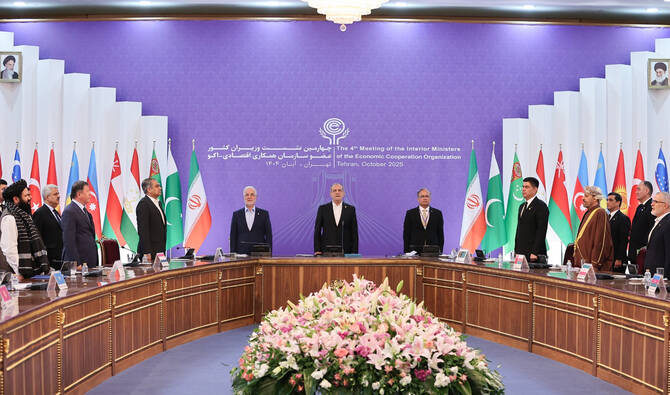
Iranian President Masoud Pezeshkian (center) and other delegates attend the Economic Cooperation Organization (ECO) summit in Tehran on October 28, 2025. (ECO)
Short Url
Updated 28 October 2025
Follow

Iran proposes regional currency to boost trade

  • Iran regards its geographical location as a bridge between Asia and Europe
  • Pezeshkian says if regional countries unite, they can overcome obstacles

TEHRAN: Iranian President Masoud Pezeshkian on Tuesday proposed that Iran and its regional trading partners establish a shared currency to boost commerce amid crippling Western sanctions.

Years of international sanctions, largely imposed by the United States over Tehran’s nuclear program, have severely weakened Iran’s economy.

The latest measures were reimposed by the United Nations in September, after months of stalled nuclear diplomacy.

Speaking on the sidelines of the Economic Cooperation Organization (ECO) summit in Tehran, Pezeshkian said religious and cultural ties in the region could create conditions for closer communication and cooperation.

“Even a common currency could be adopted in the region to help promote economic development,” he told a meeting with Tajik Interior Minister Ramazan Rahimzada, according to the presidency’s website.

Founded in 1985 by Iran, Pakistan, and Turkiye, the ECO now has 10 members, including five Central Asian countries, and aims to strengthen regional trade.

Sitting at the core of the Middle East and with a population of more than 91 million according to the World Bank, Iran regards its geographical location as a bridge between Asia and Europe.

Tehran is pursuing economic opportunities despite sanctions over its nuclear program.

Western countries, led by the US and supported by Israel, accuse Iran of seeking a nuclear weapon, a claim Tehran denies.

Pezeshkian said that if regional countries unite economically and culturally, they can overcome obstacles imposed by external powers.


US ‘totally stupid’ to attack Iran during talks: UN ambassador

Updated 5 sec ago
Follow

US ‘totally stupid’ to attack Iran during talks: UN ambassador

  • “War was not our option. War was imposed on Iran,” Bahreini told UN correspondents
  • “Nobody should expect Iran to show restraint in front of aggression”

GENEVA: The United States made a “totally stupid decision” to attack Iran while in negotiations, and betrayed Gulf nations by trashing their diplomatic efforts, Tehran’s UN ambassador said Tuesday.
Ali Bahreini, Iran’s ambassador in Geneva, insisted Tehran had no problem with its neighbors, but could not let US bases in the Gulf be used as launchpads for attacks on Iran.
“War was not our option. War was imposed on Iran,” Bahreini told UN correspondents.
“Nobody should expect Iran to show restraint in front of aggression.
“We will continue our defense until the point that this aggression is stopped,” he said.
On February 26, Washington and Tehran held indirect negotiations in Geneva on Iran’s nuclear program — with the Omani mediators reporting “significant progress.”
Bahreini was present for part of those talks and said “everybody was optimistic” and the US team “agreed to continue negotiations” in Vienna this week.
But Bahreini said Israeli Prime Minister Benjamin Netanyahu had convinced US President Donald Trump to destroy diplomacy and attack Iran, with strikes starting on Saturday.
“It was a totally stupid decision. They will know in the future how stupid this decision has been. Both of them will understand, because Iran will firmly determine the situation and the destiny of this war,” he said.
“All our neighbors are now disappointed with the betrayal of the United States because everybody was working for diplomacy, particularly Oman.
“The US betrayed everybody.”

- ‘Not a regional war’ -

Tehran has launched strikes against countries in the region that host US bases.
“I cannot accept labelling what we are doing as reprisal. What we are doing is a kind of self-defense,” said Bahreini.
The ambassador said Iran’s problem was not with its neighbors, describing the Gulf countries as friends.
“We are in daily dialogue with our neighbors to convey to them the message that this war is not a war against our neighbors.
“This is not a regional war.
“But we cannot ignore the fact that the US bases in their lands are operational against us.
“In no way we can allow those bases to be used to make military operations against Iran.”
He said Iran’s operations were “exclusively” against US military targets, and said “there has been very serious order given to our military forces not to make any harm to civilians.”
Trump claimed Tuesday that the Iranian leadership “want to talk” but Bahreini insisted no approach had been made to Washington, saying “there hasn’t been any contact from our side” since the war erupted.