

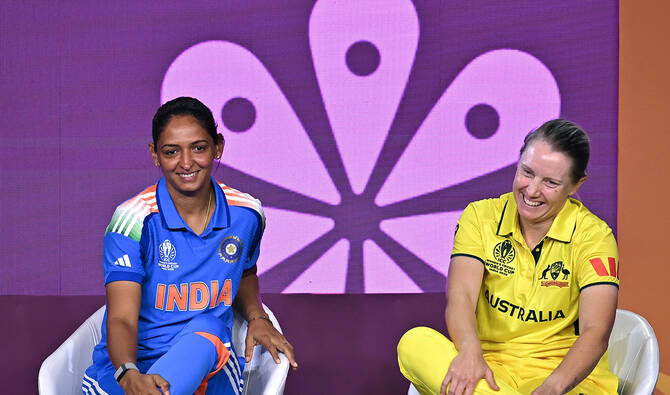

MUMBAI, India: Defending champions Australia surged unbeaten into the Women’s World Cup semifinals and are clear favorites to defeat hosts India in front of an expected sell-out crowd.
Seven-time champions Australia won six of their seven league matches to underline why they are the team to beat in the 50-over tournament, the other game being a washout.
India and Australia clash at the 45,000-capacity DY Patil Stadium on the outskirts of Mumbai on Thursday after the first semifinal between England and South Africa in Guwahati on Wednesday.
India will have the crowd firmly on their side and the country of 1.4 billion is desperate to win a first women’s World Cup crown in its favorite sport.
“You’re not just playing the XI on the field, you’re playing their whole nation, and the whole stadium is going to be a sea of blue,” Australia leg-spinner Alana King said.
“But I think the biggest thing is just embrace it. We know not everything’s going to be on our side that night, but if we just stick together and stick to our processes and try to execute our plans that we’ve got with bat and ball, it’s going to put us in a better position.”
Australia suffered a few scares in the first stage, including when Pakistan reduced them to 76-7 in a match they eventually won convincingly by 107 runs.
India, led by Harmanpreet Kaur, also tested Australia by posting 330 but the title-holders overhauled the total with three wickets and one over to spare.
Australia are sweating on the return of skipper Alyssa Healy, who missed the last two league matches with a calf injury after scoring 294 runs including two centuries in four innings.
In their previous victory, over South Africa, Australia were clinical with King starring with best-ever World Cup bowling figures of 7-18.
AUSTRALIA BEATABLE
In contrast, India had a patchy run in the league phase, where they lost three successive matches before clinching the last semifinal spot.
Opener Smriti Mandhana is in top form and leads the tournament batting with 365 runs including one ton in seven matches.
But the home team suffered a blow when another in-form opener, Pratika Rawal, went out injured in their last league match and has been replaced by Shafali Verma for the semifinal.
India have twice been runners-up, in 2005 and 2017 — when they beat Australia in the semifinals before losing to England.
Since that semifinal defeat to India, Australia have been on a roll with 15 ODI World Cup wins in a row.
Former India captain Mithali Raj said the current team can halt the Australian juggernaut.
“I think now there is this thought that it’s a possibility to beat this Australian side despite all the strengths that they boast,” Raj told ESPNcricinfo.
HOT AND COLD
England, the most successful team historically behind Australia, take on perennial underdogs South Africa.
Led by Nat Sciver-Brunt, England’s only defeat so far at this edition of the tournament was to Ashes rivals Australia.
They are favorites against a South Africa team that was bundled out for 97 before Australia raced to their target in 16.5 overs in the league stage.
Opener Laura Wolvaardt has led the Proteas with 301 runs and will be key to giving them a strong start in the knockout match.
The South Africans have run hot and cold in the eight-nation tournament, including notching up a total of 312-9 in 40 overs in a big win over Pakistan.
The final is on Sunday.


