Pakistan offers Bangladesh Karachi Port as gateway for trade with China, Central Asia

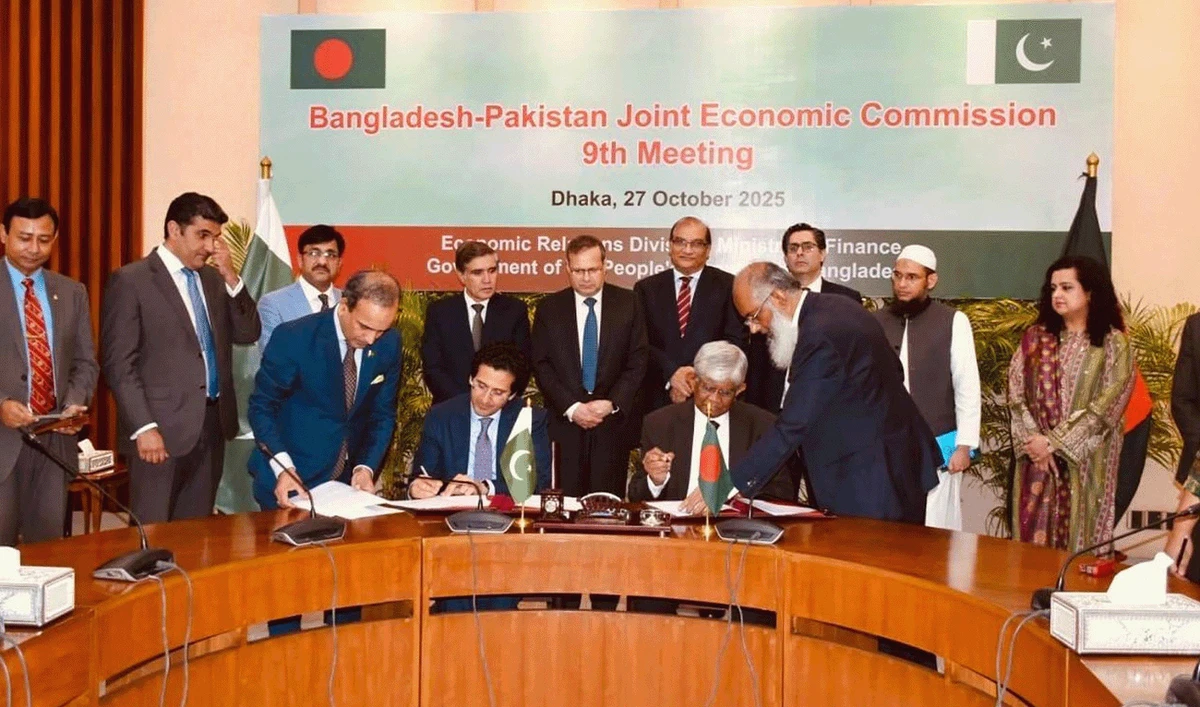
Pakistan's Federal Minister for Petroleum, Ali Pervaiz Malik (front row-right) and Bangladesh's Financial Advisor, Dr. Salehuddin Ahmed, signing MoUs at the ninth session of the Pakistan-Bangladesh Joint Economic Commission in Dhaka, Bangladesh, on October 28, 2025. (PID)
Short Url
Updated 28 October 2025
Follow

Pakistan offers Bangladesh Karachi Port as gateway for trade with China, Central Asia

  • Ninth session of Pakistan-Bangladesh Joint Economic Commission held in Dhaka after hiatus of 20 years
  • Both sides stress on importance of establishing air connectivity to boost tourism, business exchanges

ISLAMABAD: Pakistan’s government this week offered the Karachi Port Trust (KPT) as a gateway for Bangladesh’s regional trade with China and Central Asian states, state media reported, as Islamabad eyes renewed trade with Dhaka amid a thaw in ties. 

The development took place during the ninth session of the Pakistan-Bangladesh Joint Economic Commission (JEC) organized in Dhaka on Monday after a hiatus of 20 years. The session was co-chaired by Pakistan’s Petroleum Minister Ali Pervaiz Malik and Bangladesh’s Finance Adviser Dr. Salehuddin Ahmed. 

Both sides signed the Agreed Minutes of the JEC, reflecting progress in trade, investment and industries, agriculture, transport and communications, education, information technology, health, tourism, energy and other sectors. 

“The two sides emphasized the importance of enhancing cooperation between the national shipping corporations, with Pakistan offering the use of Karachi Port Trust as a gateway for Bangladesh’s trade with regional countries, including China and the Central Asian States,” Pakistan’s Press Information Department (PID) reported on Monday. 

Pakistan and Bangladesh also agreed to work actively on establishing direct air connectivity, recognizing its vital role in promoting tourism and business exchanges, PID said. 

The two sides also signed an agreement on cooperation in halal trade between the Pakistan Halal Authority and the Bangladesh Standards and Testing Institute, paving the way for enhanced collaboration in standardization and certification of halal products.

“Both sides agreed to cooperate in the areas of medical and religious tourism, and to promote greater cultural exchanges between the two countries,” PID said. 

Pakistan and Bangladesh have signaled a gradual easing of historic tensions in recent months, with regular exchanges between the two countries political and military leadership, ever since the ouster of former prime minister Sheikh Hasina. 

Pakistan and Bangladesh were once one nation, but they split in 1971 after a bloody civil war, which saw the part previously referred to as East Pakistan seceding to form the independent nation of Bangladesh.

In the years since, Bangladeshi leaders, particularly Hasina, chose to maintain close ties with India, Pakistan’s arch-rival. Ties between Pakistan and Bangladesh have warmed up since Hasina’s ouster as a result of a student-led uprising in August 2024, with both sides cautiously reopening diplomatic channels.

This February, Bangladesh resumed direct trade with Pakistan for the first time since its independence in 1971, with the first shipment of 50,000 tons of rice leaving Pakistan’s Port Qasim under a government-to-government deal.


Pakistan highlights Gwadar transshipment role as shipping routes face disruption over regional tensions

Updated 05 March 2026
Follow

Pakistan highlights Gwadar transshipment role as shipping routes face disruption over regional tensions

  • Pakistani ports possess “untapped potential” to attract global shipping lines for transshipment operations, says minister
  • Pakistan eyes leveraging Gwadar as regional transshipment hub as Iran’s closure of Strait of Hormuz disrupts global maritime trade

KARACHI: Pakistan’s Maritime Affairs Minister Junaid Anwar Chaudhry on Thursday highlighted the importance of the port city of Gwadar’s transshipment role as major shipping routes, including the Strait of Hormuz, face disruption due to Iran’s ongoing conflict with the US and Israel in the Gulf. 

The meeting takes place as Iran has effectively closed the Strait of Hormuz, a strategic waterway that lies between it and Oman. It is one of the world’s most critical oil transit routes, with roughly 20 percent of global oil supplies passing through it. Iran has vowed it will attack any ship that enters the strait, causing energy prices to rise sharply on Monday amid disruptions to tanker traffic in the waterway.

Gwadar is a deep-sea port in Pakistan’s southwestern Balochistan province that lies close to the Strait of Hormuz. Pakistani officials have in the past highlighted Gwadar’s geostrategic position as the shortest trade route to the Gulf and Central Asia, stressing that it has the potential to become a regional transshipment hub.

Chaudhry chaired a high-level meeting of government officials to assess emerging logistical challenges facing Pakistan’s trade, particularly in the energy sector, amid tensions in the Gulf. 

“Special focus was placed on fully leveraging the potential of Gwadar Port as a regional transshipment hub and positioning it as an alternative of regional instability,” Pakistan’s maritime affairs ministry said in a statement. 

The minister said Pakistani ports possessed “significant untapped potential” to attract international shipping lines for transshipment operations, noting that it could also ensure long-term sustainability and growth of the country’s maritime sector.

Participants of the meeting discussed measures to strengthen Pakistan’s position as a viable alternative transit and transshipment destination, as key waterways are affected by the disruption. 

The committee also reviewed proposals to amend relevant rules and regulations to facilitate international transshipment operations through on-dock and off-dock terminals.

The chairmen of the Port Qasim Authority, Karachi Port Trust and Gwadar Port Authority attended the meeting, briefing committee members on the current operational readiness of their ports. They spoke about the available capacity for container transshipment, bulk cargo handling and refueling services at Pakistani ports. 

The port in Gwadar is a central part of the China-Pakistan Economic Corridor (CPEC), under which Beijing has funneled tens of billions of dollars into massive transport, energy and infrastructure projects in Pakistan.

Pakistan has long eyed the deep-sea port as a key asset that can help boost its trade with Central Asian states, the Gulf region and ensure the country earns valuable foreign exchange.