

Pakistan offers Bangladesh Karachi Port as gateway for trade with China, Central Asia

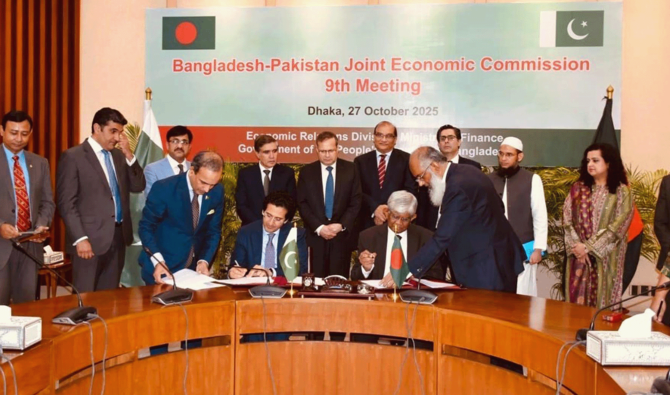
Pakistan's Federal Minister for Petroleum, Ali Pervaiz Malik (front row-right) and Bangladesh's Financial Advisor, Dr. Salehuddin Ahmed, signing MoUs at the ninth session of the Pakistan-Bangladesh Joint Economic Commission in Dhaka, Bangladesh, on October 28, 2025. (PID)
Short Url
Updated 28 October 2025
Follow

Pakistan offers Bangladesh Karachi Port as gateway for trade with China, Central Asia

  • Ninth session of Pakistan-Bangladesh Joint Economic Commission held in Dhaka after hiatus of 20 years
  • Both sides stress on importance of establishing air connectivity to boost tourism, business exchanges

ISLAMABAD: Pakistan’s government this week offered the Karachi Port Trust (KPT) as a gateway for Bangladesh’s regional trade with China and Central Asian states, state media reported, as Islamabad eyes renewed trade with Dhaka amid a thaw in ties. 

The development took place during the ninth session of the Pakistan-Bangladesh Joint Economic Commission (JEC) organized in Dhaka on Monday after a hiatus of 20 years. The session was co-chaired by Pakistan’s Petroleum Minister Ali Pervaiz Malik and Bangladesh’s Finance Adviser Dr. Salehuddin Ahmed. 

Both sides signed the Agreed Minutes of the JEC, reflecting progress in trade, investment and industries, agriculture, transport and communications, education, information technology, health, tourism, energy and other sectors. 

“The two sides emphasized the importance of enhancing cooperation between the national shipping corporations, with Pakistan offering the use of Karachi Port Trust as a gateway for Bangladesh’s trade with regional countries, including China and the Central Asian States,” Pakistan’s Press Information Department (PID) reported on Monday. 

Pakistan and Bangladesh also agreed to work actively on establishing direct air connectivity, recognizing its vital role in promoting tourism and business exchanges, PID said. 

The two sides also signed an agreement on cooperation in halal trade between the Pakistan Halal Authority and the Bangladesh Standards and Testing Institute, paving the way for enhanced collaboration in standardization and certification of halal products.

“Both sides agreed to cooperate in the areas of medical and religious tourism, and to promote greater cultural exchanges between the two countries,” PID said. 

Pakistan and Bangladesh have signaled a gradual easing of historic tensions in recent months, with regular exchanges between the two countries political and military leadership, ever since the ouster of former prime minister Sheikh Hasina. 

Pakistan and Bangladesh were once one nation, but they split in 1971 after a bloody civil war, which saw the part previously referred to as East Pakistan seceding to form the independent nation of Bangladesh.

In the years since, Bangladeshi leaders, particularly Hasina, chose to maintain close ties with India, Pakistan’s arch-rival. Ties between Pakistan and Bangladesh have warmed up since Hasina’s ouster as a result of a student-led uprising in August 2024, with both sides cautiously reopening diplomatic channels.

This February, Bangladesh resumed direct trade with Pakistan for the first time since its independence in 1971, with the first shipment of 50,000 tons of rice leaving Pakistan’s Port Qasim under a government-to-government deal.


Pakistan says 641 Afghan Taliban members killed, over 855 injured in ongoing conflict

Updated 11 sec ago
Follow

Pakistan says 641 Afghan Taliban members killed, over 855 injured in ongoing conflict

  • Both neighbors have been engaged in fierce fighting since Feb. 26 after Afghan forces launched retaliatory attacks against Pakistan
  • Pakistan information minister says 243 Afghanistan checkposts destroyed, 65 “terrorists and terror support locations” targeted by air 

ISLAMABAD: Pakistan has killed at least 641 Afghan Taliban operatives and injured more than 855 in the ongoing conflict between the two sides since last month, Information Minister Attaullah Tarar said on Wednesday.

Fresh clashes between the two neighbors began on Feb. 26 after Afghanistan’s border forces launched attacks against Pakistani military installations. Kabul said the attack was in retaliation for Islamabad’s airstrikes earlier in February. Both forces have since then engaged in the worst fighting between them in decades. 

Islamabad has said its airstrikes, which have at times directly ​targeted the Afghan Taliban government, are aimed at ending Kabul’s support for militants carrying out attacks on Pakistan. The Taliban has ​denied aiding militant groups.

“Summary of Fitna Al Khawarij/Afghan Taliban losses: 641 killed, 855+ injured, 243 check posts destroyed,” Tarar wrote on social media platform X.

https://x.com/tararattaullah/status/2031687512868159638?s=46

The minister said Pakistani security forces have destroyed 219 tanks, armored vehicles and artillery guns in the operation so far, and also decimated 65 “terrorists and terror support locations” across Afghanistan by targeting them with airstrikes. 

Relations between Pakistan and Afghanistan have remained strained since the Afghan Taliban seized power in August 2021. Pakistan has witnessed a surge in militant attacks across the country in recent months that it blames on militants it alleges are based in Afghanistan. 

Kabul denies the allegations and insists that its soil is not used by militant groups for attacks against other countries. 

While Afghanistan has voiced the desire for dialogue, Pakistan has repeatedly ruled out talks, saying it will continue targeting militant hideouts in Afghanistan through “Operation Ghazab lil Haq” till Kabul desists from supporting militants. 

The ongoing conflict between both sides has put the region on heightened alert, as it already suffers from the ongoing US-Israel war against Iran.