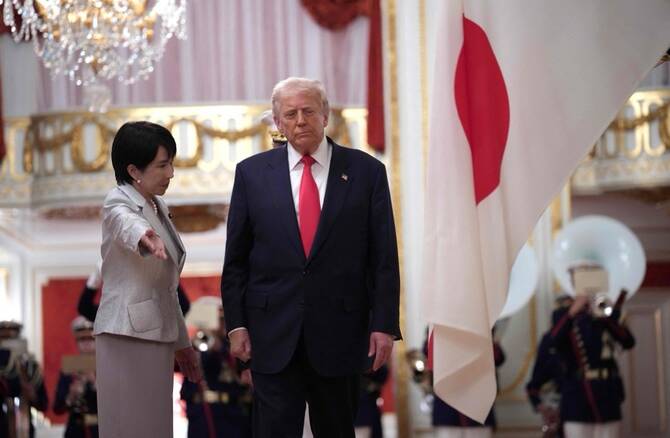
TOKYO: President Donald Trump began one of his busiest days of his Asia trip on Tuesday by warmly greeting the new Japanese prime minister, with plans to later speak to US troops aboard an aircraft carrier and mingle with business leaders.
Although Trump is visiting one of America’s most steadfast allies in Asia, there’s no shortage of uncertainty while he’s there. Sanae Takaichi, who became the country’s first female prime minister only days ago, must solidify her relationship with Trump while defending her country’s economic interests. Trump is trying to nail down $550 billion in Japanese investment as part of a trade deal that would reduce US tariffs.
As Trump and Takaichi met on Tuesday, they shook hands and he paid her a compliment: “That’s a very strong handshake.”
In return, Takaichi talked about watching the third game of the US World Series before the event. She said Japan would give Washington 250 cherry trees next year to honor America’s 250th anniversary, as well as fireworks from Akita Prefecture for July 4 celebrations.
She used her early remarks to mention former Japanese Prime Minister Shinzo Abe, her archconservative mentor who forged a strong bond with Trump during his first term through their shared interest of golf.
“As a matter of fact, Prime Minister Abe often told me about your dynamic diplomacy,” she said.
Trump called her role as Japan’s first woman prime minister as a “big deal,” putting an emphasis on the US commitment to Japan. While the president in the past has publicly scolded his foreign counterparts, he had nothing but praise for Tackaichi.
“Anything I can do to help Japan, we will be there,” Trump said. “We are an ally at the strongest level.”
Takaichi is primed for a charm offensive, including a potential purchase of Ford F-150 trucks. Reporters arriving for the event were hustled past a gold-hued Ford F-150 as well as what appeared to be white American-made Toyota vehicles parked outside the Akasaka Palace, which is Tokyo’s guest house for visiting foreign leaders.
Trump has often complained that Japan doesn’t buy American vehicles, which are often too wide to be practical on narrow Japanese streets.
Both leaders signed the implementation of an agreement for the “golden age” of their nations’ alliance. The content of the agreement was unclear, but when held up after signing the document ran to less than one-page.
Trump and Takaichi then signed a second agreement, this one laying out a US-Japan framework for securing the supply of critical minerals and rare earths.
Although Trump has focused his foreign policy toward Asia around tariffs and trade, he’s also speaking aboard the USS George Washington, an aircraft carrier docked at an American naval base near Tokyo.
Trump arrived in Tokyo on Monday, when he met with the emperor in a ceremonial visit. He was previously in Kuala Lumpur, Malaysia, where he participated in the annual summit of the Association of Southeast Asian Nations.
The gathering was an opportunity for Trump to celebrate an expanded ceasefire agreement between Thailand and Cambodia, which skirmished along their disputed border earlier this year. Trump had pressured them to stop fighting by threatening to withhold trade agreements.
There were also signs that tensions between the US and China were cooling ahead of a planned meeting between Trump and Chinese leader Xi Jinping, which is expected to take place in South Korea later this week. Top negotiators from each country said a trade deal was coming together, which could prevent a potentially damaging confrontation between the world’s two largest economies.
Details were scarce, and it was unclear how much any agreement would resolve long-standing issues, or if it would return the relationship to the status quo before recent confrontations. China has restructured the export of rare earth elements that are critical for high-tech manufacturing, and Trump responded by threatening tariffs that even he admits would be unsustainable.
Trump is scheduled to leave Wednesday for South Korea, which is hosting the Asia-Pacific Economic Cooperation summit.


Trump praises Japan’s new prime minister, saying US is an ‘ally at the strongest level’
https://arab.news/2k2wz
Trump praises Japan’s new prime minister, saying US is an ‘ally at the strongest level’


Greek coast guard search for 15 after migrant boat found adrift
- The two survivors reported that the vessel had become unstable due to bad weather and there was no means of getting shelter, food or water
ATHENS: Greek coast guard were on Monday searching for 15 people who fell into the water from a migrant boat that was found drifting off the coast of Crete with 17 bodies on board.
The 17 fatalities, all of them men, were discovered on Saturday on the craft, which was taking on water and partially deflated, some 26 nautical miles (48 kilometers) southwest of the island.
Post-mortem examinations were being carried out to determine how they died but Greek public television channel ERT suggested they may have suffered from hypothermia or dehydration.
A Greek coast guard spokeswoman told AFP that two survivors reported that “15 people fell in the water” after the motor cut out on Thursday, then the vessel drifted for two days.
At the time, Crete and much of the rest of Greece was battered by heavy rain and storms.
The two survivors reported that the vessel had become unstable due to bad weather and there was no means of getting shelter, food or water.
The vessel had 34 people on board and had left the Libyan port of Tobruk on Wednesday, the Greek port authorities said. Most of those who died came from Sudan and Egypt.
It was initially spotted by a Turkish-flagged cargo ship on Saturday, triggering a search that included ships and aircraft from the Greek coast guard and the European Union border agency Frontex.
Migrants have been trying to reach Crete from Libya for the last year, as a way of entering the European Union. But the Mediterranean crossing is perilous.
In Brussels, the EU’s 27 members on Monday backed a significant tightening of immigration policy, including the concept of returning failed asylum-seekers to “return hubs” outside the bloc.
The UN refugee agency said more than 16,770 asylum seekers in the EU have arrived on Crete since the start of the year — more than any other island in the Aegean Sea.
Greece’s conservative government has also toughened its migration policy, suspending asylum claims for three months, particularly those coming to Crete from Libya.


