

Afghan, Pakistan peace talks enter third day as Trump again offers help

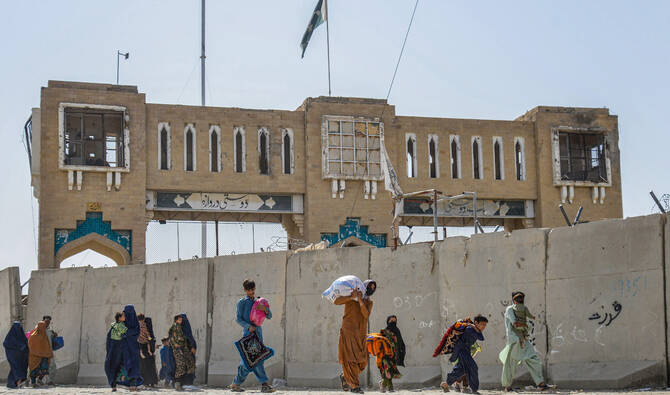
Afghan refugees deported from Pakistan arrive with their belongings at the zero point border crossing between Afghanistan and Pakistan in the Spin Boldak district of Kandahar province on October 19, 2025. (AFP/File)
Short Url
Updated 27 October 2025
Follow

Afghan, Pakistan peace talks enter third day as Trump again offers help

  • Two Pakistan security sources accused the Afghan Taliban of not cooperating with the dialogue process
  • Pakistan Defense minister says failure to reach an agreement in the Istanbul talks would mean “open war”

ISLAMABAD: Afghanistan and Pakistan officials met in Istanbul on Monday for a third day of talks after failing to clinch a lasting peace, three sources familiar with the matter said, as US President Donald Trump repeated an offer to mediate.

The South Asian neighbors agreed to a ceasefire in Doha on October 19 after days of border clashes that killed dozens in the worst such violence since the Taliban seized power in Kabul in 2021.

The current second round of peace talks mediated by Turkiye aims to hammer out a long-term truce, but both sides have offered markedly different interpretations of the talks.

Two Pakistan security sources accused the Afghan Taliban of not cooperating with the dialogue process.

“The Pakistani delegation has made it clear that no compromise is possible on our core demands on cross border terrorism,” one of the sources said.

A Taliban delegate to the talks dismissed as “false” the suggestion that the Islamist group was holding up the talks, adding that the discussions were still in progress.

“Overall the meeting is going well and we discussed multiple issues in a friendly environment,” the person said.

The sources spoke on condition of anonymity as they were not authorized to speak publicly on the issue.

In comments on Monday to state broadcaster RTA, Taliban spokesperson Zabihullah Mujahid said, “The Islamic Emirate of Afghanistan supports dialogue and believes that problems and issues can be resolved through dialogue.”

A spokesperson for Pakistan’s foreign ministry declined to comment on the current status of talks.

On Saturday, Pakistan’s defense minister said he believed Afghanistan wanted peace but that failure to reach an agreement in the Istanbul talks would mean “open war.”

Late on Sunday, Trump repeated an offer to help end the conflict.

“I’ll get that solved very quickly, I know them both,” he said in the Malaysian capital of Kuala Lumpur on the sidelines of a regional summit.

“I have no doubt we are going to get that done quickly.”

The clashes began after Pakistan’s air strike this month on Kabul, the Afghan capital, targeting the head of the Pakistani Taliban, a militant group separate from the Taliban that rules Afghanistan.

The Taliban responded with attacks on Pakistani military posts along the length of the 2,600 km (1,600 miles) border.

Pakistan accuses the Taliban of allowing the Pakistani Taliban to operate with impunity inside Afghanistan, from where it launches attacks on Pakistani security forces. Kabul denies this.

Clashes between Pakistan and the Pakistani Taliban over the weekend killed five Pakistani soldiers and 25 militants near the border with Afghanistan, the military said on Sunday.


Pakistan begins talks with Saudi delegation on local vaccine manufacturing

Updated 7 sec ago
Follow

Pakistan begins talks with Saudi delegation on local vaccine manufacturing

  • Health ministry has warned vaccine import costs could rise from $400 million to $1.2 billion by 2031
  • Local vaccine manufacturing would strengthen health security and help conserve foreign exchange 

ISLAMABAD: Pakistan on Tuesday formally began discussions with a high-level Saudi delegation on establishing local vaccine manufacturing, as Islamabad seeks to reduce import dependence and prepare for the eventual end of international funding support for its national immunization program.

The talks come amid Pakistan’s broader push to strengthen health security and industrial capacity. The country of more than 240 million people currently imports all vaccines used in its national immunization campaigns, relying heavily on international partners to help cover costs.

Officials say local vaccine manufacturing would not only strengthen health security but also help conserve foreign exchange and support Pakistan’s longer-term economic stability as the country looks to cut costly imports and build export-oriented industrial capacity.

According to the Ministry of National Health Services, the eleven-member Saudi delegation is led by Nizar Al-Hariri, senior adviser to Saudi Arabia’s minister of industry, and is visiting Pakistan as part of efforts to deepen bilateral cooperation in health, pharmaceutical manufacturing and industrial collaboration.

“Practical progress is being made toward the local production of vaccines for 13 diseases in Pakistan,” the health ministry said in a statement, quoting Federal Health Minister Syed Mustafa Kamal who met the delegation in Islamabad.

Pakistani officials presented detailed briefings on current vaccine demand, existing infrastructure and production capacity.

“Collaboration between Pakistan and Saudi Arabia in the health sector will set an example for the entire region,” the ministry said.

Kamal told the visiting delegation Pakistan is the world’s fifth most populous country, with around 6.2 million children born each year, adding that the country’s annual population growth is roughly equivalent to the population of New Zealand. 

He said the government currently provides vaccines for 13 diseases free of cost but does not manufacture any of them domestically, forcing Pakistan to import vaccines at an annual cost of about $400 million.

According to the ministry, international partners currently cover 49 percent of those costs, with the remainder borne by the Pakistani government. However, Kamal warned that this external support is expected to end after 2031.

“If vaccines are not manufactured locally, the annual cost could rise to $1.2 billion by 2031, which would place a heavy burden on the national economy,” the ministry quoted him as saying.

Pakistan regularly conducts nationwide immunization campaigns against diseases including polio, measles, rubella and hepatitis. This week, it launched a seven-day polio vaccination drive aimed at inoculating more than 45 million children.