US sees opportunity in expanding strategic ties with Pakistan, Rubio says

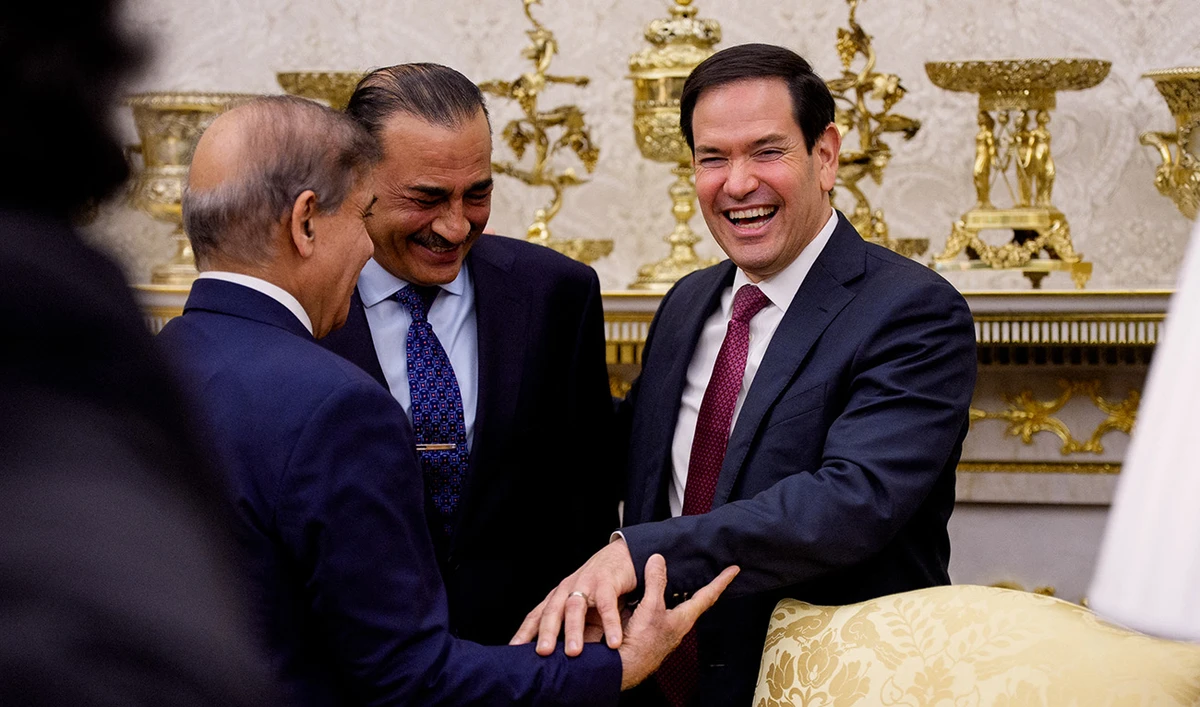
U.S. Secretary of State Marco Rubio (R) greets Prime Minister of Pakistan Shehbaz Sharif (L) as U.S. President Donald Trump speaks to reporters in the Oval Office of the White House on September 25, 2025 in Washington, DC. (AFP/ file)
Short Url
Updated 26 October 2025
Follow

US sees opportunity in expanding strategic ties with Pakistan, Rubio says

  • Islamabad, Washington have come closer in recent months, particularly after President Donald Trump brokered a ceasefire between Pakistan, India
  • Trump this year significantly lowered tariffs on Pakistan, while both sides signed a $500 million deal in Sept. for collaboration in rare earth minerals

ISLAMABAD: Secretary of State Marco Rubio has said that the United States (US) sees an opportunity in expanding its strategic relationship with Pakistan, which does not come at the expense of Washington’s ties with India.

Rubio’s statement came in response to a question at a press briefing on Saturday whether India had raised any concerns about the “stronger relationship” between Washington and Islamabad.

Relations between the US and Pakistan have seen significant ups and downs, but the two countries have come closer in recent months after President Donald Trump brokered a ceasefire between Pakistan and India following their four-day military conflict in May.

Pakistani civilian and military leaders have gained favor with Trump since publicly endorsing him for a Nobel Peace Prize for the ceasefire, with the US president significantly lowering trade tariffs on Pakistan from 29 percent to 19 percent in July this year.

“They really haven’t – I mean, we know they’re concerned for obvious reasons because of the tensions that have existed between Pakistan and India historically. But, I think they have to understand we have to have relations with a lot of different countries,” Rubio said.

“We see an opportunity to expand our strategic relationship with Pakistan, and I think we’ve made – that’s our job, is to try to figure out how many countries we can find how we can work with on things of common interest.”

In Sept., American firm US Strategic Metals (USSM) and Pakistan’s Frontier Works Organization (FWO) signed a $500 million deal for collaboration across a range of minerals essential for the defense, aerospace and technology industries.

“The partnership will begin immediately with the export of readily available minerals from Pakistan, including antimony, copper, gold, tungsten, and rare earth elements. This cooperation lays the foundation for scaling up toward the establishment of a USSM proprietary, highly flexible poly-metallic refinery in Pakistan,” Prime Minister Shehbaz Sharif’s office said.

“The refinery will produce intermediate and finished products dedicated to meeting the rapidly growing demand of the US market. The first phase of this deal is envisaged at approximately $500 million of investments into Pakistan’s critical minerals sector.”

The next steps for the MoU include forming dedicated teams to explore the full potential of Pakistan’s vast resource base, identifying critical minerals for immediate export, and building an anchor position for a long-term partnership in exploration, extraction, and processing.

Critical minerals are a select group of non-fuel minerals and metals essential for modern manufacturing, technological advancements, and the transition to clean energy technologies like solar panels and electric vehicles but are subject to supply chain vulnerabilities.

While Pakistan is rich in gold, copper and lithium reserves as well as other minerals, its mineral sector contributes only 3.2 percent to the country’s GDP and 0.1 percent to global exports, according to official figures.

In August, Pakistani and US officials also discussed ways to strengthen Pakistan’s railways and infrastructure to support mineral extraction and transportation, the US embassy said.
Pakistan sends vessels to Saudi, UAE ports to secure crude supplies amid regional crisis

Updated 5 sec ago
Follow

Pakistan sends vessels to Saudi, UAE ports to secure crude supplies amid regional crisis

  • The development comes as countries scramble to secure energy supplies amid US-Israeli strikes on Iran and Tehran’s counterattacks
  • If Islamabad arranges, Aramco has assured a large crude carrier can be loaded at Yanbu and stationed near Pakistan, minister says

ISLAMABAD: Pakistan has sent vessels to ports in Saudi Arabia and the United Arab Emirates to secure crude oil supplies, the Pakistani petroleum minister said late Friday, as tensions in the Middle East continue to threaten global energy flows.

Global oil markets have been rattled since the United States and Israeli began pounding Iran last week, prompting retaliatory strikes from Tehran across the region. The conflict has raised fears of disruptions in energy supplies, particularly through the Strait of Hormuz, and pushed petroleum prices.

Pakistani Petroleum Minister Ali Pervaiz Malik and others said Islamabad was monitoring international energy markets and domestic supply conditions as they announced a hike of Rs55 ($0.20) per liter in petrol and diesel prices, promising to bring down the prices as soon as the conflict is resolved.

Describing the situation as “extraordinary,” Malik said they did not know how long the Middle East crisis would last and it was important to stretch Pakistan’s available petroleum reserves as much as they could to ensure a steady supply to consumers during the crisis.

“At the regional and global level, you can clearly see that countries are scrambling to secure energy supplies. Pakistan is also part of this effort because a significant portion of our energy supplies comes through the Strait of Hormuz,” he said, adding that Prime Minister Shehbaz Sharif has engaged the Saudi government to secure alternative sources.

“With the help of the Foreign Office, two Pakistan National Shipping Corporation (PNSC) vessels are currently on their way, one toward Yanbu port and the other toward Fujairah port, to bring crude oil from outside the Hormuz region in order to meet Pakistan’s energy needs.”

In addition, he said, Aramco had assured that if Pakistan arranged, a Very Large Crude Carrier (VLCC) can be loaded at Yanbu and stationed near the Pakistani waters.

“From there, PNSC (Pakistan National Shipping Corporation) feeder vessels will ensure a continuous supply of crude oil to our refineries, so that even during this difficult phase Pakistan’s energy requirements continue to be met,” Malik shared.

The statement came as long queues of vehicles were seen outside petrol stations nationwide as Islamabad moved to raise petroleum prices to keep the supplies in check.

Pakistan, which relies heavily on imported fuel to meet its energy needs, is particularly vulnerable to global oil price shocks that can quickly feed into inflation and pressure the country’s external accounts.

Officials at Friday’s presser said Pakistan, which reviews petroleum prices fortnightly, will be considering them more frequently, potentially on a weekly basis, and any reduction in global oil prices would be passed on to consumers.

Finance Minister Aurangzeb said a high-level government committee formed by PM Sharif had been meeting daily to review developments in global petroleum markets and their potential impact on Pakistan’s economy.

“Pakistan currently maintains adequate energy stocks and macroeconomic stability,” Aurangzeb said, adding that the government’s response was based on preparedness rather than panic.