

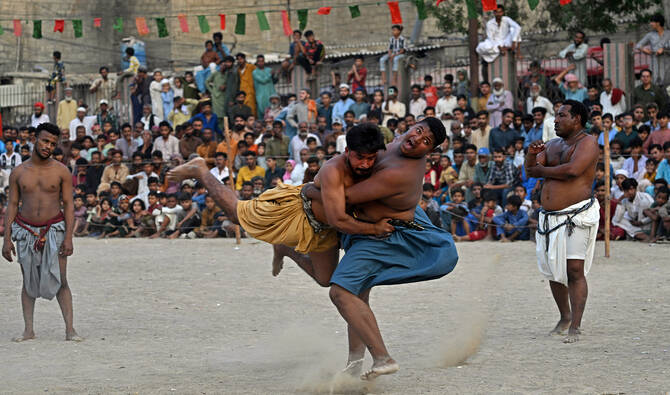

KARACHI: Two wrestlers strain and pull under the harsh glare of the sun, their feet digging into the dusty earth of the football ground. They grunt and twist, trying to unsettle the other and claim victory as hundreds watch with eager anticipation around them.
Scenes like this are typical at a malakhra contest, an ancient and traditional form of wrestling popular in Pakistan’s southern Sindh province. A malakhra showdown begins with both wrestlers, or “pehlwans” as they are known in Urdu, securing a twisted cloth known as a lungi around their opponent’s waist.
The wrestlers use the cloth to throw their opponent to the ground through strength and technique. The wrestler who falls to the ground loses the contest.
The traditional sport is believed to have originated in the ancient city of Mohenjo-Daro thousands of years ago. However, in a country where cricket dominates national passion, wrestlers often complain that malakhra receives little attention.
“This is the only game that has no stadiums, no academies,” Ghulam Nabi Sheedi, a former wrestler and general secretary of the Sindh Malakhra Association, told Arab News on the sidelines of a three-day tournament in Karachi this week.
“I want to say with regret that our game receives very little support from the government.”

Wrestlers compete in a 'Sindhi Malakhra' wrestling match, an ancient form of wrestling that originated in Pakistan's Sindh region, during a local tournament in Karachi on October 21, 2025. (AFP)
The tournament, held at Karachi’s Syed Mehmood Shah Bukhari football ground in the city’s Chanesar Goth area, featured 25 wrestlers, this year. The event is held annually to mark the death anniversary of a revered local saint, Syed Mehmood Shah.
The contests attract hundreds of people every year, a reflection of the sport’s popularity.
However, little government support means malakhra doesn’t have any dedicated facilities and is often held at unspecialized venues such as football grounds.
Khuda Bux Sheedi, another wrestler known by his ring name “Repeater Sheedi,” defeated top contender Rashid Ali Khatian to qualify for the next round of contests.
He echoed the same frustration.
“When you broadcast malakhra, the whole world watches,” he said. “But from the government side, we receive no recognition.”
‘WE HAVE PASSION, SO WE PLAY’
For participants and organizers, malakhra represents a connection to a deep historical legacy.
Behram Khasakheli, president of the Karachi Division Malakhra Association, says the sport dates back to Mohenjo-Daro, the center of the Indus Valley Civilization.
“It is not from today. It is a 5,000-year-old sport,” he said, adding that historical signs of wrestlers playing in a similar style can still be found at the ancient site.
Khasakheli recalled a time when malakhra brought prestige to the nation.
“Bakr Sheedi and Sher Mir Bar, let me remind you, competed against Indian wrestlers and the Indian wrestlers lost,” he said, mentioning the names of former Pakistani malakhra greats.
Today, with a lack of proper facilities at their disposal, wrestlers mostly compete on unsuitable grounds.
“There should be a little softer soil,” Ghulam Nabi Sheedi explained. “Someone could get injured, even die. But we have passion, so we play.”
Sarfaraz Moosa, another wrestler whose family has practiced malakhra for five generations, is all too familiar with the physical risks associated with the sport.
“It’s malakhra. Sometimes your foot goes, sometimes your leg,” he said. “We come with prayers. We leave home with prayers.”
Speaking to Arab News, Sadia Javed, the Sindh administration’s spokesperson, said the province fully supported malakhra.
“There is an endowment fund in place through which the sports department supports these wrestlers just as it supports other sportspersons,” she said. “In addition, when it comes to organizing events, the Sindh government facilitates and hosts malakhra competitions.”
Javed said the provincial administration also helps educated wrestlers secure jobs in various public departments, helping them earn a livelihood and support their families.
“So, to say that the Sindh government does not support malakhra would be incorrect,” she added. “However, since it is an old, traditional game, it doesn’t receive the same level of marketing or media attention as modern sports.”


