

Gaza risks ‘lost generation’ due to ruined schools

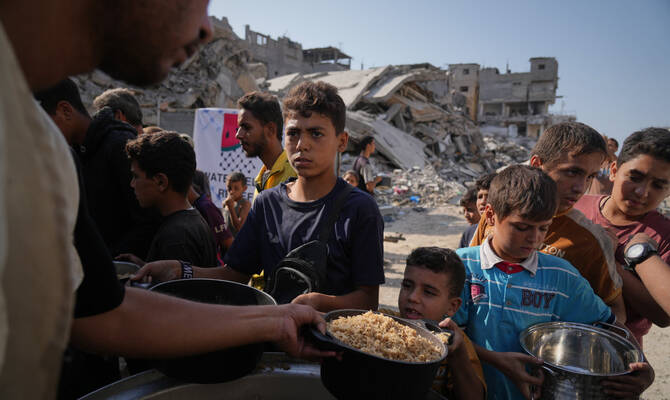
Palestinians receive donated food at a community kitchen in Gaza City. (AP)
Short Url
Updated 26 October 2025
Follow

Gaza risks ‘lost generation’ due to ruined schools

  • The ceasefire has allowed UNICEF and other education partners to get about one-sixth of children who should be in school into temporary “learning centers,” said Beigbeder

JERUSALEM: With Gaza’s education system shattered by two years of grueling war, UNICEF’s regional director says he fears for a “lost generation” of children wandering ruined streets with nothing to do.

“This is the third year that there has been no school,” Edouard Beigbeder, the UN agency’s regional director for the Middle East and North Africa, said in Jerusalem.

“If we don’t start a real transition for all children in February, we will enter a fourth year. And then we can talk about a lost generation.”

The destruction “is almost omnipresent wherever you go,” Beigbeder said.

“It is impossible to imagine 80 percent of a territory that is completely flattened out or destroyed,” he added.

The ceasefire has allowed UNICEF and other education partners to get about one-sixth of children who should be in school into temporary “learning centers,” said Beigbeder.

“They have three days of learning in reading, mathematics, and writing, but this is far from a formal education as we know it,” he added.

Beigbeder said that such learning centers consisted of metal structures covered with plastic sheeting or of tents.

He said there were sometimes chairs, cardboard boxes, or wooden planks serving as tables, and that children would write on salvaged slates or plastic boards.

“I’ve never seen everyone sitting properly,” he added, describing children on mats or carpets.

Despite the ceasefire, Beigbeder said the situation for Gaza’s education system was catastrophic, with 85 percent of schools destroyed or unusable.

Of the buildings still standing, many are being used as shelters for displaced people, he said, a situation compounded by the fact that many children and teachers are also on the move and seeking to provide for their own families.

Gaza’s school system was already overcrowded before the conflict, with half the pre-war population under the age of 18.

Of the schools managed by the West Bank-based Palestinian Authority alone, Beigbeder said that some 80 out of 300 needed renovation.

He said 142 had been destroyed, while 38 were “completely inaccessible” because they were located in the area to which Israeli troops had withdrawn under the ceasefire.

The UN agency for Palestinian refugees, UNRWA, said on Oct. 18 that it was launching a “new e-learning school year” to reach 290,000 pupils.

On Friday, US Secretary of State Marco Rubio accused UNRWA of being a “subsidiary of Hamas” and said it would play no role in post-war Gaza.

Beigbeder said it was vital to put education “at the top of the agenda” and rebuild a sense of social cohesion for Gaza’s children, almost all of whom are traumatized and in need of psychological support.

UNICEF said one of the priorities was obtaining permission at border crossings to bring in materials to set up semi-permanent schools, as well as school supplies, which have been blocked as non-essential.

Israel repeatedly cut off supplies to the Gaza Strip during the war, exacerbating dire humanitarian conditions, with the UN saying it caused a famine in parts of the Palestinian territory.

The World Health Organization said Thursday there had been a slight improvement in the amount of aid going into Gaza since the ceasefire took hold — and no observable reduction in hunger.

“How can you rehabilitate classrooms if you don’t have cement? And above all, we need notebooks and books ... blackboards, the bare minimum,” said Beigbeder.

“Food is survival. Education is hope.”


US military visits contested area in northern Syria to defuse rising tensions

Updated 14 sec ago
Follow

US military visits contested area in northern Syria to defuse rising tensions

  • US has good relations with both sides and has urged calm

DEIR HAFER, Syria: A US military delegation arrived in a contested area of northern Syria on Friday following rising tensions between the Syrian government and a Kurdish-led force that controls much of the northeast.
The US has good relations with both sides and has urged calm. A spokesperson for the US military did not immediately respond to a request for comment.
Earlier in the day, scores of people carrying their belongings arrived in government-held areas in northern Syria ahead of a possible offensive by Syrian troops on territory held by Kurdish-led fighters east of the city of Aleppo.
Many of the civilians who fled were seen using side roads to reach government-held areas because the main highway was blocked by a checkpoint in the town of Deir Hafer normally controlled by the Kurdish-led and US-backed Syrian Democratic Forces, or SDF.
The Syrian army said late Wednesday that civilians would be able to evacuate through the “humanitarian corridor” from 9 a.m. to 5 p.m. Thursday and then extended the evacuation period another day. The announcement appeared to signal plans for an offensive against the SDF in the area.
There have been limited exchanges of fire between the two sides.
Men, women and children arrived in cars and pickup trucks that were packed with bags of clothes, mattresses and other belongings. They were met by local officials who directed them to shelters.
In other areas, people crossed canals on small boats and crossed a heavily damaged pedestrian bridge to reach the side held by government forces.
The SDF closed the main highway but more than 11,000 people were still able to reach government-held areas on other roads, Syrian state TV reported.
A US military convoy arrived in Deir Hafer in the early afternoon accompanied by SDF officials. Associated Press journalists saw SDF leaders and American officials enter one of the government buildings, where they met inside for more than an hour before departing the area.
Inside Deir Hafer, many shops were closed and people stayed home.
“When I saw people leaving I came here,” said Umm Talal, who arrived in the government-held area with her husband and children. She added that the road appeared safe and her husband plans to return to their home.
Abu Mohammed said he came from the town of Maskana after hearing the government had opened a safe corridor, “only to be surprised when we arrived at Deir Hafer and found it closed.”
SDF fighters were preventing people from crossing through Syria’s main east-west highway and forcing them to take a side road, he said.
Kortay Khalil, an SDF official at the Deir Hafer the checkpoint, said they had closed it because the government closed other crossings.
“This crossing was periodically closed even before these events, but people are leaving through other routes, and we are not preventing them,” he said. “If we wanted to prevent them, no one would be able to leave the area.”
The tensions in the Deir Hafer area come after several days of intense clashes last week in Aleppo, previously Syria’s largest city and commercial center, that ended with the evacuation of Kurdish fighters from three neighborhoods north of the city that were then taken over by government forces.
The fighting broke out as negotiations stalled between Damascus and the SDF over an agreement reached in March to integrate their forces and for the central government to take control of institutions including border crossings and oil fields in the northeast.
The US special envoy to Syria, Tom Barrack, posted on X on Friday that Washington remains in close contact with all parties in Syria, “working around the clock to lower the temperature, prevent escalation, and return to integration talks between the Syrian government and the SDF.”
The SDF for years has been the main US partner in Syria in fighting against the Daesh group, but Turkiye considers the SDF a terrorist organization because of its association with Kurdish separatist insurgents in Turkiye.