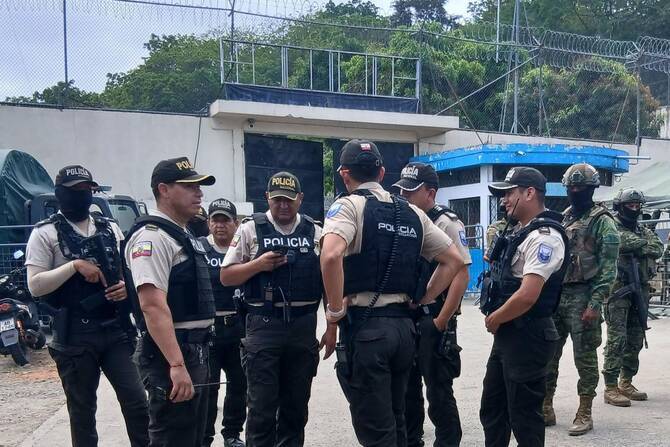
Five shot dead at pool hall in Ecuador

Five people were killed in a shooting at a pool hall in western Ecuador, police said Saturday -- the latest homicides in a country struggling through a bloody wave of drug gang violence. (AFP/File)
Short Url
Updated 25 October 2025
Follow

Five shot dead at pool hall in Ecuador

  • Three men got out of a van and opened fire at the hall in Santo Domingo
  • Similar killings have occurred at pool halls in Santo Domingo in recent months

QUITO: Five people were killed in a shooting at a pool hall in western Ecuador, police said Saturday — the latest homicides in a country struggling through a bloody wave of drug gang violence.
Three men got out of a van and opened fire at the hall in Santo Domingo, located about 60 kilometers (37 miles) from the capital Quito, a police official said, describing the incident as a “dispute between organized crime groups.”
Beyond the five people killed, one more was wounded, the official told local news outlet Alfa & Omega.
Similar killings have occurred at pool halls in Santo Domingo in recent months.
Nestled between the world’s biggest cocaine producers, Colombia and Peru, a growing gang presence has turned once-peaceful Ecuador into the country with South America’s highest homicide rate, according to the InSight Crime think tank.
In the first half of 2025, the number of homicides increased 47 percent as compared with the same period last year, according to the Ecuadoran Observatory on Organized Crime.


35 million Nigerians ‘risk hunger after global funding collapse’

Updated 5 sec ago
Follow

35 million Nigerians ‘risk hunger after global funding collapse’

  • The UN can only aim to ‌deliver $516 million to provide lifesaving aid to 2.5 million people this year, down from 3.6 million in 2025, which in turn was about half the previous year’s level

ABUJA: Nearly 35 million Nigerians are at risk of hunger this year, including 3 million children facing severe malnutrition, ​the UN said, following the collapse of global aid budgets.
Speaking at the launch of the 2026 humanitarian plan in Abuja, UN Resident and Humanitarian Coordinator Mohammed Malick Fall said the long-dominant, foreign-led aid model in Nigeria is no longer sustainable and ‌that Nigeria’s ‌needs have grown. 
Conditions in ‌the conflict-hit ​northeast ‌are dire, Fall said, with civilians in Borno, Adamawa, and Yobe states facing rising violence. 

BACKGROUND

UN Resident and Humanitarian Coordinator Mohammed Malick Fall said the foreign-led aid model in Nigeria is no longer sustainable and ‌that the country’s needs have grown.

A surge in terror attacks killed more than 4,000 people in the first eight months of 2025, matching the toll for all of 2023, he said.
The UN can only aim to ‌deliver $516 million to provide lifesaving aid to 2.5 million people this year, down from 3.6 million in 2025, which in turn was about half the previous year’s level.
“These are not statistics. These numbers represent lives, futures, and Nigerians,” Fall said.
He also said ​the UN had no choice but to focus on “the most lifesaving” interventions given the drop in available funding. 
Shortfalls last year led the World Food Programme to also warn that millions could go hungry in Nigeria as its resources ran out in December and it was forced to cut support for more than 300,000 children. 
Fall said Nigeria was showing growing national ownership of the crisis response in recent months through measures such as local funding for ‌lean-season food support and early-warning action on flooding.