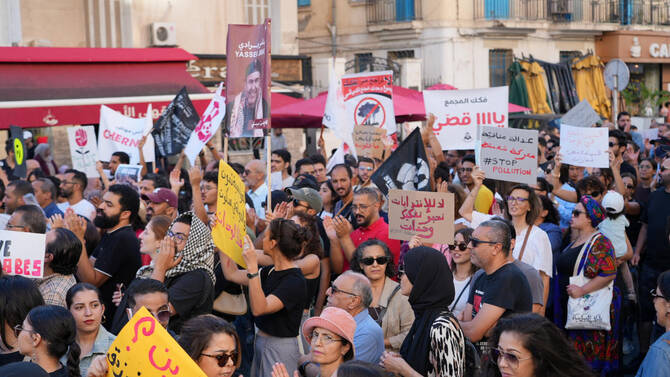
TUNIS: Hundreds of Tunisians marched through the capital Tunis on Saturday to protest a severe environmental crisis caused by pollution from a state chemical plant in Gabes, as protests that began there widen outside the southern city.
The protest is the latest in a series of demonstrations that have underscored growing public frustration over the government’s handling of pollution and worsening state of public services, marking the biggest challenge to President Kais Saied since he seized all power in 2021.
Residents of Gabes have reported rising rates of respiratory illnesses, osteoporosis and cancer, which they blame on toxic gases from the state chemical group’s phosphate plants, which dump thousands of tons of waste into the sea daily.
The latest wave of protests in Gabes was triggered this month after dozens of schoolchildren suffered breathing difficulties caused by toxic fumes from a plant that converts phosphates into phosphoric acid and fertilizers.
Protesters in Tunis carried banners and chanted slogans in solidarity with residents of Gabes, calling the response of authorities “repression.” The government said it arrested people for violence.
“It’s that simple, the people of Gabes want to breathe,” Hani Faraj, a protester from the “Stop Pollution” campaign, told Reuters. “Gabes is dying slowly ... We will not remain silent. We will escalate our peaceful protests.”
Saied’s administration fears protests in the capital could spark unrest elsewhere in Tunisia, deepening pressure as it struggles with a prolonged economic downturn and political instability.
Saied has described the situation in Gabes as an “environmental assassination,” blaming criminal policy choices by a previous government.
In an effort to quell the protests, he has called for repairs to the industrial units to stop leaks as an immediate step. Health Minister Mustapha Ferjani said this week the government would build a cancer hospital in Gabes to deal with rising cases.
However, protesters have rejected the fixes as temporary, and are demanding the polluting facilities be permanently shut and relocated.
Environmental groups warn that tons of industrial waste are discharged daily into the sea at Chatt Essalam, severely damaging marine life. Local fishermen have reported a sharp decline in fish stocks over the past decade, threatening a vital source of income for many in the region.


Hundreds protest in Tunisia’s capital over worsening pollution crisis
https://arab.news/276cn
Hundreds protest in Tunisia’s capital over worsening pollution crisis

- Residents of Gabes have reported rising rates of respiratory illnesses, osteoporosis and cancer
- Protesters in Tunis carried banners and chanted slogans in solidarity with residents of Gabes, calling the response of authorities “repression“


Family of Palestinian-American shot dead by Israeli settler demand accountability
- Relatives say Abu Siyam was among about 30 residents from the village of Mukhmas who confronted armed settlers attempting to steal goats from the community
LONDON: The family of a 19-year-old Palestinian-American man reportedly shot dead by an Israeli settler in the occupied West Bank have demanded accountability, amid mounting scrutiny over a surge in settler violence and a lack of prosecutions.
Nasrallah Abu Siyam, a US citizen born in Philadelphia, was killed near the city of Ramallah on Wednesday, becoming at least the sixth American citizen to die in incidents involving Israeli settlers or soldiers in the territory in the past two years.
Relatives say Abu Siyam was among about 30 residents from the village of Mukhmas who confronted armed settlers attempting to steal goats from the community. Witnesses said that stones were thrown by both sides before settlers opened fire, wounding at least three villagers.
Abu Siyam was struck and later died of his injuries.
Abdulhamid Siyam, the victim’s cousin, said the killing reflected a wider pattern of impunity.
“A young man of 19 shot and killed in cold blood, and no responsibility,” he told the BBC. “Impunity completely.”
The US State Department said that it was aware of the death of a US citizen and was “carefully monitoring the situation,” while the Trump administration said that it stood ready to provide consular assistance.
The Israeli embassy in Washington said the incident was under review and that an operational inquiry “must be completed as soon as possible.”
A spokesperson for the Israeli Defense Forces said troops were deployed to the scene and used “riot dispersal means to restore order,” adding that no IDF gunfire was reported.
The military confirmed that the incident remained under review and said that a continued presence would be maintained in the area to prevent further unrest.
Palestinians and human rights organizations say such reviews rarely lead to criminal accountability, arguing that Israeli authorities routinely fail to prosecute settlers accused of violence.
A US embassy spokesperson later said that Washington “condemns this violence,” as international concern continues to grow over conditions in the occupied West Bank.
Palestinians and human rights groups say Israeli authorities routinely fail to investigate or prosecute settlers accused of violence against civilians.
Those concerns were echoed this week by the UN, which warned that Israel’s actions in the occupied West Bank may amount to ethnic cleansing.
A UN human rights office report on Thursday said that Israeli settlement expansion, settler attacks and military operations have increasingly displaced Palestinian communities, with dozens of villages reportedly emptied since the start of the Gaza war.
The report also criticized Israeli military tactics in the northern West Bank, saying that they resembled warfare and led to mass displacement, while noting abuses by Palestinian security forces, including the use of unnecessary lethal force and the intimidation of critics.
Neither Israel’s foreign ministry nor the Palestinian Authority has commented on the findings.


