

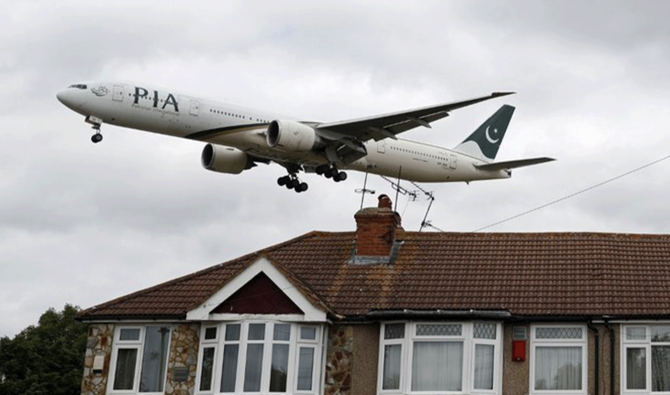

KARACHI: The Pakistan International Airlines (PIA) on Saturday resumed weekly flights to the United Kingdom (UK) after a hiatus of five years, with Defense Minister Khawaja Asif and British High Commissioner Jane Marriott bidding farewell to passengers at Islamabad airport.
The development came days after the UK Civil Aviation Authority issued a Foreign Aircraft Operating Permit to PIA and cleared the final administrative hurdle for Pakistan’s national carrier to resume flights to Britain, according to the Pakistani high commission in London.
Britain lifted restrictions on Pakistani carriers in July, nearly half a decade after grounding them following a 2020 PIA Airbus A320 crash in Karachi that killed 97 people. The disaster was followed by claims of irregularities in pilot licensing, which led to bans in the US, UK and the European Union.
A PIA flight left the Islamabad airport for Manchester with 284 passengers aboard at around noon on Saturday, according to a PIA spokesperson.
“PIA has initially started operations with two weekly flights, which will operate on Tuesdays and Saturdays,” the spokesperson said. “The number of flights will be gradually increased, and flights to London and Birmingham will also be started.”
The airline had already received the Third Country Operator (TCO) approval for flight operations in the UK, according to the Pakistani high commission.
Defense Minister Asif directed PIA officials to further improve the flight schedule and aircraft cabins.
“Direct flights will provide better and more comfortable facilities to passengers, which was a long-standing demand of over 1.6 million Pakistanis living in the UK,” the PIA spokesman said.
Britain is Pakistan’s third-largest trading partner, with bilateral commerce worth about £4.7 billion ($5.7 billion) annually.
The Pakistani government, which has repeatedly bailed out the loss-making carrier, is pushing ahead with its privatization as part of a broader plan to reduce losses at state-owned firms under a $7 billion International Monetary Fund (IMF) loan program.
PIA has accumulated more than $2.5 billion in losses over roughly a decade, draining public finances.
In Nov. 2024, the European Union Aviation Safety Agency lifted its suspension, allowing the airline to resume flights from Islamabad to Paris in January and later expand to Lahore–Paris in June. However, PIA suspended those services in recent months to prioritize resources for the UK relaunch. The airline remains barred from flying to the US.


