

At Islamabad summit, PM showcases Pakistan as regional tri-junction for enhanced cooperation

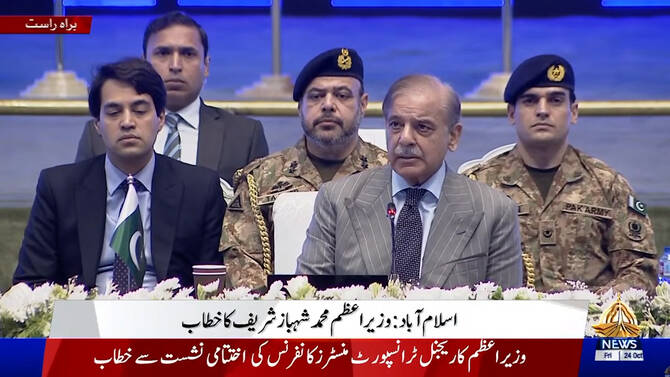
Pakistan Prime Minister Shehbaz Sharif is addressing a regional transport summit in Islamabad, Pakistan, on October 24, 2025. (PTV/Screengrab)
Short Url
Updated 24 October 2025
Follow

At Islamabad summit, PM showcases Pakistan as regional tri-junction for enhanced cooperation

  • Pakistan’s coastline makes its ports key transit points, linking China, Central Asia and the broader Middle East
  • Shehbaz Sharif says Islamabad also investing in digital infrastructure to catch up with 4th industrial revolution

ISLAMABAD: Prime Minister Shehbaz Sharif on Friday underscored Pakistan’s strategic position as a regional tri-junction connecting China, Central Asia and the Middle East, emphasizing the country’s potential to drive greater trade, transport and digital cooperation across the wider region.

Sharif’s comments came during his address with attendees at a regional transport ministers’ conference in Islamabad, which brought together officials from neighboring countries to discuss infrastructure, trade and cross-border cooperation.

The prime minister said Pakistan’s long coastline makes its ports key transit points on the Maritime Silk Road, a maritime section of the historic Silk Road that connected Asia, Indian subcontinent, Arabian Peninsula and Africa, and Europe.

“Our geography links the warm waters of the Arabian Sea and the Arabian Gulf, traversing the majestic Karakoram and Himalayan [mountain] range and flowing through the timeless Indus Valley,” he said.

“We are at the confluence of China, the Eurasian land bridge and the Middle East — a unique tri-junction of economic corridors connecting China, Central Asia and the broader Middle East.”

The summit comes at a time when Pakistan is trying boost trade and investment by establishing itself as a regional transit hub. In recent years, Islamabad has undertaken several trade, regional connectivity and energy initiatives such as the

Uzbekistan-Afghanistan-Pakistan Railway Framework Agreement, the Istanbul-Tehran-Islamabad corridor, and the CASA-1000 and TAP-500 electricity transmission projects.

Sharif shared that his government has been working on these initiatives to enhance regional connectivity, adding that these projects offer a “great opportunity” to revolutionize cross-border trade.

“I am confident that these mega projects would synergize the economic strength of regional countries and usher in a new era of enhanced trade, economic cooperation and energy collaboration in the region, and of course, beyond,” the Pakistan premier said.

Pakistan has also been prioritizing digital trade platforms and e-port integration to create seamless, paperless and efficient flows, boosting efficiency, transparency and competitiveness.

In today’s digital age, Sharif noted, connectivity is not just limited to roads, railways and air links, but it has also evolved into data, innovation, research and development, and technological integration.

“Pakistan is investing in digital infrastructure to ensure that we are adequately equipped to catch up with the fourth industrial revolution around the globe,” he said.

Sharif noted that 60 percent of his country’s population ages between 15 and 30 years, which can be turned into its greatest asset if they are provided with ample opportunities in the fields of information technology, artificial intelligence, and vocational training.

“We don’t have black gold, but we have our youth as our greatest asset, which will become the harbinger of Pakistan’s speedy progress and prosperity in times to come,” he added.


Pakistan to launch last 2025 anti-polio nationwide drive targeting 45 million children next week

Updated 3 sec ago
Follow

Pakistan to launch last 2025 anti-polio nationwide drive targeting 45 million children next week

  • Over 400,000 frontline health workers will participate in Dec. 15-21 nationwide polio vaccination campaign, say authorities
  • Pakistan is one of only two countries in the world, the other being Afghanistan, where wild poliovirus remains endemic

KARACHI: Pakistan will kick off the last nationwide anti-polio vaccination campaign of 2025 targeting 45 million children next week, the National Emergencies Operation Center (NEOC) said on Monday, urging parents to coordinate with health workers during the drive. 

The campaign takes place days after Pakistan launched a nationwide vaccination drive from Nov. 17-29 against measles, rubella and polio. Pakistan said it had targeted 22.9 million children across 89 high-risk districts in the country with oral polio vaccination drops during the drive. 

Over 400,000 health workers will perform their duties during the upcoming Dec. 15-21 nationwide polio vaccination campaign, the NEOC said in a statement. 

“Parents are urged to cooperate with polio workers and ensure their children are vaccinated,” the NEOC said. “Complete the routine immunization schedule for all children up to 15 months of age on time.”

Health authorities aim to vaccinate 23 million children in Punjab, 10.6 million in Sindh, over 7.2 million in Khyber Pakhtunkhwa, over 2.6 million in Balochistan, more than 460,000 in Islamabad, over 228,000 in Gilgit-Baltistan and more than 760,000 children in Pakistan-administered Kashmir during the seven-day campaign, it added. 

Pakistan is one of only two countries in the world where wild poliovirus remains endemic.

Polio is a highly infectious and incurable disease that can cause lifelong paralysis. The only effective protection is through repeated doses of the Oral Polio Vaccine for every child under five during each campaign, alongside timely completion of all routine immunizations.

Islamabad’s efforts to eliminate poliovirus have been hampered by parental refusals, widespread misinformation and repeated attacks on anti-polio workers by militant groups. In remote and volatile areas, vaccination teams often operate under police protection, though security personnel themselves have also been targeted and killed in attacks.